
You wake up to a cold house. The taps run cold. The boiler display is flashing something unhelpful, and everyone in the home suddenly wants hot water at the same time.
That’s usually when people make one of two mistakes. They either panic and start pressing every button on the front of the boiler, or they ignore the problem and hope it sorts itself out by evening. Neither helps.
Gas boiler repair is often straightforward when the fault is caught early. It gets more expensive, more disruptive, and sometimes more dangerous when basic warning signs are missed. For London homeowners, that matters even more because many properties have older pipework, tight cupboard installations, and heating systems that have been altered over the years.
Your Boiler's Gone Cold What To Do First
A boiler failure rarely happens at a convenient time. It’s usually early morning, late evening, or just before guests arrive. The heating cuts out, the hot water disappears, and the first question is simple. Is this something I can safely check myself, or do I need an engineer now?
That’s the right question.
During the strictest UK lockdown period, boiler repair enquiries surged by 26% year-on-year, which showed how quickly people notice heating faults when they’re spending more time at home, according to Boiler Guide’s report on repairs rising during lockdown. That doesn’t just tell you breakdowns are common. It tells you your situation is familiar, diagnosable, and usually solvable.
Start with the symptom, not the assumption
Don’t begin by deciding the boiler is “broken”. Start by noticing exactly what the system is doing.
Ask yourself:
- No heating and no hot water means the issue may be with power, pressure, ignition, or a lockout.
- Hot water works but radiators don’t often points to controls, valves, air in the system, or circulation issues.
- Heating works but taps run cold can suggest a hot water demand problem or internal component fault.
- Boiler runs, but home stays cold may mean the fault is in the wider heating system rather than the appliance itself.
That distinction saves time.
Keep the first checks calm and basic
Before anyone reaches for a screwdriver, do the safe checks first. Look at the display. Check whether the thermostat is calling for heat. Confirm the power is on. Listen for obvious signs like repeated clicking, gurgling, or a fan trying to start and then stopping.
If you’ve got no hot water as well as no heating, it helps to compare your symptoms with a more specific guide on no hot water in the house, because that often narrows the fault faster than focusing on the boiler alone.
Practical rule: If your boiler fault can be checked from the front panel, thermostat, or visible pipework without removing a case, it’s usually a homeowner check. If it involves gas, combustion, wiring inside the boiler, or sealed components, stop.
What matters most in the first ten minutes
Three things matter straight away:
Safety
If you smell gas, see scorching, or notice a strange flame, stop immediately and move to emergency action.Damage limitation
Don’t keep resetting the boiler over and over. Repeated reset attempts can mask the underlying fault and make diagnosis slower.Accurate information
Take note of any fault code, warning light, odd noise, or pressure reading. An engineer can use that information quickly.
A calm first look often tells you whether this is a simple reset issue, a frozen condensate pipe, low pressure, or a fault that needs Gas Safe repair. That’s the difference between a minor interruption and a long day without heating.
Safe DIY Boiler Checks Before You Call
A lot of heating callouts start with faults that a homeowner can identify safely. The key word is safely. You’re checking controls and visible signs, not opening the boiler or trying to repair gas components.
Use the list below in order. Stop if anything looks unsafe.
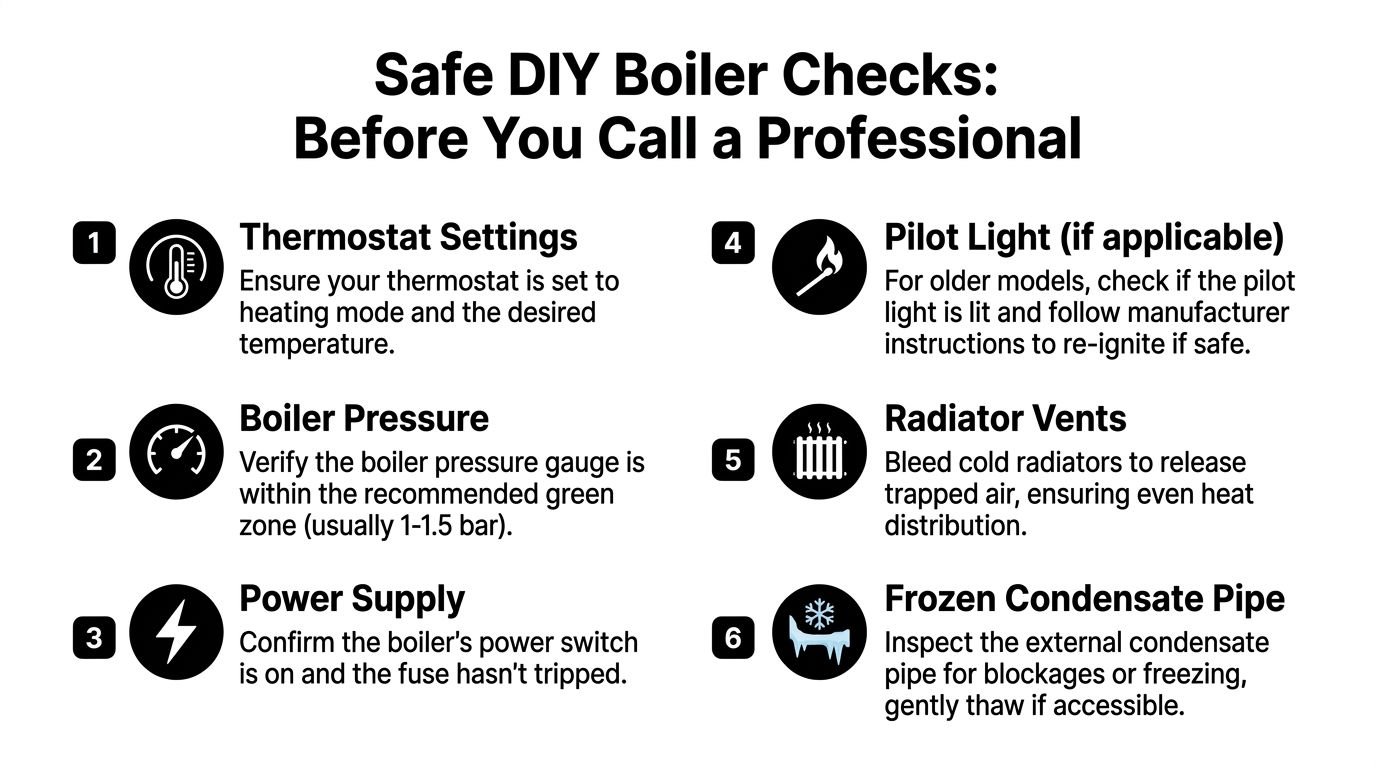
Check the controls first
Start with the simple things because they fail more often than people expect.
Thermostat and programmer
Make sure the thermostat is asking for heat. Raise the set temperature well above room temperature and listen for a click if you have a manual room stat. If you use a smart controller like Hive, Nest, or Tado, check that it’s online, calling for heating, and hasn’t dropped into a schedule you forgot about.
Also look at the programmer or timer. A boiler can be healthy while the heating is off because the schedule is wrong.
Common homeowner misses include:
- Heating mode off after a warm spell
- Flat thermostat batteries on wireless controls
- Clock reset after a power cut
- Hot water only mode selected by mistake
Boiler display and status lights
Modern boilers usually tell you something useful if you read the panel properly. You may see a fault code, a reset symbol, or a status indicator showing standby, ignition attempt, or lockout.
Write the code down exactly as shown. Don’t rely on memory.
Check whether the boiler has power
A boiler that looks dead may have lost power at the fused spur or consumer unit.
Look for:
- Fused spur switched off near the boiler
- Tripped breaker at the consumer unit
- Blank display even though heating should be on
- Recent electrical work in the property
If the breaker trips again after you restore power, leave it off and call for help. Repeated tripping suggests an electrical fault that shouldn’t be guessed at.
A visible, methodical check often rules out the basics before you need an engineer. This short video is useful if you want a quick visual walkthrough of common homeowner checks.
Read the pressure gauge
Low system pressure is one of the most common reasons a boiler stops or locks out.
What to look for
Most sealed systems have a pressure gauge on the boiler front or underside. On many domestic boilers, the normal cold reading sits around the marked green zone. If the needle is very low or near zero, the boiler may refuse to operate properly.
If your model allows topping up via a filling loop, follow the manufacturer’s instructions only. Open the valves slowly and stop once the gauge reaches the recommended range. Don’t overfill.
If the pressure keeps dropping, that’s not a resetting issue. It usually points to a leak, a faulty expansion vessel, or another system fault. If your boiler keeps doing this, this guide on why a boiler loses pressure helps explain what the pressure loss usually means.
If you top up the system once and it holds, that may be a one-off. If you top it up repeatedly, you’re not fixing the problem. You’re hiding it.
Try a single reset
If the display shows a lockout and there are no safety red flags, a single reset is reasonable.
Do it once, then watch what happens
Press and hold the reset button as instructed by the manufacturer. Then give the boiler time to run through its start-up sequence.
What happens next matters:
- It fires and stays on. The fault may have been temporary.
- It fires, then drops out. There is still an underlying issue.
- It doesn’t start at all. More diagnosis is needed.
- It locks out again immediately. Stop resetting and call an engineer.
Repeated resets don’t repair blocked condensate lines, failed fans, faulty ignition, gas valve faults, or circulation problems.
Check the pilot light if you have an older boiler
Many London homes still have older appliances, especially in flats and long-held family properties. If your boiler has a pilot light, check whether it’s gone out.
Only relight it if:
- the manufacturer instructions allow a homeowner relight procedure
- there’s no smell of gas
- you can do it from the external controls without dismantling anything
If the pilot won’t stay lit, that points to a fault. Leave it there.
Look outside for a frozen condensate pipe
In cold weather, the condensate pipe can freeze, especially if it runs externally with poor protection. When that happens, condensing boilers often lock out.
Signs include:
- Gurgling noises
- A fault after freezing weather
- Visible ice on a white plastic waste pipe outside
If the pipe is safely accessible, thaw it gently with warm, not boiling, water. Once cleared, reset the boiler once. If it restarts normally, you’ve likely found the issue.
Bleed radiators only if the problem is uneven heat
If the boiler runs but some radiators stay cold at the top, trapped air may be the problem. Bleeding a radiator is a heating-system task, not a gas task, so it’s often safe for homeowners.
Use a radiator key and cloth. Open the vent slowly until air escapes, then close it when water appears. Afterwards, recheck boiler pressure because bleeding can lower it.
This helps with cold spots. It does not solve a dead boiler, ignition fault, gas issue, or fault code related to internal components.
Know where DIY ends
There’s a clear line between checking and repairing.
Stop and book professional gas boiler repair if you find any of the following:
- Leaking water from the boiler casing
- Burning smells or scorch marks
- Persistent fault codes after a reset
- Pressure loss that keeps returning
- Pilot or ignition faults that recur
- Unusual noises from inside the boiler
Never remove the boiler case unless you’re qualified and authorised to work on it. On many appliances, the case forms part of the room-sealed combustion system. Once you interfere with that, it’s no longer a safe homeowner check.
Red Flags When to Call a Gas Safe Engineer Immediately
Some faults are inconvenient. Others are unsafe. You need to treat the second group differently.
If any of the signs below are present, stop trying to troubleshoot the boiler and call a Gas Safe engineer immediately.
Smell of gas
A gas smell is never a “wait and see” situation.
Don’t try to relight anything. Don’t keep pressing reset. Don’t start investigating with tools. Turn the appliance off if it’s safe to do so, avoid electrical switches, ventilate the area, and move to emergency guidance. If you’ve noticed this around the appliance, this page on what to do if you smell gas from a boiler sets out the immediate next steps clearly.
Gas safety isn’t about confidence. It’s about boundaries. If you can smell gas, the job has already moved beyond DIY.
Yellow or unstable flame
On boilers where the flame is visible, it should generally burn cleanly. A yellow, lazy, or flickering flame can indicate poor combustion.
Poor combustion is not something a homeowner can diagnose by trial and error. It needs proper testing by a qualified engineer.
Scorching, soot, or burning smells
Visible discolouration around the boiler, soot marks, melted wiring insulation, or a hot electrical smell all point to faults that need professional investigation.
Those signs may relate to combustion issues, electrical overheating, or damaged components. None should be ignored.
Water from the boiler casing
A little water under a pipe joint can sometimes come from a visible external fitting. Water from inside or through the casing is different.
That can affect electrical parts, seals, and combustion components. Turn the boiler off and leave it alone until it’s inspected.
Loud banging, metal-on-metal noise, or repeated failed starts
Boilers make normal operating sounds. They shouldn’t bang violently, scrape, scream, or repeatedly attempt ignition without firing properly.
Listen for patterns:
- Fan starts, then stops repeatedly
- Rapid clicking with no ignition
- Banging during heat-up
- Humming plus lockout
- Kettling or harsh rumbling
Each points to a different underlying issue, but the shared point is simple. These are repair faults, not user-setting faults.
A boiler that’s noisy and failing to fire is telling you something useful. Don’t drown it out with resets.
Carbon monoxide concerns
If anyone in the property feels unwell around boiler operation, take it seriously. Headache, dizziness, nausea, or unusual tiredness should never be brushed off where faulty combustion is a possibility.
Leave the area, switch the appliance off if safe, and get urgent professional help. A working carbon monoxide alarm adds protection, but it doesn’t replace servicing or inspection.
When not to wait for “one more try”
People often delay the call because the boiler still works sometimes. That’s a mistake.
Intermittent faults can be harder on components and harder to diagnose after the fact. If the appliance is showing clear danger signs, don’t keep running it to “see if it behaves”. A proper gas boiler repair starts with safe isolation, proper testing, and evidence-based diagnosis.
What to Expect from a Professional Gas Boiler Repair
A proper repair visit should feel organised from the start. In London homes, that matters because access is often tight, parking affects arrival windows, and many faults sit somewhere between a simple fix and a wider system problem. The job is to identify which one you have, make it safe, and tell you clearly what the repair is likely to cost before parts are fitted.
How the appointment usually runs
The first part is diagnosis, not spanner work. A Gas Safe engineer should ask what the boiler has been doing, when the fault started, whether it failed completely or intermittently, and what you have already tried. That short history often saves time.
From there, the visit usually follows a set process:
- Safety and appliance checks to confirm the boiler and work area are safe.
- Fault review using the display code, lockout history, controls, and your description of the symptoms.
- Visual inspection of the boiler case, flue, condensate pipe, external pipework, filter, and visible heating components.
- Testing of the electrical supply, system pressure, ignition sequence, pump operation, fan response, valves, sensors, and combustion where the fault points that way.
- Diagnosis and quote so you know what has failed, whether the part is available, and whether repair is sensible.
Good engineers do not skip straight to swapping parts. Misdiagnosis wastes money.
What you should be told before work starts
You should get a clear explanation in plain English. For example:
- what has failed
- whether the boiler is safe to run
- whether the fault is isolated or linked to system condition
- whether the part can be fitted on the first visit
- what the labour and parts are likely to cost
That last point matters. In our line of work, the awkward conversations usually come from poor explanation, not the repair itself.
If the boiler is older, a decent engineer should also say so plainly. Some faults are worth repairing. Some are technically repairable but poor value once parts cost, boiler age, and future reliability are taken into account.
Typical repair costs in London
London repair costs are shaped by more than the part price. Travel, congestion, property access, boiler location, and same-day parts availability all affect the final number.
As a working guide, many standard boiler repairs in the UK fall into the low hundreds rather than the low thousands, and more involved faults rise from there. Here is a practical budgeting range for London homes.
| Typical Gas Boiler Repair Costs in London (2026 Estimates) | Estimated Cost Range | Typical Time |
|---|---|---|
| Minor diagnostic and reset-related fault | £150 to £250 | 1 to 2 hours |
| Pressure-related repair or visible external component issue | £150 to £300 | 1 to 3 hours |
| Pump, fan, valve, or ignition-related repair | £200 to £500 | 2 to 4 hours |
| PCB or complex internal component replacement | £250 to £500 | 2 to 4 hours |
| Heat exchanger-related repair assessment | £250 to £500 | Half day or more |
These are estimates, not fixed quotes. A combi in an open utility area is quicker to work on than a boiler boxed into a kitchen unit with limited clearance. Parts support also varies a lot by manufacturer and age.
What tends to increase the quote
Five things usually push costs up:
- awkward access to the boiler or flue
- older appliances with limited parts availability
- dirty system water that has contributed to component failure
- more than one failed part
- earlier DIY interference that complicates testing
London landlords should also factor in the wider picture. A repair that restores heat but leaves poor controls, sludge, or weak efficiency in place may not be the best decision for tenant comfort or EPC planning. At Urbanic Services, that is part of the conversation, especially on rental properties where the immediate fix and the longer-term compliance picture need to line up.
Repair or replace
Homeowners want a straight answer here, and they should get one.
Repair usually makes sense when the boiler has been reliable up to this point, the failed part is available, and the rest of the appliance tests well. Replacement becomes more sensible when faults are repeating, major components are wearing out, or the repair bill starts stacking up against the age of the boiler.
Questions about grants and upgrade schemes often come up at this stage. If you want a useful list of what to ask before agreeing to work, M5 Plumbing sets out several sensible homeowner questions in its guide to boiler repair questions. Use that kind of checklist, but expect the final answer to depend on your actual boiler, your property, and how the system has been maintained.
For London flats and smaller homes, the best choice is often the one that restores safe, dependable heating at sensible cost now, while keeping an eye on future efficiency upgrades rather than forcing a rushed replacement.
What a good diagnosis sounds like
You do not need trade jargon. You need a useful explanation.
A clear diagnosis sounds like this:
- the boiler has power and demand, but the ignition sequence is failing
- pressure is dropping through the system, so the problem is not just a control setting
- the part can be replaced today, and the boiler should be retested afterwards
- the immediate fault can be repaired, but poor system water may cause further issues if left untreated
That level of honesty helps you make the right call.
What happens after the repair
Once the repair is complete, the engineer should prove the boiler is operating properly. That means checking start-up, burner operation, response to hot water or heating demand, and safe shutdown. If the work affected combustion or safety performance, the testing should reflect that.
You should also be told what to keep an eye on over the next few days. On many London systems, the failed part is only part of the story. Sludge, poor circulation, ageing controls, or neglected servicing often sit behind the breakdown, and a trustworthy engineer will say so clearly rather than leave you guessing.
From Repair to Reliability Preventative Boiler Maintenance
A boiler rarely goes from fine to failed overnight. In London homes, I usually see a trail of smaller warnings first. Pressure drops every few weeks. One radiator stays lukewarm. Hot water runs hot then cool. The boiler starts making a new whistling or kettling noise, and nobody books it in because the heating still comes on.
That is how routine faults become winter breakdowns.
Maintenance that reduces breakdowns
Some habits improve reliability. Some just delay the next fault.
What helps
Annual professional servicing
This keeps safety checks, combustion performance, wear, and control operation under review.Dealing with small symptoms early
A minor pressure loss, occasional lockout, or new system noise is usually cheaper to sort before another part is affected.Keeping repair and service records
Previous faults, replaced parts, and recurring symptoms make diagnosis quicker and more accurate.Looking after the whole heating system
The boiler depends on clean system water, working controls, free circulation, sound pipework, and a clear condensate route.Checking inhibitor and system cleanliness when needed
On older London systems especially, dirty water shortens the life of pumps, heat exchangers, and valves.
What causes repeat trouble
Using reset after reset instead of booking diagnosis
That often turns an intermittent fault into a no-heat emergency.Ignoring pressure loss
If pressure keeps dropping, there is a reason. It needs finding.Assuming every heating problem starts inside the boiler
Sticking valves, air in radiators, poor balancing, or sludge can produce symptoms that look like boiler failure.Skipping service because the heating is still working
Hidden wear is common on appliances that appear normal from the outside.
A serviced boiler can still fail. The difference is that faults are more likely to be spotted early, explained clearly, and repaired before they affect the whole household.
Care plans and predictable costs
Some London homeowners prefer to pay for maintenance and callout cover monthly. That can make sense if the boiler is older, the property is hard to leave cold for even a day, or the household wants one company handling the service history from year to year.
The detail matters. Some plans include the annual service but limit parts cover. Some cover breakdown attendance but not system issues outside the boiler casing. Some are good value. Some are poor value once you read the exclusions.
Before agreeing to any plan, check:
- whether the annual service is included
- whether parts and labour are both covered
- whether heating controls, pumps, valves, and pipework are included or excluded
- whether there is an excess fee on each repair
- how quickly they attend in peak winter periods
That gives you a fair comparison against paying for servicing and repairs as they arise.
A note for landlords and letting agents
For landlords, maintenance is tied to compliance, tenant comfort, and running costs. A repair that gets the boiler firing again may not be enough if the controls are poor, the system is cycling badly, or the property is wasting heat because the heating setup has been neglected.
At Urbanic Services, we take an EPC-conscious view where it is useful. That means looking beyond the failed part and checking whether the system is operating in a way that supports efficiency as well as reliability. In practical terms, that can mean identifying failed room controls, outdated programmer settings, circulation issues, or a system condition that is pushing fuel use up and comfort down.
For London rentals, that approach helps owners avoid the same complaint returning a month later under a different label.
Reliability comes from habits
The homes with the fewest boiler emergencies tend to follow a simple pattern. They book servicing regularly, they act on warning signs early, and they keep a record of what has already been done.
That is usually cheaper than repeated emergency visits. It is certainly less disruptive.
Your Next Steps for a Warm and Safe Home
If your boiler has gone cold, start with the checks that are safe. Confirm the controls, power, pressure, and obvious external issues. Use the display, not guesswork. Try one proper reset if the situation is safe and the manufacturer allows it.
Then be strict about the limits.
If there’s a gas smell, signs of poor combustion, scorching, water from the casing, repeated lockouts, or harsh mechanical noise, stop there and book a qualified engineer. Those faults need proper testing, not another attempt from the front panel.
A good gas boiler repair does more than restore heat for the day. It tells you why the fault happened, whether the system is in decent shape, and whether you’re looking at a one-off repair or the start of a bigger reliability problem. That’s the part many homeowners miss. The cheapest immediate fix isn’t always the best long-term answer.
For London homes, that decision also sits inside real-world constraints. Older housing stock, space limits, landlord obligations, and varying system quality all affect what “best value” really means. Sometimes that’s a straightforward repair. Sometimes it’s a service and system tidy-up after the repair. Sometimes it’s an honest conversation about whether continued repair makes sense.
What matters is taking the next step before the fault gets worse.
If the issue looks safe and simple, do the basic checks properly. If it doesn’t, get professional help quickly. Fast action protects the boiler, the property, and the people living in it.
If you need help from Urbanic Services Ltd, book a qualified engineer for gas boiler repair, annual servicing, landlord-focused EPC-conscious heating work, or ongoing Boiler Care Plan support across London.