
It’s a horrible way to start the day. You step into the shower, turn the handle, and get a blast of icy water. Before you start imagining a huge repair bill, it's worth knowing that the most common reasons for having no hot water are often things you can fix yourself in minutes.
We’re talking about simple issues, like a boiler that needs its pressure topped up, a tripped switch on your fuse board, or even just a thermostat that's been knocked to the wrong setting.
That Icy Shock When You Have No Hot Water
Waking up to a cold house is more than just a hassle; it can throw your whole day off track. But the good news is, you don't need to be a heating engineer to figure out what's going on. A few simple, safe checks are usually all it takes to find the root of the problem.
Rather than immediately fearing the worst, a little bit of detective work can help you figure out if this is a five-minute fix or something that genuinely needs a professional.
First Things First: Your Initial Checks
Before you get too deep into troubleshooting, run through these basics. From my experience, nine times out of ten, the culprit is on this list.
- Check Your Other Taps: Is the cold water coming from just one tap—say, the shower—or is it the same everywhere in the house? If it’s only one outlet, the problem is more likely a localised plumbing issue like an airlock, not your main heating system.
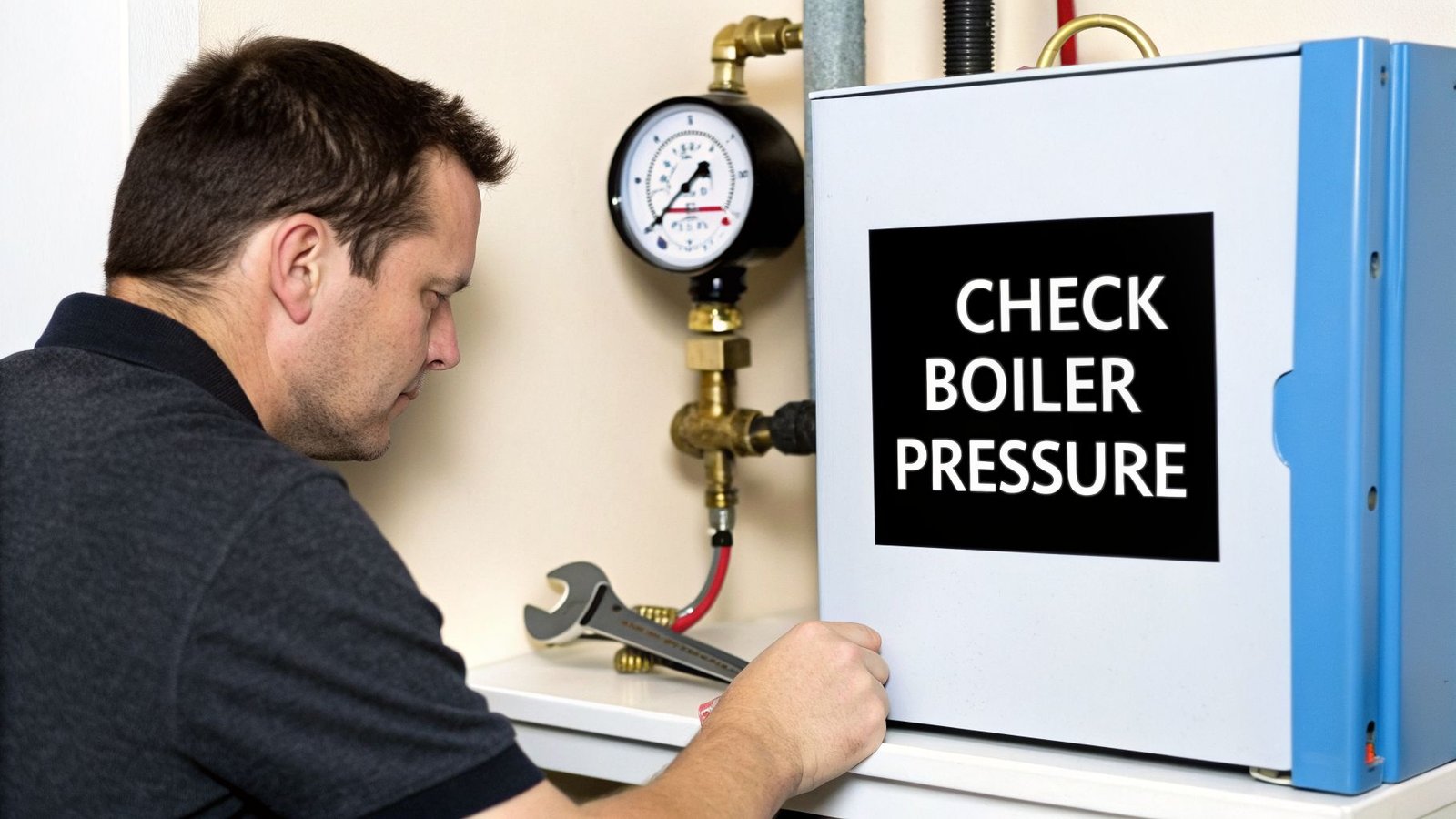
- Take a Look at the Boiler: Head over to your boiler. Is the display lit up? Do you see any flashing error codes? Pay close attention to the pressure gauge. It should be sitting somewhere in the green zone, usually between 1 and 1.5 bar. Low pressure is one of the top reasons a boiler will simply shut itself down.
- Is the Pilot Light On? If you have an older boiler, you might have a pilot light—a tiny blue flame that should always be on. Sometimes, a strong draught is all it takes to blow it out, and without it, your boiler can't ignite to heat the water.
- Check Your Fuse Box: It’s easy to forget the simple stuff. A power surge could have tripped a switch. Go to your consumer unit (what most people call a fuse box) and make sure the switch for your boiler or immersion heater is flipped to the 'on' position.
Here’s a tip I always give homeowners: start with the simplest checks first. You’d be amazed how often the big "no hot water" panic ends up being a tripped switch or a dial that needs turning. Don't automatically jump to the worst-case scenario.
This flowchart below is a great visual guide to walk you through those first steps. It helps narrow down the possibilities quickly.
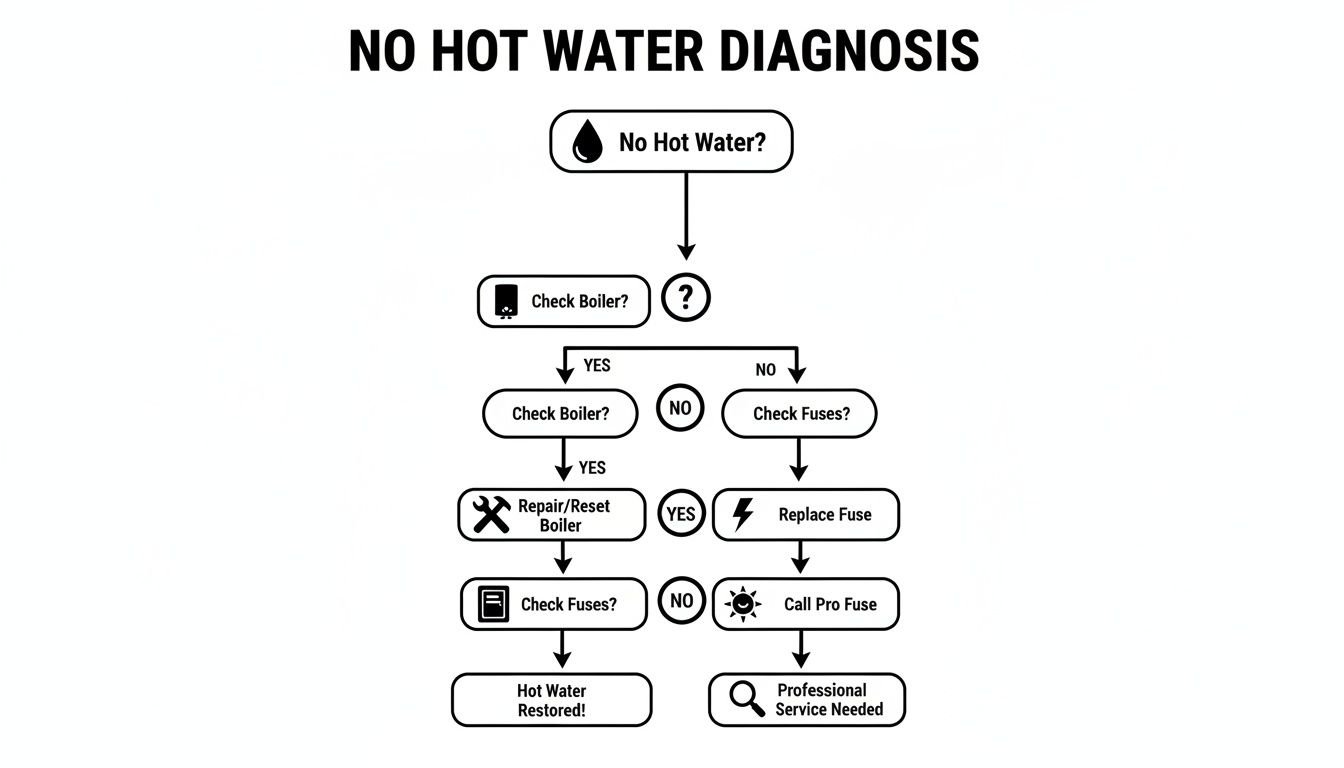
Working through this path methodically, from the boiler display to the fuse box, will give you a clear idea of whether you can sort this yourself or if it's time to call in a pro.
Quick Diagnostic: What Is Wrong With My Hot Water?
If you're still scratching your head, this table can help you match what you're seeing with the likely cause. It’s a fast way to get pointed in the right direction.
| Symptom | Potential Cause | Your First Action |
|---|---|---|
| No hot water or heating anywhere | Boiler pressure is too low, or there's a power issue. | Check the pressure gauge and your fuse box. |
| Hot water is only lukewarm | Thermostat setting is too low, or a faulty diverter valve. | Check the hot water thermostat on your boiler and cylinder. |
| Hot water works but heating doesn't | Diverter valve issue, programmer settings, or a room thermostat fault. | Check your programmer is set correctly for both heating and hot water. |
| No hot water from just one tap | Airlock in the pipe or a blocked tap. | Try to clear the airlock (guides online can help with this). |
This table covers the most frequent scenarios we encounter. It helps you quickly rule out the simple stuff before deciding you need an expert.
When To Call a Gas Safe Registered Engineer
If you've run through all the checks above and you’re still left with cold water, it's time to stop. Any work involving the inside of a gas boiler, replacing parts, or dealing with the gas supply itself is a job for a professional.
For your safety, you must use a Gas Safe registered engineer. These are the only people legally qualified to work on gas appliances in the UK. Trying to fix it yourself isn't just dangerous—it can invalidate your home insurance.
Our team at Urbanic are all Gas Safe registered and ready to help. If you're facing a stubborn boiler problem, you can easily book an engineer online to get it sorted safely and efficiently.
A Practical Boiler Troubleshooting Walkthrough
In most UK homes, the boiler is the heart of your heating and hot water system. So, when the taps run cold, it’s the first place you should look. Before you even think about calling an engineer, let's run through a few simple and safe checks you can do yourself.
First things first, take a look at the boiler itself. Is the display panel completely dead, or are there any lights on or perhaps an error code showing? If it’s totally blank, you’re likely looking at a power problem. Your first stop should be the main fuse box (often called a consumer unit) to see if a switch has tripped.
Checking Your Boiler Pressure
Nine times out of ten, the culprit behind a modern combi boiler shutting down is surprisingly simple: low water pressure. The water in your central heating system needs to be at the right pressure to circulate properly; think of it like the air in a car tyre. No pressure, no go.
Somewhere on your boiler, you’ll find a pressure gauge. It’ll either be a classic dial (often with red and green sections) or a digital reading on the main display.
- Find the gauge: They’re usually on the front, but sometimes they’re tucked away underneath the boiler casing.
- Read the pressure: When the heating is off and the system is cold, you want to see the needle in the green zone, somewhere between 1 and 1.5 bar. If it’s dropped below 1 bar, and especially if it's in the red, you’ve probably found your problem.
Losing a little pressure over many months is fairly normal. However, if you're having to top it up regularly, that's a tell-tale sign of a leak somewhere in your heating system. If that sounds familiar, it's worth reading our guide on what to do if your boiler keeps losing pressure.
How to Repressurise Your Boiler
If the pressure is indeed low, you can usually top it up yourself in a few minutes using the filling loop. This is a small, silver-braided hose that connects two points on the pipework underneath the boiler.
Some newer boilers have a built-in lever or key instead, so it’s always a good idea to have your user manual handy.
For a standard filling loop, here’s what you do:
First, turn the boiler off at the fused spur switch on the wall for safety. Now, make sure both ends of the filling loop are screwed on tightly.
You’ll see two small handles or levers. Slowly open one, and then gently open the second. You should hear the sound of water flowing into the system.
Keep your eyes glued to that pressure gauge. As the water enters, you'll see the needle or digital reading start to climb. Let it rise until it’s squarely in the green zone, aiming for about 1.5 bar.
Once you’re there, firmly close both valves, one after the other. It’s absolutely vital to make sure they are fully closed. Then, you can unscrew and remove the filling loop. A small drip of water is normal, so having a tea towel ready is a good idea.
Finally, switch the boiler’s power back on. It should fire up and start heating your water again.
A word of warning: Never leave the filling loop connected or the valves open. This can cause the pressure to get dangerously high, forcing a safety valve to release water and creating a whole new problem.
Decoding Fault Codes and Pilot Lights
Okay, so what if the pressure is fine? The next clue your boiler gives you is often a fault code flashing on its display—something like "F22" or "L2."
Don’t worry, this isn’t as scary as it looks. The code is simply the boiler's way of diagnosing itself. Grab the manufacturer's manual (if you can’t find it, a quick Google search of your boiler model will usually bring it up). It will have a list of all the fault codes and what they mean, from a minor sensor issue to something more serious.
If you have an older boiler, you might have a pilot light instead of a digital display. This is a tiny blue flame that should always be lit. If it’s gone out, the boiler has no way to ignite the main burner. The instructions for relighting it are typically printed on a sticker inside the boiler's front casing.
However, if you smell gas or you’re not 100% confident, do not attempt to relight it. Turn off the gas supply at the meter if you can and call a Gas Safe registered engineer immediately.
Checking Thermostats and Timers
It sounds obvious, but you’d be amazed how often the problem is just a simple setting. Before assuming the worst, do a quick check of all your controls.
- Room Thermostat: Is it set to a temperature higher than the current room temperature? If not, it won’t be telling the boiler to fire up.
- Programmer/Timer: Double-check that the hot water is actually set to ‘ON’ or is within a timed period. It’s easy for settings to get knocked or changed by accident.
- Cylinder Thermostat: If you have a separate hot water tank (not a combi boiler), find the thermostat strapped to the side of the cylinder. Make sure it is set to a reasonable temperature, typically around 60-65°C.
If you've worked through all these checks and the water is still cold, you’ve done all you can. The problem is likely an internal component failure, and for your own safety, that's a job for a qualified professional.
Looking Beyond the Boiler for Hot Water Issues
So, you’ve been through all the usual boiler checks. The pressure is spot on, the power’s definitely on, and there isn't a single fault code in sight. Yet, you’re still faced with cold taps. What now?
It’s easy to assume the boiler is always the culprit, but often the problem lies elsewhere in your heating or plumbing system. If your boiler seems to be doing its job, it’s time to play detective and broaden the search.
Checking Your Electric Immersion Heater
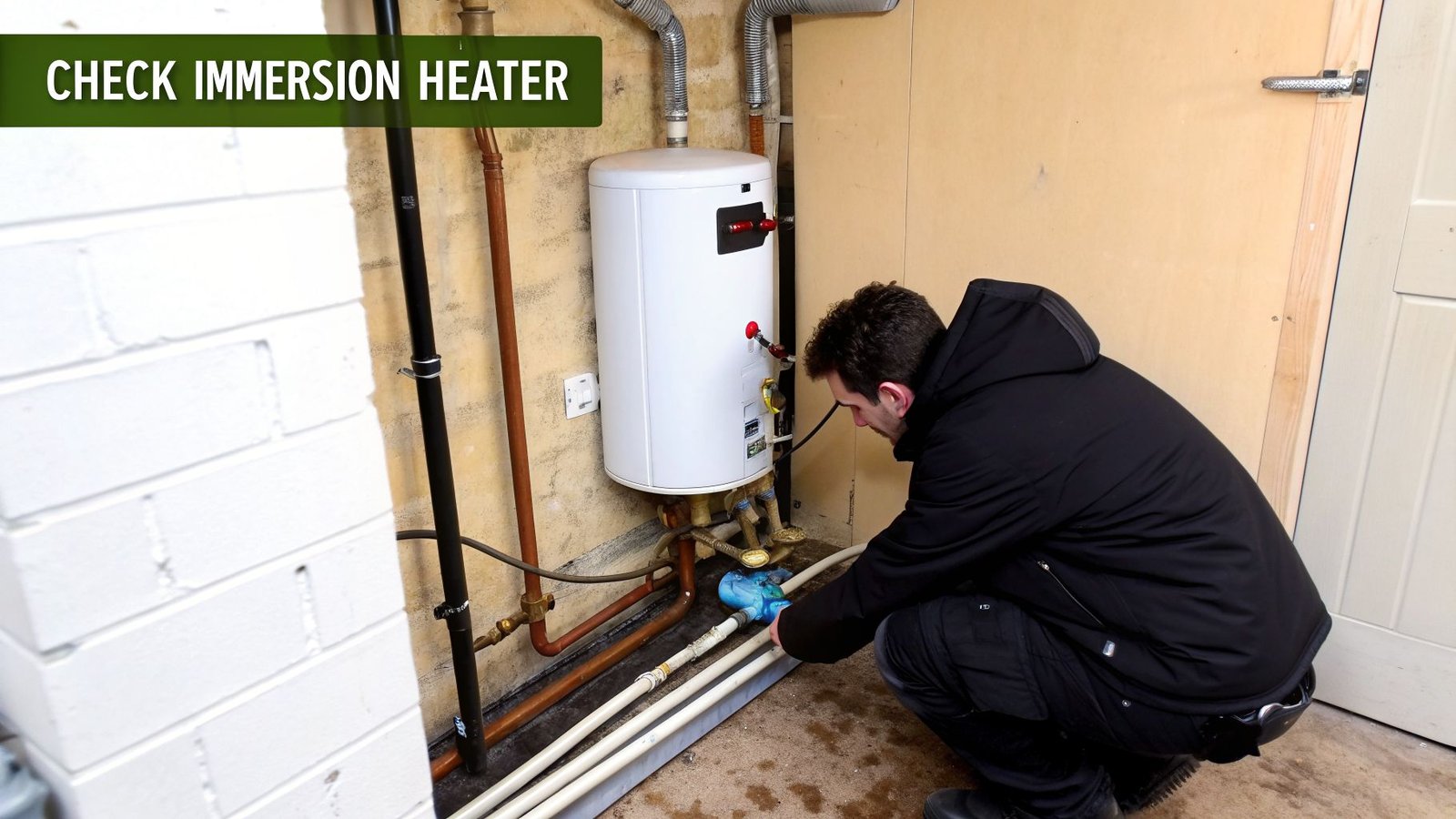
In many homes, particularly those with a hot water cylinder (or tank), there's a trusty backup: the electric immersion heater. It’s designed to be a lifesaver when the boiler is out of action, but it can also be a point of failure itself.
An immersion heater is basically a big heating element, just like in a kettle, that sits inside your hot water tank. If the boiler is working fine but your water is cold, this is the next logical place to look.
First things first, find its dedicated switch. It’s usually on a wall plate near the cylinder, often in an airing cupboard, and typically has a little red light to show it’s active. It's surprisingly common for these to be knocked off by accident. Also, take a quick look at your main fuse board to make sure it hasn't tripped.
If the switch is on but the water is still cold after an hour or two, you’re likely looking at a faulty thermostat or a burnt-out element. The thermostat tells the element when to heat the water, so if it fails, the element never gets the message.
Be very careful here. While checking a switch is simple enough, trying to fix a faulty immersion heater yourself is a bad idea. It involves working with both mains electricity and water—a genuinely dangerous mix. This is a job strictly for a qualified professional.
Our engineers are well-versed in diagnosing and safely repairing all types of hot water cylinders and can sort these issues out quickly and safely.
The Mystery of the Switched-Off Hot Water Tank
Sometimes, the reason for no hot water is completely out of your hands. This is especially true for households on older Economy 7 or Economy 10 tariffs, which use a radio signal to switch on water heating during cheaper, off-peak hours.
Believe it or not, this system is being shut down. The old Radio Teleswitching System (RTS) meters, relics from the 1980s, are being phased out. As of early 2026, this is set to affect around 156,000 households across Britain. The signal infrastructure is being switched off region by region, leaving some homes without the trigger to heat their water overnight.
If you’re on one of these tariffs and your hot water has suddenly vanished, this could well be the cause. Your energy supplier should contact you about a smart meter upgrade, but it’s worth giving them a call to find out if the switch-off is affecting your area.
Investigating Common Plumbing Problems
If you've ruled out the boiler and the immersion heater, it’s time to consider the pipework. A couple of common plumbing gremlins can stop hot water from ever reaching your taps.
Airlocks in Your Pipes
An airlock is just a stubborn bubble of air trapped in a pipe. It acts like a blockage, preventing water from flowing past it. This often happens after the mains water has been shut off for maintenance work in your street. You might notice you have no hot water from one specific tap, while others are fine.
You can sometimes clear a minor airlock yourself. A classic plumber's trick involves using a short length of hosepipe to connect the misbehaving hot tap to a working cold tap. Open both taps (cold first), and the higher pressure from the mains cold water can often force the air bubble out of the hot pipe.
Frozen Pipes in a Cold Snap
During a proper cold spell, any pipes running through unheated spaces—think lofts, garages, or basements—are at risk of freezing. When water freezes, it expands, and that expansion can put enough pressure on a pipe to split it wide open.
You can usually spot a frozen pipe by looking for:
- Visible frost or heavy condensation on the outside of the pipe.
- No water at all from a tap. Not even a drip or a gurgle.
If you find a frozen pipe, never, ever use a blowtorch or any open flame to thaw it. The extreme, sudden heat can easily cause the pipe to burst. Instead, use a hairdryer on a low setting or wrap the pipe in towels soaked in hot (not boiling) water. Always start thawing from the tap end and work your way back towards the blockage. If you’re not sure what you're doing or can't reach the pipe, the safest bet is always to call a plumber.
Getting By Without Hot Water and Knowing When to Call a Pro
Let's be honest, waiting for an engineer when the hot water has gone off feels like an eternity, especially in the middle of winter. Before you brave an icy shower, there are a few things you can do to get by.
A bit of old-fashioned ingenuity goes a long way. Boil the kettle for washing up, let the dishwasher handle the plates, or heat a pan of water on the hob for a quick wash. If you happen to have an electric shower, you're in luck – they heat water independently, so you can still have a hot shower.
Sadly, with energy costs as they are, living without heating or hot water is becoming a grim reality for many. It's reported that over 2 million households in the UK are planning to go without central heating this winter, a 22% increase from last year. You can read more about these findings in the Uswitch study on household heating habits here.
The Red Line: When to Put the Tools Down
While it’s great to be resourceful, there's a clear line you should never cross when it comes to boiler repairs. Some jobs are simply too dangerous to attempt yourself.
If you find yourself needing to work on any gas-related part of your system or remove the main boiler casing, you must stop. This isn't just a strong suggestion—it's a legal requirement designed to keep you and your family safe.
Only a Gas Safe registered engineer has the training and qualifications to work on gas appliances. Trying to fix it yourself is not only illegal but could also invalidate your home insurance and, far worse, lead to a gas leak or carbon monoxide poisoning.
Warning Signs That Demand an Engineer Now
Some boiler problems are more than just an inconvenience; they’re clear signals that you need professional help immediately. If you spot any of these, pick up the phone.
Don’t hesitate to call an expert if you see, hear, or smell any of this:
- A smell of gas: This is a true emergency. If you get a whiff of sulphur or rotten eggs near your boiler or meter, you may have a gas leak. Don't touch any light switches or electrical appliances. Head outside, turn off the gas using the emergency valve next to your meter, and immediately call the National Gas Emergency Service on 0800 111 999.
- The boiler is leaking water: Even a small drip can escalate, causing serious water damage to your home and shorting out the boiler's electronics. Shut off the boiler and the water supply to it (if you can do so safely), and then call an engineer.
- A fault code that won’t go away: You’ve reset the boiler, followed the manual, but that pesky fault code is still flashing. This points to a deeper issue with an internal part that needs an expert to diagnose and fix.
- Loud banging or gurgling sounds: This is often called 'kettling'. It usually means limescale or sludge has built up inside the heat exchanger, which can cause severe damage if you leave it.
When you're stuck with no hot water, especially with these worrying signs, you need someone you can count on. Here at Urbanic, our Gas Safe registered engineers are on hand for rapid-response repairs. We provide clear, fixed-price quotes to get your hot water back on quickly, restoring your peace of mind without any hidden costs.
How To Prevent a Future Hot Water Breakdown
Once your hot water is back on, the last thing you want is a repeat performance. Moving from reactive panic to proactive care is the best way to protect your home, your wallet, and your morning routine from that icy shock.
The most important thing you can do is get your boiler serviced every year. It’s genuinely the best preventative measure out there. Think of it as an MOT for your heating system; it's a chance for a professional to spot small issues before they become major, expensive headaches.
An experienced Gas Safe engineer can catch things you’d never notice—a slight drop in pressure hinting at a tiny leak, a component showing early signs of wear, or the beginnings of a blockage. A single visit can prevent the vast majority of "no hot water" emergencies.
What an Annual Boiler Service Actually Involves
A proper boiler service is far more than a quick look-over. It's a comprehensive check-up where an engineer gets their hands dirty to make sure everything is running efficiently and, most importantly, safely.
Here’s what they’ll typically do:
- Inspect key components: The burner, heat exchanger, and main injector are all checked for wear, corrosion, or damage.
- Analyse the flue gases: This is a crucial safety test to ensure your boiler is burning fuel correctly and not leaking dangerous carbon monoxide.
- Clean out essential parts: Over time, sludge and debris can build up and reduce efficiency. A good clean keeps everything running smoothly.
- Test all safety devices: They'll confirm that things like pressure relief valves and cut-out switches are working perfectly.
An annual service is your number one defence against a breakdown. It’s a small investment in reliability that pays for itself by keeping your boiler from failing you on the coldest day of the year.
Booking this in is straightforward. You can see what’s included and arrange a visit from one of our experts in our guide to boiler servicing.
Consider a Boiler Care Plan for Complete Peace of Mind
For many people, the best way to handle boiler maintenance is with a care plan. These plans are designed to take the sting out of unexpected repair bills by rolling everything into a manageable monthly payment.
Our Urbanic care plans, for instance, bundle the annual service with cover for most repairs. That means if a pump fails or the thermostat packs in, the cost of the parts and the labour to fit them is already covered. It’s invaluable peace of mind, knowing that a solution is just a phone call away, with no surprise invoice to follow.
These plans are especially practical for landlords. They help you meet your legal duties to tenants while making your property maintenance costs clear and predictable.
Smart Upgrades That Pay for Themselves
While regular maintenance is vital, sometimes the smartest move is an upgrade, especially if you’re nursing an old, inefficient boiler that breaks down frequently.
Switching to a modern A-rated condensing boiler is a game-changer. They aren't just more reliable; they're significantly more efficient and can make a real dent in high energy bills by wasting far less fuel.
Another worthwhile investment is a smart thermostat. These devices learn your daily habits and let you control your heating from your phone. You can optimise your hot water schedule and stop paying to heat an empty house.
As we look to the future, it's clear that traditional boilers aren't disappearing overnight. A Spring 2026 report from the Department for Energy Security and Net Zero revealed that 45% of UK residents are unlikely to install an air source heat pump, with the figure hitting 52% for ground source models. This hesitation means millions of us will rely on our gas boilers for years to come, making proper maintenance more critical than ever. You can explore the complete DESNZ Public Attitudes Tracker findings on gov.uk.
Your Top Hot Water Questions Answered
It's one thing to run through a checklist, but you've probably still got questions buzzing around your head. That's completely normal. When you're stuck with no hot water, a bit of clarity can make all the difference. We get asked these questions all the time, so let's get you some answers.
My Heating Is Working But I Have No Hot Water, What Does That Mean?
Ah, the classic "hot radiators, cold taps" scenario. If you have a separate hot water cylinder (often in an airing cupboard), the culprit is almost always a faulty diverter valve.
Think of this valve as a traffic controller inside your boiler. It directs the hot water to either your radiators or your hot water tank. When it gets stuck in the 'heating' position, your radiators get all the attention, but your taps are left out in the cold. It could also be a problem with the cylinder thermostat failing to signal the boiler that the water has gone cold.
For combi boilers, which heat water instantly, this issue almost certainly points to an internal fault. While you can safely check the cylinder thermostat’s setting yourself, fiddling with a diverter valve is strictly a job for a Gas Safe engineer.
How Much Does a Typical No Hot Water Fix Cost in London?
The cost really depends on what’s gone wrong. A simple fix, like repressurising your boiler, costs you nothing but a few minutes of your time. If you need an engineer for a straightforward job, like swapping out a faulty thermostat, you're likely looking at a bill in the £100-£250 range.
Bigger problems, of course, mean bigger bills. Replacing a key part like a diverter valve or the boiler's main circuit board (the PCB) can push the cost up to between £250 and over £500.
The best way to avoid a nasty surprise is to get a fixed-price quote from your engineer before any work begins. This is why many London homeowners opt for a boiler care plan, which turns a large, unpredictable bill into a manageable monthly cost.
Is No Hot Water Covered by My Home Insurance?
Probably not, unfortunately. Most standard home insurance policies are designed to cover the damage caused by a failure—like a flood from a burst pipe—not the cost of repairing the appliance that broke down in the first place.
You’ll need to check your policy for a specific 'Home Emergency Cover' add-on. This is often what’s needed for situations like a complete loss of hot water. Always read the small print to see exactly what is and isn't included. Honestly, a dedicated boiler care plan from a specialist is often the more direct and reliable route, as insurance can have many exclusions for heating systems.
As a Tenant, How Long Can My Landlord Leave Me Without Hot Water?
Legally, your landlord has to act fast. A lack of hot water is considered an urgent repair under the Landlord and Tenant Act 1985. They are required to sort the problem within a "reasonable time," which is almost universally understood to be 24 to 48 hours.
If your landlord isn't responding, your next port of call should be your local council's environmental health department. For landlords, having a reliable emergency service on speed dial is key to meeting these legal duties and keeping tenants happy.
Don't let a cold shower throw your whole day off track. If you're grappling with no hot water and need a fast, reliable solution, the Urbanic Services Ltd team is here to help. Our Gas Safe registered engineers give you transparent, fixed-price quotes to get your home warm and comfortable again. Learn more and book your expert engineer today at urbanicservice.co.uk.
Composed with the Outrank app