
That faint, unmistakable smell of rotten eggs is a serious warning. When you suspect a gas leak, what you do in the next few minutes is absolutely critical. The plan is simple: ventilate, shut off the gas, and get everyone out before you call for help. Knowing these steps isn't just good advice—it can make all the difference.
Your First Five Minutes in a Gas Emergency
A potential gas leak requires a swift, measured response. Panic clouds judgement, but a clear head and a simple plan will keep you safe. Those first moments are everything. It’s not always that classic ‘rotten egg’ smell, either. A hissing sound near your pipework, plants that are mysteriously dying near a gas line, or even unexplained dizziness can all point to a problem.
Worryingly, gas-related incidents are on the rise. Recent data from the 2025-26 period in Great Britain shows a 17.1% surge in reported gas leaks. With over 21% of these leaks traced back to faulty boilers, it’s a stark reminder of how appliance safety and home safety are directly linked. It highlights just how many homeowners find themselves in this exact situation.
Get Fresh Air in—Without Causing a Spark
First, get fresh air circulating. As you head for the exit, open any doors and windows you pass to help disperse the gas building up inside.
But here’s the crucial part: you cannot create a spark.
The smallest spark can ignite gas in the air. This means no light switches, on or off. Don't unplug appliances, don't use the landline, and absolutely do not use your mobile phone while you're still inside the house.
Even the tiny spark from a switch or a phone's electrical circuit could be catastrophic. Your only job is to open a path for air to flow and to get yourself out.
Here is a quick-reference table to help you remember the most critical do's and don'ts in the heat of the moment.
Immediate Gas Emergency Action Plan Do's and Don'ts
| Action to Take Immediately (DO) | Actions to AVOID at All Costs (DON'T) |
|---|---|
| Open windows and doors on your way out. | Don't operate any electrical switches (lights, sockets). |
| Locate and turn off the gas at the meter. | Don't use a mobile phone or landline inside the property. |
| Extinguish any naked flames (e.g., candles). | Don't unplug or plug in any electrical appliances. |
| Evacuate everyone from the building. | Don't re-enter the property until a Gas Safe engineer says it's safe. |
| Call for help from a safe distance outside. | Don't try to find or fix the leak yourself. |
Memorising these simple rules can be a lifesaver when you're under pressure and need to act fast.
Find and Shut Off Your Gas Supply
Every homeowner should know exactly where their emergency gas shut-off valve is. You'll typically find it at the gas meter, which could be in a meter box on an outside wall, under the stairs, or in a cellar. The valve itself is usually a lever handle on the pipe.
To stop the gas flow, give the lever a quarter turn. It should move from being parallel with the pipe to being at a right angle to it, forming a 'T' shape. This single action cuts the gas supply to your home, containing the immediate danger. If you’re having trouble finding it, our detailed guide on what to do when you smell gas from your boiler has more specific visuals and instructions.
This simple process is your blueprint for safety.
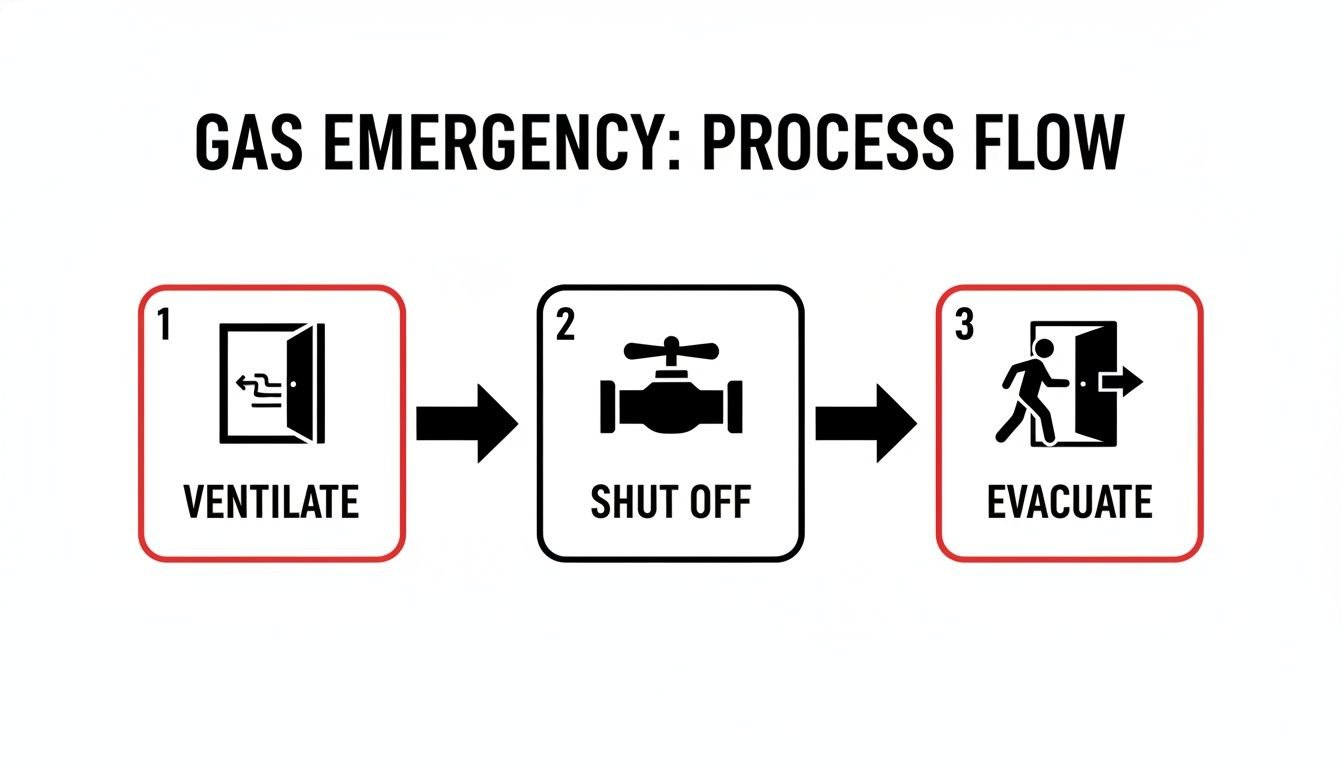
Evacuate and Make the Call
Once you've opened the windows and turned off the gas, get everyone out of the house. Don't stop to grab anything. Move to a safe distance, well away from your property and preferably uphill and upwind.
Only when you are safely outside and far from the building should you use your phone to call for emergency gas repairs. You've done your part to manage the immediate risk. Now, it’s time to let the professionals handle it.
Calling an Emergency Gas Engineer
Okay, you've done the most important thing: you've got everyone safely out of the house. Now, it's time to get a professional on the scene. Making that call for an emergency repair can feel stressful, but a little bit of information from your end helps us get an engineer to your door that much faster.
Think of it like giving a clear report. The more detail you can share, the better prepared our engineer will be when they arrive.
What to Have Ready When You Call
To get things moving quickly, try to have a few details handy. Don’t panic if you don't have all the answers—your safety comes first—but anything you can tell us is a huge help.
- Your full address and postcode. This is the non-negotiable one. Be as precise as you can, especially if you know sat-navs sometimes get your location wrong.
- A contact number. Ideally, the mobile phone you're holding, so our engineer can call you when they're close or if they have trouble finding you.
- A quick description of the problem. "I can smell gas" is the most important thing to say. But if you have more detail, it’s golden. For instance, "I can hear a hissing noise by the meter" or "the smell is really strong in the kitchen" helps our engineer start diagnosing the issue before they've even stepped out of the van.
- Where your gas meter is. Just letting us know it's under the stairs, in a cellar, or in a box outside means the engineer can head straight there to confirm the supply is off and start their safety checks.
Giving us this information upfront bridges that crucial gap between your emergency call and our expert arriving to take control.
What Happens After You Make the Call
The second you hang up the phone, we’re on it. The job is immediately dispatched to the nearest available Gas Safe registered engineer in your area. These aren't just any technicians; they're specialists trained for emergency situations.
You’re not in this alone. Think of our engineer as your partner in making the house safe again. They'll have all the right diagnostic kit and, more importantly, the experience to trace the fault and sort it out.
When they arrive, their first job is to confirm the scene is secure. They'll introduce themselves and—this is vital—show you their Gas Safe ID card. Always, always ask to see it. It’s your guarantee that the person you’re letting into your home is legally qualified to work on gas.
Verifying Your Engineer's Credentials
That ID card is more than just a piece of plastic; it’s your peace of mind. It confirms who they are and, on the back, details exactly what type of gas work they are certified to carry out.
Check the list of qualifications on the reverse side. If you've got a boiler problem, you should see "Gas Boilers" listed. You can even use their unique licence number to check the official Gas Safe Register website right there and then.
Once you’re happy, you can let them get to work. They’ll begin systematically and safely tracing the fault, explaining what they're doing as they go, with the single goal of getting your home back to normal.
Understanding Emergency Gas Repair Costs in London
When you’re facing a gas emergency, the last thing you want to worry about is a spiralling, unpredictable bill. We get it. That fear of hidden costs can be just as stressful as the fault itself. That’s why we’ve built our entire emergency service around a simple, honest promise: fixed-price quotes.
What this means is the price we give you upfront is the final price you pay. Period. There are no hidden call-out charges, no confusing hourly rates that creep up, and absolutely no nasty surprises once the job is finished. Before we even think about touching a tool, our Gas Safe engineer will diagnose the issue and give you a single, clear cost for the complete repair. You are always in control and have the final say.
What Shapes the Final Cost?
Of course, every gas emergency is different, and a few key things will determine the final price. Knowing what these are can give you a much clearer idea of what to expect and take the guesswork out of the situation.
The biggest factor, naturally, is the complexity of the repair. Think about it: replacing a faulty thermocouple on a boiler is a common and relatively quick job for an experienced engineer. On the other hand, tracking down a slow, hidden gas leak inside a wall or under floorboards takes specialised detection gear and a lot more time. The cost will reflect that difference in labour and skill.
Then there are the parts required. Most of the time, our engineers have the common components for major boiler brands right in their van. But if you have an older or more obscure model, we might need to source a specific part from a supplier, which can affect the final quote.
Here’s a quick look at what goes into your quote:
- Time of the Call: An emergency call-out on a Sunday evening will understandably cost more than a standard weekday appointment, reflecting the unsociable hours for our engineers.
- The Task Itself: Is it a simple component swap or a complex diagnostic mission? The intricacy of the work is a huge part of the cost.
- Parts and Materials: The price of any replacement parts needed for the fix is always included in your fixed-price quote.
- Accessibility: If the fault is tucked away in a really awkward spot—say, behind kitchen units or under sealed flooring—the extra labour involved will be factored into the price.
Our commitment is to total clarity. The engineer who visits your home will walk you through exactly what needs doing and why, breaking down the costs so you can see the value in the work. This is a fundamental part of our service, especially for homeowners in areas like Greenwich and Lewisham who rely on our transparent approach.
Realistic Cost Examples
To help you get a sense of what to expect, let’s run through a few common scenarios. Just remember, these are guides—your fixed-price quote will be tailored to the specific problem at your property.
A fairly minor repair, like fixing a leak on a visible pipe fitting or replacing a flexible gas cooker hose, is on the lower end of the scale. These jobs typically involve less diagnostic work and use standard, inexpensive parts.
A more moderate repair might be something like replacing a crucial boiler component, such as a gas valve or a faulty fan. These parts are more expensive, and the work requires a higher level of technical skill. For a more detailed look at potential charges, you can see a full overview by exploring our rates on the Urbanic website.
The most significant costs usually come from major issues. The classic example is locating and repairing a gas leak on pipework that’s hidden from view. This is highly labour-intensive work that demands meticulous safety checks every step of the way.
By sticking to fixed-price quotes, we take all the guesswork and anxiety out of the equation. You get the peace of mind that comes from knowing the full and final cost before any work begins. That leaves you free to focus on what really matters: getting your home safe, sound, and warm again.
From Diagnosis to Sign-Off: How We Handle Your Gas Emergency
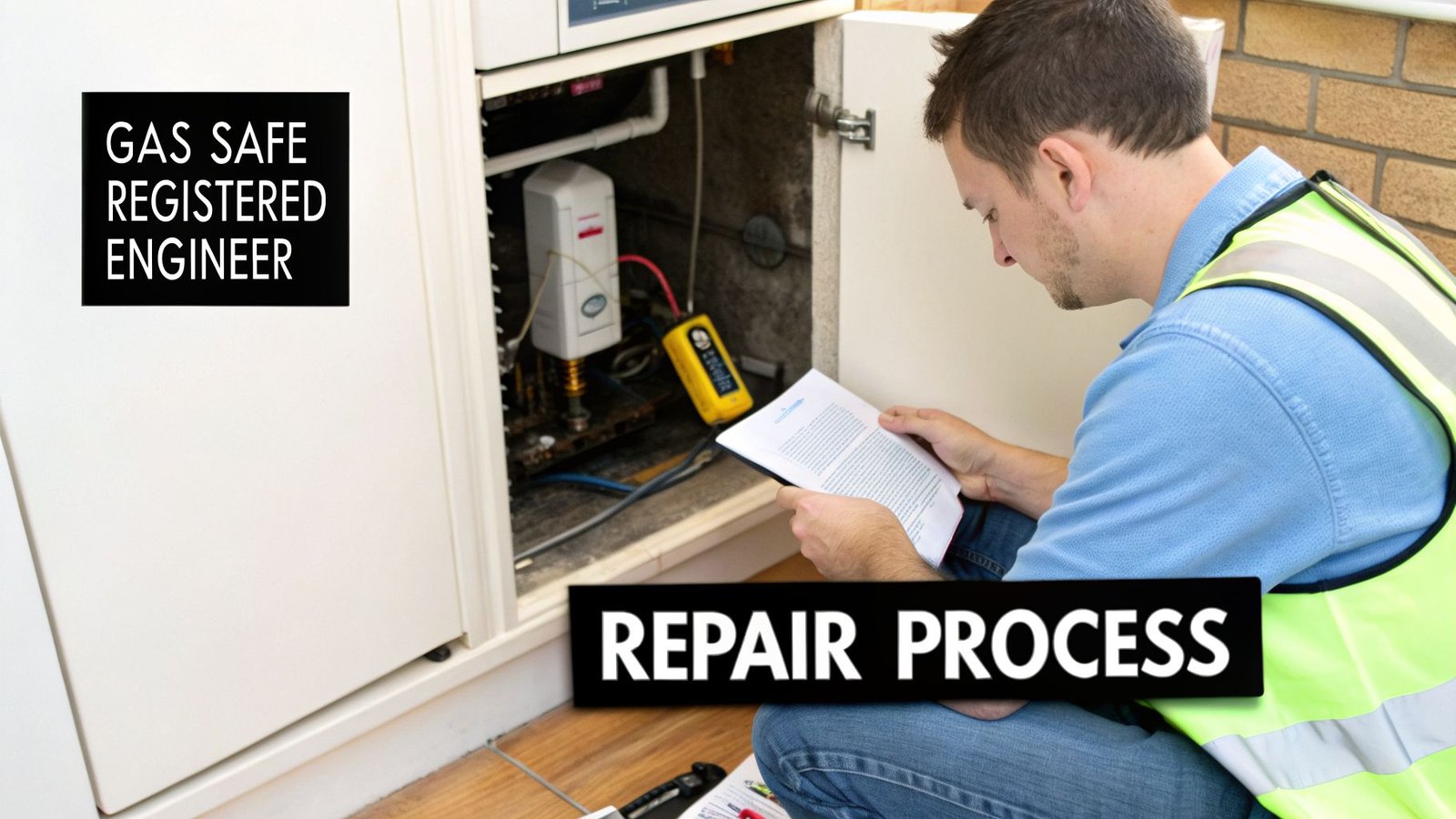
Once our Gas Safe registered engineer is at your door, their first job is to show you their credentials so you know you’re in safe hands. After you give the go-ahead, we can get down to business. Our focus isn't just on patching up the immediate problem; it's about making sure your entire gas system is safe and sound, from top to bottom.
We know it’s a stressful time, so our engineers make a point of explaining what’s happening at every stage. You can generally expect the visit to unfold in three parts: a meticulous safety check and diagnosis, the repair itself, and finally, a full set of post-repair tests to sign everything off.
H3: Finding the Fault: Safety Assessment and Diagnosis
First things first: safety. Even if you've already turned the gas off, our engineer will double-check that the supply is isolated at the meter. With the area secured, they’ll get out their specialist equipment, including an Electronic Gas Analyser (EGA), to trace the exact source of the leak or fault.
This isn’t a case of guesswork. An EGA is an incredibly sensitive piece of kit that can detect tiny traces of gas, allowing the engineer to follow the trail right to the source. It’s how we can tell if you’ve got a corroded pipe, a loose fitting, or a faulty boiler component, often without having to take things apart unnecessarily.
This diagnostic phase is the most critical part of any emergency gas repairs. Getting the diagnosis spot-on means we can apply the right fix the first time, preventing a call-back and keeping your family safe. It’s all about precision.
Once we’ve pinpointed the problem, our engineer will walk you through what’s wrong in plain English, explain the work that’s needed, and confirm the fixed-price quote before picking up any tools.
H3: The Fix: Common Repair Work We Carry Out
With the fault clearly identified and the price agreed, the hands-on work begins. What this involves will obviously depend on the diagnosis, but here are a few of the most common fixes we perform on emergency calls:
- Fixing Faulty Boilers: A huge number of gas emergencies start with the boiler. We often find ourselves replacing failing gas valves, worn-out thermocouples, or faulty fans to get the appliance running safely again.
- Securing and Replacing Pipework: Over the years, pipe joints can work themselves loose and seals can perish. Sometimes the fix is as simple as tightening a compression fitting. Other times, it means cutting out an old, corroded section of pipe and replacing it with a brand-new, secure piece.
- Repairing Appliance Connections: The flexible hoses that connect to your gas hob or cooker can wear out or get damaged. In that situation, the engineer will swap the old hose for a new, compliant one and make sure the seal is perfect.
No matter the task, our engineers always work with a safety-first mindset. They'll isolate the part of the system they’re working on and stick to industry best practices. When a part needs replacing, for instance, they'll only use an exact, manufacturer-approved component to maintain your appliance’s safety certification. That level of detail is simply non-negotiable for us.
H3: The All-Clear: Post-Repair Checks and Certification
Getting the repair done is only half the battle. The final, crucial stage is to prove that the entire system is now airtight and working exactly as it should. This involves a gas tightness test, where the engineer uses a device called a manometer to pressurise the pipework. They then watch closely for any drop in pressure, which would immediately flag up any other potential leaks in your home.
Once they're satisfied the system is 100% sealed, they will safely recommission your gas supply. This is a careful process of turning the gas back on, bleeding any air from the pipes, and then testing the repaired appliance to make sure it’s firing up and running correctly. They’ll also give your other gas appliances a quick check to ensure they’re working properly too.
Before they leave, the engineer will write up and give you a Gas Safe report. This is your official record detailing the work that was done, the results of all the safety checks, and a clear confirmation that your gas installation is safe to use. It’s the proof you need that the emergency is officially over.
Preventing Future Gas Emergencies
The best way to handle emergency gas repairs is, quite simply, to stop them from happening in the first place. While it’s good to know an expert is ready to help 24/7, the real goal is to get ahead of the problem. Shifting to a proactive mindset will save you a world of stress, money, and hassle down the line.
Preventative maintenance isn't some optional extra you can tick off a list. It's a core part of being a responsible homeowner. A well-looked-after gas system is a safer gas system. It's as simple as that.
The Value of Annual Boiler Servicing
Think of your boiler's annual service as its yearly MOT. It’s a crucial opportunity for a Gas Safe registered engineer to get under the bonnet, check every vital component, and clean out the parts that inevitably get clogged up after a year of hard graft.
During a service, our engineers look for any hint of corrosion, test the safety cut-outs, and analyse the flue gases to check for efficiency. They’re also hunting for minor leaks or weak spots in seals and pipes. These are the small, quiet issues that can suddenly turn into a full-blown emergency if ignored.
An annual service is your first and best line of defence. It’s a small, predictable investment that significantly reduces the risk of facing a much larger, unexpected repair bill down the line.
Catching a deteriorating seal or a slight pressure drop early is always better than being woken by an alarm or the faint smell of gas. What’s more, a regularly serviced boiler runs far more efficiently, using less gas to heat your home—which is great for your energy bills and the environment.
Urbanic's Boiler Care Plans for Peace of Mind
Let's be honest, remembering to book a service is just another thing to add to an already long to-do list. That’s exactly why we developed our Boiler Care Plans, designed to give London homeowners total peace of mind by taking the guesswork out of maintenance.
Our plans bundle your essential annual service with extra cover for the rest of your heating system. With a simple monthly payment, you can be covered for:
- Annual Boiler Service: The vital yearly check to keep your boiler safe, legal, and efficient.
- Heating Controls: Cover for the thermostats, programmers, and valves that are the brains of your system.
- Gas Pipework: Protection against leaks on the internal gas pipes running through your home.
- Plumbing & Drains: Some of our plans even extend to your home’s plumbing, giving you a complete home care solution.
These plans transform unpredictable repair costs into a manageable monthly fee. It's a smart way to budget for your home's upkeep and know an engineer is always on hand—not just for gas emergencies, but for other common household headaches too.
Practical Tips for a Safer Home
Beyond professional servicing, there are a few simple habits you can build to help keep your home safe. They cost nothing but can make a huge difference.
First, keep the area around your boiler clear. Boilers need a good flow of air to work safely and correctly. Avoid the temptation to store coats, cleaning supplies, or other clutter in the cupboard where it’s housed. Piling things around it can easily block essential air vents and create a serious fire hazard.
Next, just be more aware. Get to know the normal sounds your heating system makes. If you suddenly start hearing odd noises like clanking, whistling, or gurgling, it could be an early warning sign. Also, take a quick look at the boiler's pilot light if it has one—it should always be a crisp, blue flame. A weak, yellow, or orange flame is a red flag that it isn’t burning gas properly, which can produce deadly carbon monoxide. You can learn more about the dangers of boiler-related carbon monoxide and what to watch out for.
Finally, make sure you have audible carbon monoxide (CO) alarms fitted. Put one in the same room as your boiler and another near your sleeping areas. Test them regularly, just like you would a smoke alarm. A CO alarm is an inexpensive, life-saving device that will alert you to this invisible, odourless gas long before you’d ever notice it yourself.
Your Emergency Gas Repair Questions Answered
When you're dealing with a potential gas fault, a million questions can run through your head. The stress is bad enough without adding confusion to the mix. Over the years, our London-based engineers have heard it all, so we've put together some straight-talking answers to the questions we get asked most often during emergency gas repairs.
This is your quick guide to knowing what’s what, who to call, and what you can expect. A little bit of knowledge can go a long way in making a tense situation feel more manageable.
How Do I Know if It’s a Gas Leak or a Faulty Appliance?
This is the big one, and it's a critical distinction to make. The most obvious, tell-tale sign of a natural gas leak is that unmistakable 'rotten egg' smell. Gas itself is odourless, so suppliers add an odorous chemical called mercaptan for this exact reason – to make even the smallest leak easy to detect by smell.
But you can't always bank on your nose alone. Keep an eye (and ear) out for these other signs:
- A hissing sound: Any hissing or whistling noise near a gas appliance, meter, or pipework is a dead giveaway that gas could be escaping.
- Feeling unwell: If you or your family members are suddenly experiencing headaches, dizziness, or nausea for no apparent reason—and feel better once you're outside in the fresh air—it could be a sign of gas exposure.
- Dying plants: A patch of dead or dying vegetation near an external gas line can sometimes point to an underground leak.
A faulty appliance often presents differently. You might see a lazy, yellow flame on your boiler or hob instead of a sharp, blue one. Soot marks or black stains appearing on or around an appliance are another red flag. But the golden rule is this: if you smell gas, always treat it as a gas leak first.
Don't ever try to figure it out on your own. If you smell gas, your only job is to get everyone out, open windows if you can do so quickly on your way out, and call for help. The risk is just too great to second-guess it.
What's the Difference Between Calling My Supplier and a Gas Safe Engineer?
This is a common point of confusion, but the dividing line is actually very simple. Your gas supplier (the company that runs the national network, like National Grid) is responsible for the gas main in your street and the service pipe that runs right up to your gas meter.
If you smell gas outside your home, in the street, or around your meter box, that's who you call. They have a national emergency number for exactly this purpose.
A Gas Safe engineer—like the team here at Urbanic—is your go-to for everything inside your property, from the meter onwards. That includes:
- All the internal gas pipes running to your appliances.
- Your gas boiler and central heating system.
- Gas hobs, cookers, and fires.
- Every connection and fitting that links it all together.
So, if the problem is inside your home, from a boiler that won't fire up to a suspected leak behind your cooker, you need a registered Gas Safe engineer for your emergency gas repairs.
How Long Does a Typical Emergency Gas Repair Take?
The honest answer is: it really depends on what we find. No two jobs are ever exactly the same. A simple fix, like replacing a standard boiler part or tightening a loose fitting, can often be sorted in under an hour, especially if the engineer has the part in their van.
On the other hand, some jobs are much more involved. Tracing a very slight leak on pipework hidden under floorboards or inside a wall, for instance, is a painstaking process. It takes time and specialist equipment to locate the source without causing unnecessary damage. This sort of detective work can take several hours to diagnose, access, and then repair properly.
What we will always do is work quickly to find the root of the problem. As soon as our engineer knows what's wrong, they'll explain it to you clearly, give you a fixed-price quote, and a realistic estimate for how long the work will take. You’ll have all the facts before we start, so there are no nasty surprises. Our first priority is always a safe, correct, and lasting repair—never a rushed job.
When you need fast, reliable, and safe solutions for your heating and plumbing, you can count on Urbanic Services Ltd. For expert advice or to book a Gas Safe engineer, visit us at https://urbanicservice.co.uk.