
The boiler tends to pick an inconvenient moment. A cold London morning, everyone trying to shower, the heating meant to come on before school or work, and suddenly there is no hot water, the radiators stay cold, or the boiler starts making a noise it definitely was not making last week.
Such situations prompt serious consideration of boiler maintenance. Not when the system is running well, but when it stops.
The problem is that a boiler rarely goes from perfect to failed in one jump. More often, it runs a little less efficiently, gets noisier, loses pressure, struggles after summer, or develops a fault that could have been caught in a planned visit. In London, that matters more than many homeowners understand. Hard water, older housing stock, tight utility budgets, and long stretches where some landlords leave properties lightly occupied all put extra strain on heating systems.
A good maintenance routine is not the same as a repair. A repair deals with a fault after the damage is done. Maintenance is the planned work that keeps the appliance safe, compliant, and reliable before the breakdown happens.
Why Boiler Maintenance is a London Essential
A London boiler often gets tested hardest on the most inconvenient morning of the year. The weather turns, everyone is at home, the heating comes back on after months of light use, and a system that seemed fine in summer starts losing pressure, kettling, or refusing to fire properly.

In London, that pattern is common for a reason. A lot of homes have older pipework, compact boiler locations, converted flats, and water that leaves scale behind. For landlords, there is also the added pressure of tenant expectations, access arrangements, and keeping the property safe and serviceable through winter.
Maintenance is not the same as repair
The distinction matters because the cost, urgency, and risk are different.
A repair deals with something that has already failed. The boiler may have locked out, started leaking, stopped heating water, or shown a fault code. At that stage, the job is to diagnose the defect and replace or fix the failed part.
Boiler maintenance is planned work. It involves checking safe operation, cleaning key components where appropriate, testing performance, spotting wear early, and looking at the wider system conditions that shorten boiler life. In practice, that can mean finding scale buildup, poor system water quality, a slow pressure loss, or early signs of flue or seal deterioration before they turn into a no-heat callout.
That is especially important in rented London property, where a small issue ignored in October can become a tenant emergency in December.
London adds its own pressure
Hard water is one of the biggest local problems. Across much of London, limescale builds up faster than homeowners expect, especially in combi boilers working hard for both heating and hot water. The result is reduced heat transfer, more strain on the heat exchanger, and higher running costs over time. The UK government’s guidance on water hardness and scale in hot water systems explains why scale control matters in domestic systems.
The housing stock adds another layer. Victorian terraces, post-war flats, and piecemeal refurbishments often leave boilers connected to systems that have been altered several times. I see filters fitted on one visit, old radiators left on another, and controls upgraded without the rest of the system being properly balanced. A boiler can be perfectly decent and still struggle if the system around it is dirty, poorly set up, or full of old compromises.
Then there is the simple fact that city properties are harder on heating systems. Some are left empty between tenancies. Some are occupied all day. Some have limited ventilation or boxed-in pipework. If you ever smell gas near the boiler, that stops being a maintenance issue and becomes an immediate safety job.
What helps
Good boiler care is usually straightforward.
- Worth doing: annual servicing by a Gas Safe engineer, checking pressure now and then, dealing with small leaks early, bleeding radiators if they have cold spots, and asking about scale or sludge if the boiler is getting noisy
- Usually a mistake: topping up pressure again and again without finding the cause, ignoring banging or kettling sounds, blocking ventilation openings, or letting anyone unregistered work on gas components
- Easy to overlook: the first start-up after summer, when stuck pumps, air in the system, and pressure problems often show themselves
A well-maintained boiler is rarely dramatic. It starts cleanly, heats evenly, and does its job without wasting fuel or giving the property owner another avoidable bill.
Gas Safe Engineers and Your Legal Duties
If a boiler burns gas, the legal side is not optional. Safety rules are strict because the risks are serious, and London landlords in particular need to treat compliance as part of routine property management, not as an afterthought.
Who can legally work on a gas boiler
In the UK, regular boiler maintenance is mandated by law under the Gas Safety (Installation and Use) Regulations 1998, requiring annual safety checks by Gas Safe registered engineers for all gas boilers in domestic properties. Non-compliance can risk fines up to £6,000 or imprisonment, and the same reference notes that between 2012 and 2022, over 100 deaths and 200 serious injuries from carbon monoxide leaks were linked to poorly maintained appliances, according to HSE data in this legal and safety summary.
A Gas Safe engineer is not just someone with experience. They must be on the register and qualified for the type of appliance they are working on.
For a homeowner, that means checking the engineer’s ID before work starts. For a landlord or letting agent, it means using properly registered contractors every time and keeping records straight.
What landlords need to do
Landlords have the clearest duties because they are responsible for tenant safety. In practical terms, that means:
- Arrange the annual gas safety check on time.
- Use a Gas Safe registered engineer and confirm they are qualified for boiler work.
- Keep the records organised so there is evidence of compliance.
- Act on defects promptly rather than waiting for the next visit.
If a tenant reports a gas smell, unusual combustion smell, or signs of distress from the appliance, treat that as urgent. This guidance on what to do if you smell gas from a boiler is useful because the right first response matters.
Homeowners still carry responsibility
Owner-occupiers do not have the same landlord paperwork burden, but the safety duty is still real. If you live in the property, a neglected boiler can expose your household to carbon monoxide, leaks, or unsafe combustion.
That is why “it still works” is not a maintenance standard.
Carbon monoxide is dangerous precisely because people often do not spot it. If a gas appliance is not being checked properly, you are relying on luck.
A simple compliance test
Use this quick filter if you are unsure whether you are handling boiler maintenance properly.
| Question | If the answer is no |
|---|---|
| Has the boiler had an annual gas safety check? | Book one |
| Was the engineer Gas Safe registered? | Stop and verify before any work |
| Do you have the paperwork filed? | Get copies and keep them accessible |
| Have reported faults been fixed, not just noted? | Treat them as live safety issues |
The common mistake
The biggest mistake is treating a service visit like a tick-box exercise. A rushed attendance with no proper testing, no explanation, and no record is not the same as a proper annual check.
The second mistake is trying to save money with unregistered labour. In gas work, cheap can become expensive very quickly.
A Seasonal Boiler Checklist for London Homes
Boilers do not fail on a tidy schedule. They respond to use, neglect, water quality, weather, and long idle periods. A seasonal routine works better than a once-a-year panic because it catches different issues at the right time.
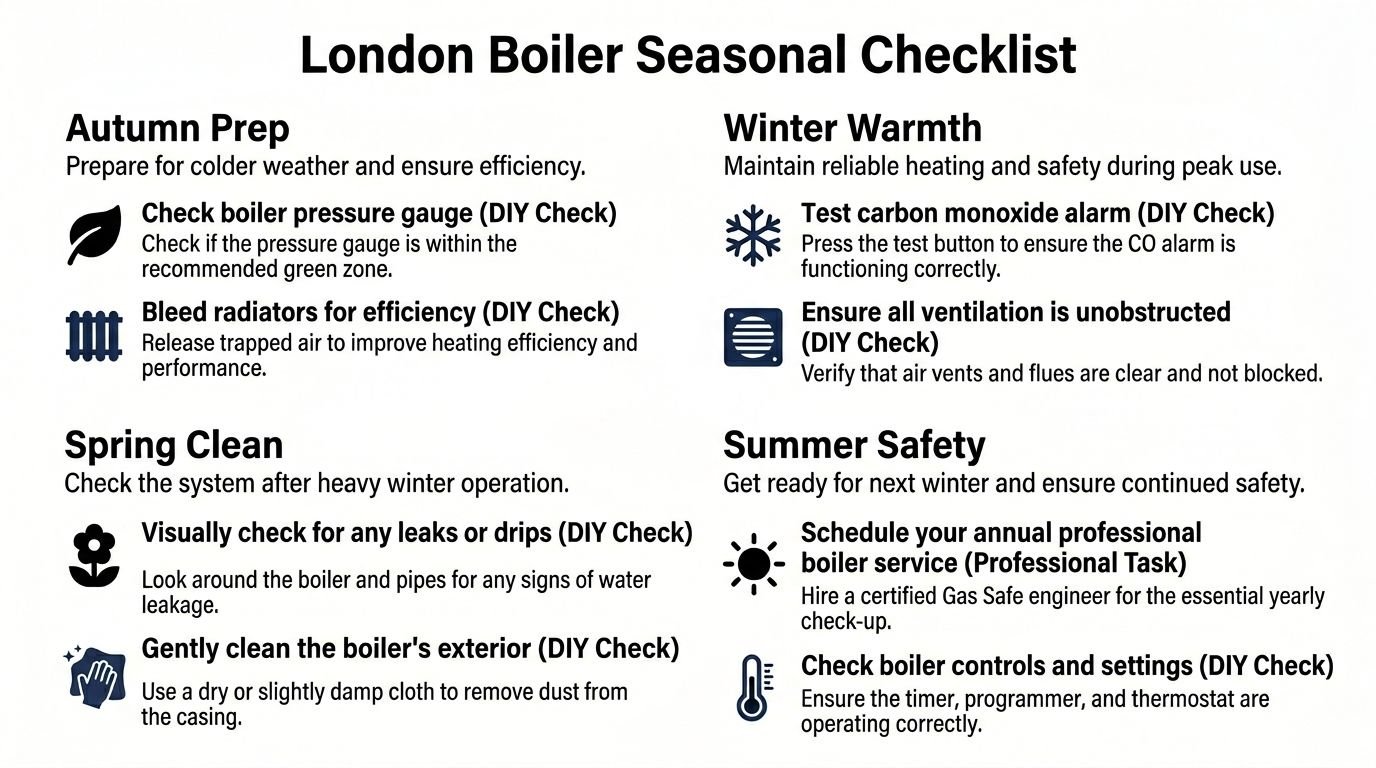
Autumn is when problems show up
Many engineers notice a rush of trouble when the weather turns. UK gas engineers anecdotally report higher emergency callouts in September to October, though the available search results do not quantify that pattern. The same source notes that turning on a boiler once or twice during the warmer months can help prevent difficult autumn start-ups after 4 to 6 months of summer dormancy, as described in this note on seasonal boiler dormancy.
That lines up with what happens in homes. A boiler that has sat still all summer may struggle when controls, pumps, valves, or ignition components are suddenly asked to work daily again.
What you can safely do yourself
Some checks are sensible for homeowners and landlords. They are visual, basic, and low risk.
- Check the pressure gauge: If pressure is obviously low or unstable, note it. Do not keep topping up repeatedly without asking why it dropped.
- Bleed radiators with cold spots: Air in the system reduces comfort and can make the boiler cycle poorly.
- Look for drips or staining: Check below the boiler, around valves, and along visible pipework.
- Test the carbon monoxide alarm: A dead battery or expired alarm gives false reassurance.
- Keep ventilation clear: Air bricks, boiler cupboard ventilation, and terminal areas should not be blocked by storage or debris.
- Run the boiler briefly in warmer months: This helps avoid the first-start struggle that shows up after dormancy.
What must stay off-limits
The line is simple. If it involves gas, combustion, sealed components, or internal boiler disassembly, leave it to a Gas Safe engineer.
Do not remove the case unless the appliance design and legal requirements allow for that in a way you are trained to handle. Do not try to tune combustion. Do not interfere with gas valves, burners, flues, or safety devices.
A practical year-round rhythm
Autumn prep
This is the best time to catch issues before heavy use starts.
Check the programmer, thermostat, and radiator response. If one room heats and another stays cold, do not assume the boiler is at fault. The issue may be balancing, air, a stuck valve, or sludge.
Winter watch
In winter, look for changes rather than perfection. A boiler under steady demand should behave consistently.
If pressure drops, noises develop, or hot water becomes erratic, log what is happening. Time of day, error code, and whether the heating or hot water was running all help an engineer diagnose the fault faster.
Spring review
Once heating demand eases, inspect the system while it is still fresh in your mind. Were some rooms slower to heat? Did any radiator stay partially cold? Was the boiler noisy after long runs?
Spring is a good time to deal with those issues before they become your first autumn emergency.
Summer planning
Summer provides the least disruptive time for professional servicing because losing the heating for a short appointment matters less. It is also when landlords can plan access more easily in some properties.
DIY checks are useful because they spot symptoms early. They are not a substitute for professional servicing.
Quick divide between DIY and engineer-only work
| Safe DIY check | Professional task |
|---|---|
| Pressure gauge observation | Combustion testing |
| Bleeding radiators | Internal boiler inspection |
| Visual leak checks | Burner and flue assessment |
| Testing CO alarm | Gas tightness and safety checks |
| Checking room controls | Fault diagnosis on gas components |
The most effective households do not try to do the engineer’s work. They do the simple observation well, then book skilled help before a minor issue turns into a no-heat callout.
Inside a Professional Boiler Service What to Expect
A proper boiler service is a working inspection, not a quick stamp for your records. In London, that matters for two reasons. Homeowners need confidence that the boiler is safe before winter load returns, and landlords need a service that stands up if a tenant reports faults or a safety question comes up later.

The visit starts with the installation, not the casing
Before opening the boiler, a competent engineer checks the wider picture. That includes the appliance condition, visible pipework, the flue route where it can be seen, signs of staining or past leaks, system pressure, and whether the boiler has been boxed in or surrounded by stored items that affect access and ventilation.
Then come the questions that save time and improve fault finding. Has the pressure been dropping? Has hot water gone hot and cold? Did the problem start after the heating came back on in autumn? In rented property, I also want to know whether the issue is repeat behaviour or a new complaint, because that affects whether we are looking at wear, water quality, controls, or tenant use.
For households comparing standards, a clear outline of what a professional boiler service includes helps set expectations before the appointment.
Safety checks and combustion testing
The part many people never see is often the part that matters most.
A service should include the safety checks appropriate to the appliance and installation, plus testing to confirm the boiler is burning gas properly. That can include gas tightness checks, flue integrity checks where accessible, and combustion analysis using calibrated equipment. A flame that looks steady can still be running poorly. You cannot judge combustion accurately by eye.
For landlords, this matters beyond good practice. If an engineer finds a safety concern, it needs to be recorded and handled properly. For homeowners, it is the difference between assuming the boiler is fine and knowing it has been tested.
Internal inspection, cleaning, and parts under strain
Once the case is off, the engineer inspects the components that do the work. The exact steps depend on the make, model, age, and manufacturer guidance, but the job commonly includes checking the burner, heat exchanger, seals, ignition components, condensate trap, and key safety devices.
Not every boiler needs intrusive cleaning at every annual visit. That is a trade-off. Some appliances benefit from a lighter annual inspection with targeted cleaning only where readings or condition justify it. Others, especially older units or boilers with a history of poor combustion, debris, or condensate contamination, need closer attention.
London water quality adds another layer. Hard water can leave scale on heat exchangers and stress hot water performance over time. In practice, that is why one boiler starts kettling, another struggles to keep hot water consistent, and a third keeps working but uses more gas than it should. A proper service will not reverse heavy scale damage, but it can spot the warning signs early enough to avoid a bigger repair.
Condensate and drainage checks
Condensing boilers depend on clean, free-flowing condensate routes. If the trap or pipework is partially blocked, the fault can look intermittent to the homeowner and completely predictable to an engineer, especially after cold snaps.
In London terraces and flats, condensate routing is not always ideal. Long external runs, awkward falls, and older alterations can all contribute to nuisance lockouts. A careful service checks those wet-side components where the boiler history points in that direction.
A useful visual walkthrough sits below.
The service should end with a clear outcome
You should be left with a definite position on the boiler’s condition. Safe and working well. Safe, but follow-up work advised. Or unsafe, with action required.
Good advice is specific. Pressure is drifting. Expansion vessel charge needs checking. Signs of scale stress are present. Combustion readings are outside the manufacturer’s target. Access around the flue needs improving. In a landlord setting, that clarity matters because vague notes do not help if the tenant loses heating two weeks later.
The best service gives you more than a certificate or invoice. It gives you a realistic view of risk, likely costs, and what to sort now before winter or tenancy pressure turns a manageable issue into an urgent callout.
Warning Signs Your Boiler Needs Attention
Boilers tend to give warnings before they stop altogether. The skill is knowing which signs are inconvenient and which are unsafe.
Noises that mean more than age
A boiler that was quiet and is now banging, kettling, gurgling, or whistling is telling you something.
Kettling suggests heat transfer trouble inside the boiler, commonly from scale buildup on the heat exchanger. Gurgling can suggest trapped air or circulation issues. Whistling may relate to airflow or restrictions. The noise itself is not the diagnosis. It is the symptom.
If the sound is sudden, repeated, or tied to heating demand, it needs investigation rather than guesswork.
Smells and air problems
Not every smell means gas, but any unusual smell around a boiler deserves caution. Gas Safe audits reveal that 20% of domestic boiler faults stem from blocked flue vents or inadequate combustion air, according to this technical summary on common domestic faults."
That is why blocked vents, enclosed cupboards packed with storage, and poor airflow around the appliance are not small housekeeping matters. They affect combustion conditions.
If you suspect a carbon monoxide risk, stop using the appliance and seek urgent professional help. This guidance on boiler carbon monoxide risks is worth keeping bookmarked.
Leaks are never just cosmetic
A drip from beneath the boiler may come from seals, valves, pressure-related issues, corrosion, or a failing component. The danger is not only water damage. Repeated leaks tend to change system pressure, affect reliability, and can damage surrounding parts.
In hard water areas like Greenwich and Lewisham, waterside scaling can significantly increase corrosion rates, and a notable percentage of older combi boilers without inhibitor treatments may develop pinhole leaks. That is not a reason to panic over every drip. It is a reason not to ignore one.
Signs that need same-day attention
Use common sense, but treat these as urgent:
- Persistent unusual smell: Especially if linked to operation.
- Repeated lockouts: One reset may be reasonable. A pattern is not.
- Visible water from the casing or fittings: Water and electrical parts do not mix well.
- Sooting, scorching, or staining near the appliance or flue: That can point to combustion problems.
- A vent or flue terminal that looks blocked or damaged: Do not keep running the boiler and hope for the best.
Signs that can wait briefly, not indefinitely
Some issues are less dramatic but still worth booking in.
| Symptom | Likely concern |
|---|---|
| One or two radiators slow to heat | Air, balancing issue, sludge |
| Pressure needs topping up now and then | Minor leak or expansion issue |
| Hot water temperature fluctuates | Sensor, plate exchanger, scale, flow issue |
| Boiler runs louder than usual | Early internal wear or scale stress |
A homeowner does not need to diagnose the exact fault. The useful job is to notice the symptom early and report it accurately.
Payback: Lower Bills and a Longer Lifespan
A London boiler usually fails at the worst moment. It is cold, parts are delayed, the tenant is calling, or you are trying to sort access around work and school. Regular maintenance cuts the odds of that expensive timing.

Lower costs usually start with avoided repairs
The first financial return is simple. A serviced boiler is less likely to need an emergency visit in January, when demand is high and decisions are rushed.
For homeowners, that often means avoiding callout charges, temporary heaters, and the pressure of replacing a boiler before you have compared options properly. For landlords, the cost is wider than the repair itself. There is the engineer visit, the coordination with tenants, the risk of complaint, and in some cases the legal and management pressure that comes with a loss of heating or hot water.
That matters more in London than many owners expect. Access can be awkward, parking can add time, and older flats often hide pipework and flue routes that turn a small fault into a longer job.
Servicing helps hold onto efficiency
The savings on fuel are real, but they are not magic and they are not identical in every property.
What annual maintenance does well is preserve performance. A clean burner, correct combustion, steady system pressure, sound seals, and proper water quality all help the boiler run as designed. If the system is already scaled, sludged, badly balanced, or paired with poor controls, the service may identify the issue, but the primary saving comes after that underlying problem is corrected.
In London, hard water is a practical issue, not a theory. Limescale on heat exchangers and hot water components makes the boiler work harder, especially in combi systems. That shows up as longer run times, noisier operation, and higher gas use over time.
Longer boiler life comes from controlling wear
Boilers do not last because someone hopes they will. They last because the common causes of premature wear are dealt with before they spread through the system.
The usual drivers are familiar on service visits:
- Scale build-up in hard water areas
- Dirty system water or low inhibitor levels
- Recurring pressure loss
- Short cycling caused by control or flow issues
- Minor leaks left unresolved
- Poor combustion setup or blocked condensate and flue components
A single issue may not justify replacement. Two or three at once often do. That is why regular servicing has a financial value beyond the annual fee. It helps keep a repairable boiler repairable.
The return is different for homeowners and landlords
Homeowners usually care most about fuel spend, reliability, and delaying replacement by a few useful years.
Landlords have another layer to consider. A documented service record supports compliance, helps show that the heating system has been looked after properly, and reduces the chance of reactive work landing in the middle of a tenancy problem. In practical terms, planned maintenance is usually cheaper than repeated urgent attendance across a portfolio.
A cared-for heating system is easier to trust
Buyers, tenants, and managing agents notice the condition of the heating. They may not know the boiler model, but they understand the difference between a system that has been maintained and one that has been ignored.
Service history, stable operation, and prompt minor repairs protect the value of the appliance and reduce the chance that the next spend is a full replacement rather than a manageable fix. In a London property, where labour, access, and disruption all cost more than they should, that is a worthwhile return.
Securing Peace of Mind with Urbanic Services
Choosing the right engineer matters as much as choosing the right maintenance plan. Homeowners and landlords in London tend to want the same things. Clear pricing, proper qualifications, reliable attendance, and someone who understands the specific considerations of London properties rather than applying generic advice.
What to check before you hire anyone
The basics are essential.
- Gas Safe registration: Verify it every time, not once years ago.
- Insurance and local trading presence: You want a firm that can stand behind its work.
- Clear scope of work: Ask what the service includes, not just what it costs.
- Good communication: The engineer should explain findings in plain English.
- Experience with your setup: A combi in a compact flat, a system boiler in a family house, and a landlord portfolio all create different service demands.
The cheapest booking tends to be the least useful if the engineer rushes, skips explanation, or leaves you with vague advice and no confidence.
Why care plans suit many London properties
A one-off annual service is still important, but care plans solve a different problem. They turn boiler maintenance from a diary task into an ongoing managed arrangement.
That serves London households effectively because failures seldom happen at convenient times. Landlords benefit too because predictable cover is easier to budget for than scattered reactive spend across the year.
A sensible care plan can include:
- annual servicing
- heating controls checks
- coverage for leaks and heating components
- support for internal or external drains
- optional electrical cover where appropriate
That kind of structure helps when faults sit between trades. A boiler issue may involve controls, pressure loss, pipework, drainage, or a heating-side defect rather than one dramatic component failure.
Why Urbanic Services is a practical fit
Urbanic Services Ltd is a London-based plumbing and heating company focused on home heating, boiler servicing, repairs, energy-efficient upgrades, and ongoing care for residential properties across the capital.
For homeowners, that means access to Gas Safe registered support from a firm that already works in the conditions London boilers face, including hard water areas, older housing stock, and properties where space, access, and tenancy coordination can complicate routine maintenance.
For landlords and agents, the monthly Boiler Care Plans are useful because they bundle the routine annual service with broader coverage around heating controls, gas pipe and plumbing leaks, drains, and selected electrical support depending on the level chosen. That makes budgeting easier and reduces the scramble when several smaller issues appear at once.
The practical appeal is straightforward. You get planned maintenance, clearer cost control, and a faster route to help when the boiler, the heating system, or connected pipework starts causing trouble.
If you want a reliable route to safer, simpler boiler maintenance in London, contact Urbanic Services Ltd for a quote, a service booking, or details on the right Boiler Care Plan for your property.