
Picking the right smart thermostat isn't just about fancy gadgets; it's about making a real dent in your energy bills and finally getting your home's temperature just right. In the UK, it’s a crowded market, but a few names always come up in conversation: Google Nest, Hive, and Tado. They’ve become the go-to choices for a reason.
Your Guide to the Best Smart Thermostats in the UK
This guide is designed to cut through the marketing fluff for 2026. We’re going to look at what these devices actually do for a typical UK home, comparing them on the things that matter—compatibility with our varied heating systems, genuine energy savings, and how easy they are to live with day-to-day. My goal is to give you the clarity you need to choose the right thermostat for your home, your budget, and your lifestyle.

Why Bother With a Smart Thermostat?
With energy prices always on our minds, a smart thermostat has shifted from a "nice-to-have" to a genuinely smart investment. It’s not just a fancy timer. These devices learn from you, adapt to your routine, and give you control you've never had before.
It boils down to a few key advantages:
- Real Savings: By learning when you're home or away (geofencing) and optimising your heating schedule, these devices can genuinely cut heating costs by 20-30%. That’s a significant saving, year after year.
- Total Control & Comfort: Ever left the heating on by mistake? Or come home to a freezing house? A quick tap on your phone or a word to your smart speaker solves that, making sure your home is always comfortable without wasting a penny.
- Know Your Usage: Most smart systems provide simple, clear reports on your energy use. This helps you spot where the money is going and find even more ways to be efficient.
A critical bit of news for UK buyers: Google has announced it will stop software support for its 1st and 2nd generation Nest thermostats from October 2025. They've also confirmed they won't be launching new Nest models in Europe. This makes it vital to choose a device from a brand that’s clearly committed to the UK market for the long haul.
To help you get straight to the point, here are our quick picks for 2026. This table matches the best devices to specific needs, so you can see at a glance which one might be the right fit for you.
Quick Picks: Best UK Smart Thermostats for 2026
| Best For | Top Recommendation | Key Differentiator |
|---|---|---|
| Effortless Automation | Google Nest Learning Thermostat (3rd Gen) | Automatically learns your routine and creates its own schedule. |
| British Gas Customers & Simplicity | Hive Active Heating 2 | Integrates seamlessly with British Gas and offers a very user-friendly app. |
| Advanced Geofencing & Boiler Control | Tado V3+ Smart Thermostat | Offers precise location-based control and advanced OpenTherm modulation. |
| Rental Properties & Budget | Drayton Wiser Thermostat Kit | Cost-effective, easy to install, and provides excellent zonal control options. |
Each of these thermostats excels in different areas. Your choice really depends on what you value most—whether it's set-and-forget automation, deep integration with your energy supplier, or granular control over every room.
Why a Smart Thermostat is an Essential Upgrade for 2026
Let's be clear: a smart thermostat is no longer just a gadget for the tech-obsessed. For any UK homeowner looking to get a grip on fluctuating energy bills, it's become a fundamental piece of kit. The reason is simple – they are packed with clever features that make traditional, wall-mounted dials look ancient.
Take algorithmic learning, for instance. Your thermostat quietly learns your family's daily routine and builds a heating schedule around you, all by itself. Then there's geofencing. This feature uses your smartphone's location to automatically turn the heating down when the last person leaves and fire it up again just in time for the first person's return. No more heating an empty house – one of the single biggest energy-wasters.
The Real-World Savings and Environmental Impact
The true power of a good smart thermostat comes from the data it gives you. The companion apps provide easy-to-read energy reports, showing you exactly where your money is going. This kind of insight is invaluable. It empowers you to spot inefficiencies and make small tweaks to your habits that can add up to big savings.
And the numbers back this up. The UK's smart thermostat market isn't just growing; it's exploding. It generated USD 214.5 million in 2026 and is on track to more than double to USD 542.1 million by 2030. That's a huge compound annual growth rate of 17.4%. It's no surprise that Wi-Fi models are the most popular, accounting for over 75% of the market thanks to how easily they connect to your home network. Grand View Research has tracked this trend, highlighting just how mainstream this technology has become.
Installing a smart thermostat isn't just a financial decision; it's a significant step towards a more sustainable, low-carbon household. By optimising energy use, these devices directly reduce your home's carbon footprint, aligning with the UK's broader environmental goals.
Think of it as a savvy investment that pays you back over time, not just in lower bills but in a far more comfortable and responsive home.
Built for the Realities of UK Homes
A common worry we hear, especially from those in older properties, is compatibility. Britain's housing is a unique mix, from modern flats to draughty Victorian terraces with plumbing that’s seen a few things. Will a smart thermostat even work with my system?
The answer is almost certainly yes. Today's leading models are specifically designed to handle the diversity of UK heating systems. They are surprisingly flexible and can be retrofitted to most setups:
- Combi Boilers: As the most common boiler in the UK, nearly every smart thermostat on the market supports them out of the box.
- System and Regular Boilers: If you have a separate hot water tank, brands like Hive, Tado, and Nest have you covered with specific kits.
- Heat Pumps: With renewable heating on the rise, modern thermostats are built to integrate with these systems. You can read more about our approach to integrating smart controls with modern heat pump solutions.
This adaptability means that no matter the age of your home, you can start taking advantage of smarter heating. Installation is often more straightforward than people think, making it one of the most accessible and impactful upgrades you can make.
Nest vs Hive vs Tado: A Head-to-Head Comparison
When you start looking for a smart thermostat in the UK, you’ll quickly find the conversation dominated by three big names: Google Nest, Hive, and Tado. They all promise to trim your energy bills and make your home more comfortable, but how they get there is fundamentally different. Let's move past the marketing hype and analyse how each one stacks up in a real UK home.
We’re going to dig into their core philosophies. Is it Nest's clever automation, Hive's friendly simplicity, or Tado's pinpoint precision that will work best for you? The answer depends entirely on your lifestyle, your home's heating system, and how hands-on you want to be.
The Core Philosophy: What Drives Each System
Getting to grips with the thinking behind each brand is the first step. Each one is built for a different kind of person.
Google Nest Learning Thermostat is really for the homeowner who wants to "set it and forget it." Its whole identity is built around a powerful learning algorithm. For the first week or so, you just turn the heating up and down as you normally would. Behind the scenes, Nest is watching, learning your habits, and building a schedule for you.
Hive Active Heating, which originally came from British Gas, is all about making smart control simple and familiar. It doesn't try to be cleverer than you; instead, it gives you a brilliantly straightforward app for scheduling and boosting your heat. It’s a perfect fit if you want smart features without a headache.
Tado V3+ is for the person who craves granular control and maximum efficiency. Its standout features are its incredibly accurate geofencing and its ability to "talk" to modern boilers using OpenTherm. This one really appeals to tech enthusiasts and anyone determined to squeeze every last drop of performance from their heating system.
Each thermostat offers a distinct experience. Nest wants to automate your life, Hive wants to simplify it, and Tado gives you the tools to perfect it. Figuring out which of these approaches you prefer is the most important part of your decision.
Learning and Automation: A Tale of Two Logics
The "smart" part of a smart thermostat is all about automation, but Nest and Tado have very different ideas about how to achieve it.
Nest's method is what you’d call passive learning. It watches your manual adjustments and uses its own sensors (plus your phone's location) to figure out when you're home or away. From this, it builds and refines a schedule, aiming to get so good you never have to touch the dial. This works wonderfully for households with a predictable, daily routine.
Tado, on the other hand, is all about active geofencing. It doesn't guess your schedule for the week ahead; it reacts in real-time based on where the family's smartphones are. As soon as the last person leaves, the heating drops to an eco-setting. When the first person starts heading home, Tado calculates how long it will take to warm the house and fires up the boiler just in time. This is far better for people with erratic schedules, like shift workers or freelancers.
Hive takes a middle-of-the-road approach. It has basic geofencing—it'll send you a phone notification if you’ve left the heating on after going out—but it leaves the main scheduling up to you. It puts you firmly in control.
This infographic can help you visualise that initial thought process.
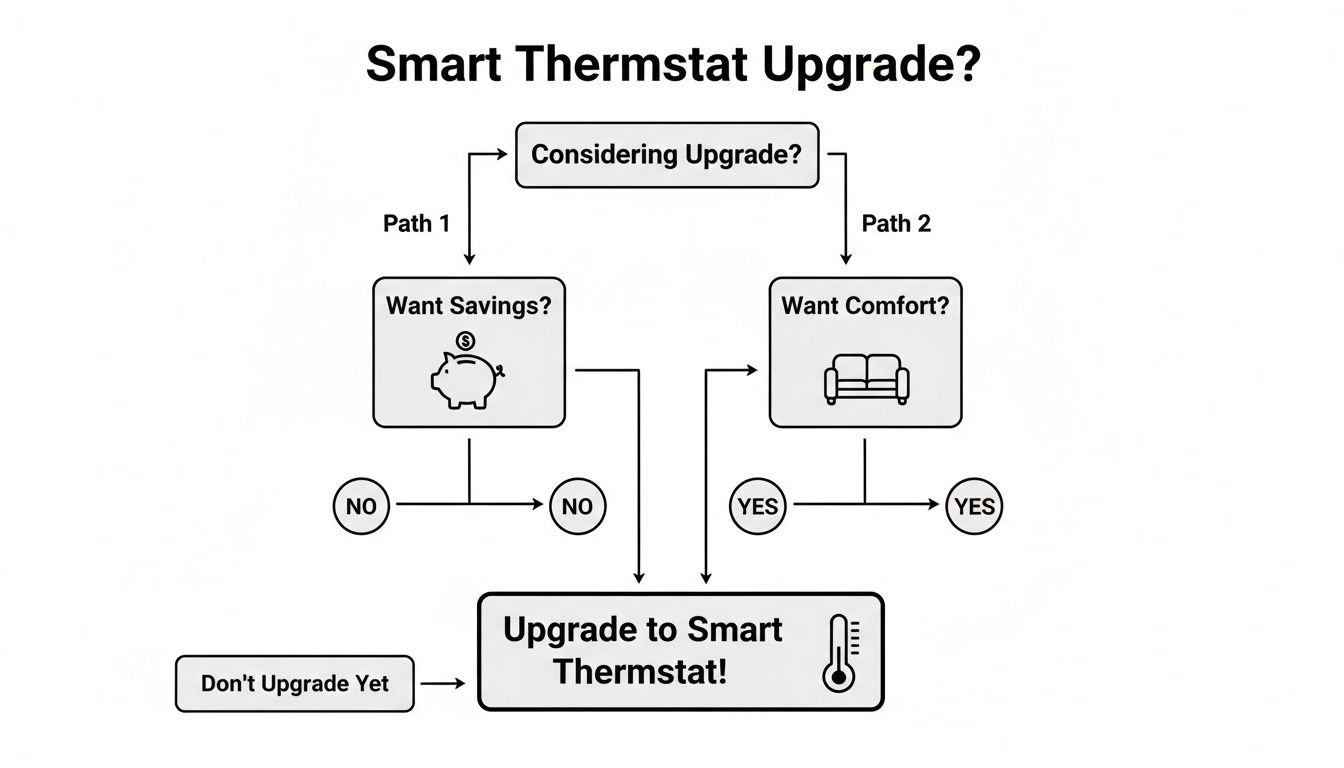
As the flowchart shows, whether you’re driven by cutting costs or just being more comfortable, a smart thermostat is a logical upgrade for most modern homes.
UK Boiler Compatibility and Advanced Control
This is where things can get a bit technical, but it’s crucial for UK homes. While all three thermostats work with the vast majority of UK boilers, Tado has a clear advantage if you have a modern system.
Tado offers full support for OpenTherm, which is a digital language many new condensing boilers use. Instead of just barking "on" or "off" commands, an OpenTherm thermostat can ask the boiler to run at a lower power for longer. This "modulation" is much more efficient than the old stop-start cycle, leading to real gas savings and less wear on your boiler.
Both Nest and Hive can work with OpenTherm systems, but their integration isn't as polished or as widely supported across different boiler manufacturers as Tado's is. If you have a recent combi or system boiler that supports OpenTherm, Tado makes the strongest case for wringing every bit of efficiency out of it.
Here’s how they manage different setups in practice:
- Combi Boilers: All three are a perfect match. Tado just gets an extra nod if your combi has OpenTherm.
- System/Regular Boilers (with a hot water tank): All three have kits that let you control your heating and hot water schedules separately right from the app.
- Multi-zone Systems: If you want to set different temperatures for different rooms, all three brands offer smart radiator valves (TRVs). Tado is often praised here for its robust multi-room controls and app design, which makes managing lots of zones feel effortless.
Subscriptions and Ongoing Costs
The price on the box isn't the whole story. You need to think about what, if anything, you'll be paying down the line.
Historically, Hive and Nest give you their main smart features for free once you've bought the hardware. The energy-saving stuff, like scheduling and learning, is all included. Hive does have an optional subscription called Hive Heating Plus, which adds things like budget tracking and an extended warranty.
Tado operates differently. To unlock its best automation feature—the geofencing-powered "Auto-Assist" skill—you need a monthly or annual subscription. Without it, Tado will just send you a notification reminding you to turn the heating off when you leave; it won't actually do it for you. This has been a sore point for some, who feel that such a key feature should be included in the purchase price.
The Verdict on Subscriptions:
If you're dead set against subscriptions, your choice is simple: go for Nest or Hive. But if you see the small monthly cost for Tado's Auto-Assist as a fair price for total automation and potentially greater savings, then it’s still a top-tier option. It really comes down to personal preference and how you value that hands-off service.
Will a Smart Thermostat Work with My Heating System?
One of the first questions we get from UK homeowners is a simple one: "Is this thing even compatible with my boiler?" Before you can start fine-tuning schedules and watching your energy bills drop, you need to be sure your shiny new thermostat can actually talk to your heating system.
The good news is that most smart thermostats are built for the sheer variety of heating setups found in UK homes.
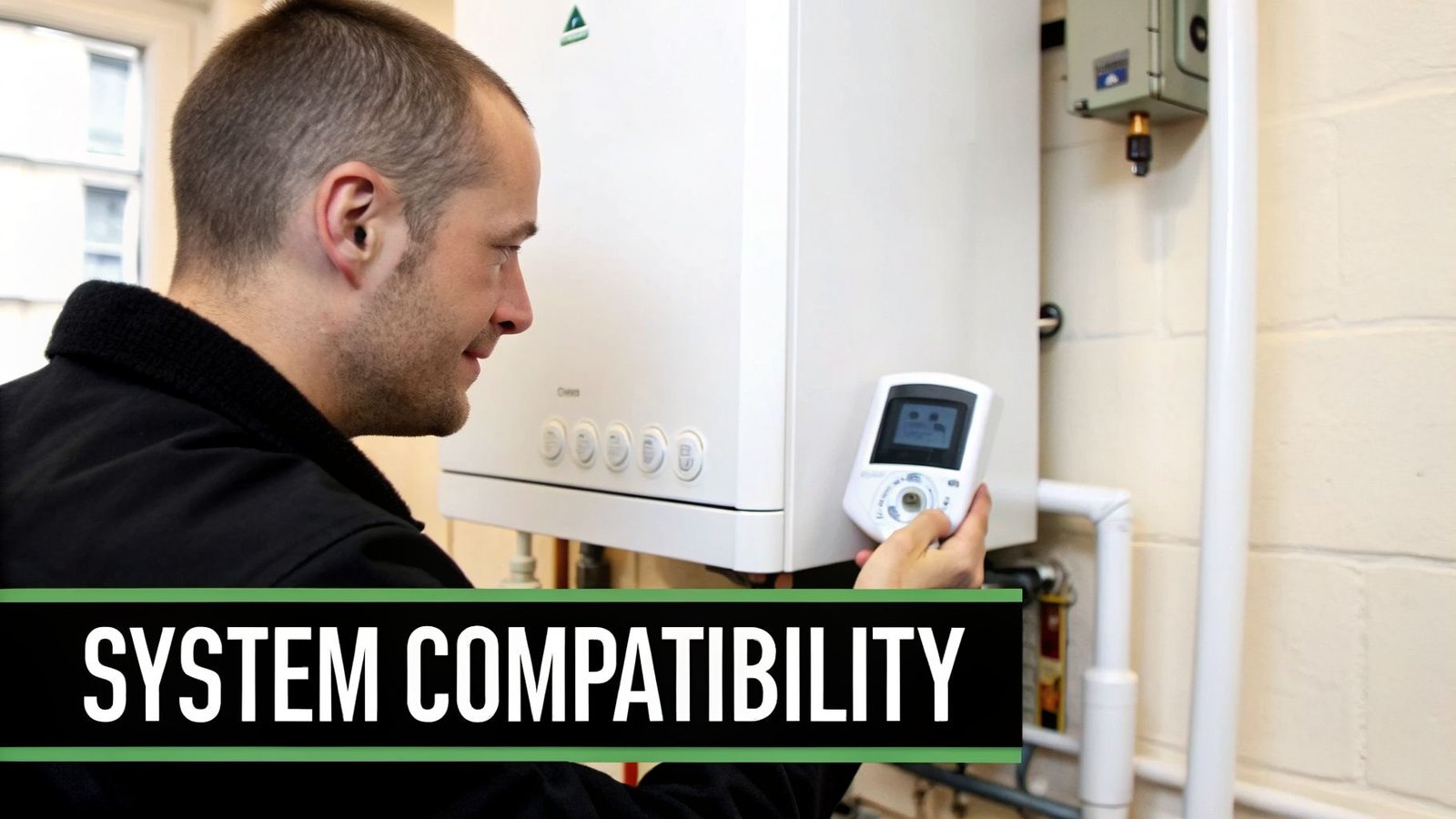
From new builds with cutting-edge heat pumps to Victorian terraces with plumbing that’s seen a thing or two, our housing stock is a real mix. Understanding what you’re working with is the key to getting this right from the start.
Combi Boilers: The UK Standard
Combi (combination) boilers are the go-to for most UK homes today. They deliver both central heating and instant hot water from a single unit, which means they don't need a separate water tank. This simple setup makes them a perfect match for a smart thermostat.
Pretty much every smart thermostat on the market—Nest, Hive, Tado, you name it—works seamlessly with combi boilers. The installation usually involves fitting a small receiver box near your boiler. This box 'talks' to the main thermostat wirelessly, replacing the basic on/off function of your old stat with far more intelligent control.
System and Regular Boilers (With a Hot Water Tank)
If you have a hot water cylinder tucked away in an airing cupboard, you've got either a system or a regular (also called conventional) boiler. For these, you need a smart thermostat kit that can handle both your heating and your hot water.
Most of the big brands offer exactly this. Hive’s ‘Active Heating and Hot Water’ kit or the Tado ‘Smart Thermostat V3+ with Extension Kit’ are designed for this two-part job. Their apps let you create separate schedules, so you're only heating the water tank when you actually need it—unlocking another great way to save money. If you're not sure, you can determine what type of boiler you have with our guide.
For homes with older system or regular boilers, checking for hot water control is non-negotiable. You must choose a smart thermostat that can manage a separate hot water circuit. Without it, you’ll just be wasting energy by constantly heating a tank of water you don’t need.
Heat Pumps and the Magic of OpenTherm Modulation
As the UK shifts to greener energy, air source heat pumps are popping up everywhere. These systems work very differently from boilers, and a simple on/off thermostat just won't cut it—in fact, it can make the heat pump run inefficiently.
This is where a technology called OpenTherm comes in. Think of it as a smart language that lets the thermostat and the heat pump (or modern boiler) have a proper conversation. Instead of just yelling "ON!" or "OFF!", an OpenTherm thermostat can ask the system to run at a lower, steady output. This gentle, continuous operation is far more efficient than the old stop-start cycle.
While most new boilers and heat pumps support OpenTherm, not all smart thermostats use it to its full potential. Tado, for instance, has a strong reputation for its excellent OpenTherm integration, making it a top choice if you want to get the absolute best performance out of your modern heating system.
The UK's appetite for this tech is growing fast, with the nation accounting for 9% of the entire European thermostat market. This boom is led by homeowners, with residential use making up 48% of the global share. The ease of retrofitting smart controls in older housing stock, like the many Victorian homes in areas like Greenwich, has played a huge part in this uptake. You can read more on the global thermostat market on Fortune Business Insights.
Choosing Between DIY and Professional Installation
You’ve picked out the perfect smart thermostat. Now for the crucial next step: getting it installed. Should you roll up your sleeves and do it yourself, or is it better to call in a professional? While many brands market their thermostats as simple DIY projects, the reality, especially with the unique quirks of UK heating systems, can be a different story.
The appeal of a DIY installation is understandable. If you’re comfortable with basic wiring and know your way around a toolbox, the job might seem straightforward. It usually involves turning off the mains power, carefully removing your old thermostat, and connecting the new smart receiver to your boiler. Most manufacturers provide decent instructions and video tutorials to guide you.
But it’s a path that comes with its own set of risks. The wiring inside UK homes, particularly older ones, isn't always standard or predictable. A simple slip-up, like mixing up the live and neutral wires, won’t just stop your shiny new thermostat from working—it could fry your boiler's circuit board. That’s a very expensive mistake to make.
When DIY Makes Sense
For the right person with the right setup, a DIY installation is perfectly achievable and saves you the cost of a professional call-out. You’re likely a good candidate to tackle this yourself if:
- You have a genuine understanding of home electrics. You’re confident in telling a live wire from a switched live and know how to use a multimeter safely.
- Your heating system is a modern, straightforward combi boiler with simple thermostat wiring already in place.
- The manufacturer’s instructions are crystal clear, UK-specific, and match your system perfectly.
For a DIY job, you’ll absolutely need these tools:
- A set of screwdrivers (both flat-head and Phillips).
- A reliable voltage tester to be 100% certain the power is off.
- Wire strippers to prepare the connections neatly.
Why Calling a Professional Is Often the Wiser Choice
For most homeowners, we find that hiring a professional is the smarter, safer bet. Yes, there's an upfront cost for labour, but what you’re really paying for is peace of mind and the guarantee that your system will perform correctly from the get-go.
A Gas Safe registered engineer knows exactly what they’re doing. They work with the huge variety of UK boiler types every single day, from standard combis to complex systems with separate hot water cylinders. This expertise is vital—not just for a safe installation, but for configuring the thermostat to achieve the maximum possible energy savings. Our expert team provides professional smart thermostat installation services across London, ensuring your system is optimised from day one.
"The most common DIY mistake we see is miswiring the receiver to a combi boiler. Homeowners often mix up the permanent live and switched live connections, which can either leave the heating permanently on or, worse, short out the boiler's main control panel. A professional gets it right first time, every time." – An Urbanic Services Heating Engineer
Ultimately, think of a professional installation as an investment. It’s an investment in your home’s safety, the longevity of your heating system, and in unlocking every bit of the energy-saving potential your new smart thermostat promises. It simply takes the guesswork out of the equation.
Your Smart Thermostat Questions Answered
When you're looking at the best smart thermostats on the UK market, it’s only natural to have a few questions. Making the right choice for your home and budget comes down to getting clear, practical answers. We’ve pulled together the most common queries we hear from homeowners to help you understand what this technology really means for you.
Can a Smart Thermostat Genuinely Reduce My Energy Bills?
Yes, they really do work. While the exact figure will always depend on things like your home’s insulation and your family's habits, industry data points to realistic savings of 20-30% on heating costs. These aren't just clever marketing claims; the savings come from specific, intelligent features that stop you from wasting energy.
Take geofencing, for instance. It ensures you never heat an empty house again by automatically turning the temperature down when everyone's out. Then you have the learning algorithms, which build optimised schedules to avoid those inefficient stop-start cycles, using only the precise amount of energy needed to keep you comfortable.
Is My Older Boiler Compatible with a New Smart Thermostat?
More often than not, the answer is yes. Most smart thermostats are designed to be retrofitted to a huge range of UK heating systems, including the older gas boilers many of us still have. Compatibility typically boils down to the boiler's wiring, and most have a simple on/off connection that a smart thermostat can easily manage.
That said, it’s worth thinking about the bigger picture. If your boiler is over a decade old and not very efficient, adding a smart thermostat is a fantastic first step, but the boiler itself will always be the weak link. For the biggest possible savings, you might find upgrading the boiler is the smarter long-term investment.
A smart thermostat can only be as efficient as the heating system it controls. For an older, G-rated boiler, you'll see savings, but they'll be capped compared to what's possible when you pair a smart device with a modern, A-rated condensing boiler.
What Is the Real Difference Between Geofencing and Learning?
These are two of the most powerful features, but they deliver savings in completely different ways and suit very different lifestyles. Think of it as active control versus passive automation.
Geofencing: This is all about reacting in real time. The thermostat uses your phone's location, turning the heating down when the last person leaves and firing it up again as the first person heads home. It’s perfect for busy households with unpredictable schedules where a fixed routine just doesn't work.
Learning: This is about building a routine for you. A thermostat like the Google Nest Learning Thermostat watches how you manually adjust the temperature for the first week or two. From this, it creates a predictive heating schedule that mirrors your habits. It’s ideal for people who have a fairly consistent daily rhythm.
Ultimately, geofencing adapts to your life as it happens, while learning automates a pattern you've already established. The best choice for you depends entirely on how you live.
Ready to make your home smarter and more efficient? The expert team at Urbanic Services Ltd specialises in professional smart thermostat installation across London, ensuring your system is perfectly optimised for maximum savings. Get a fast, fixed-price quote today.