
Staring at that white box on the wall and thinking, "What type of boiler do I actually have?" Don't worry, you're not alone. It's a common question, but figuring it out is usually simpler than you’d expect.
Most of the time, you can identify your boiler just by taking a quick look around your home. The biggest clues are whether you have a hot water cylinder (that big tank, usually in an airing cupboard) or any water tanks tucked away in the loft. These tell-tale signs will quickly point you toward having a combi, system, or regular boiler.
Your Quick Boiler Identification Checklist
Before we get bogged down in pipework and data plates, let's start with a simple visual check. A quick walk around your property is often all you need to get a solid idea of your heating system's setup.
This handy flowchart is a great starting point. It walks you through the key questions about water tanks and cylinders to help you get an answer in seconds.
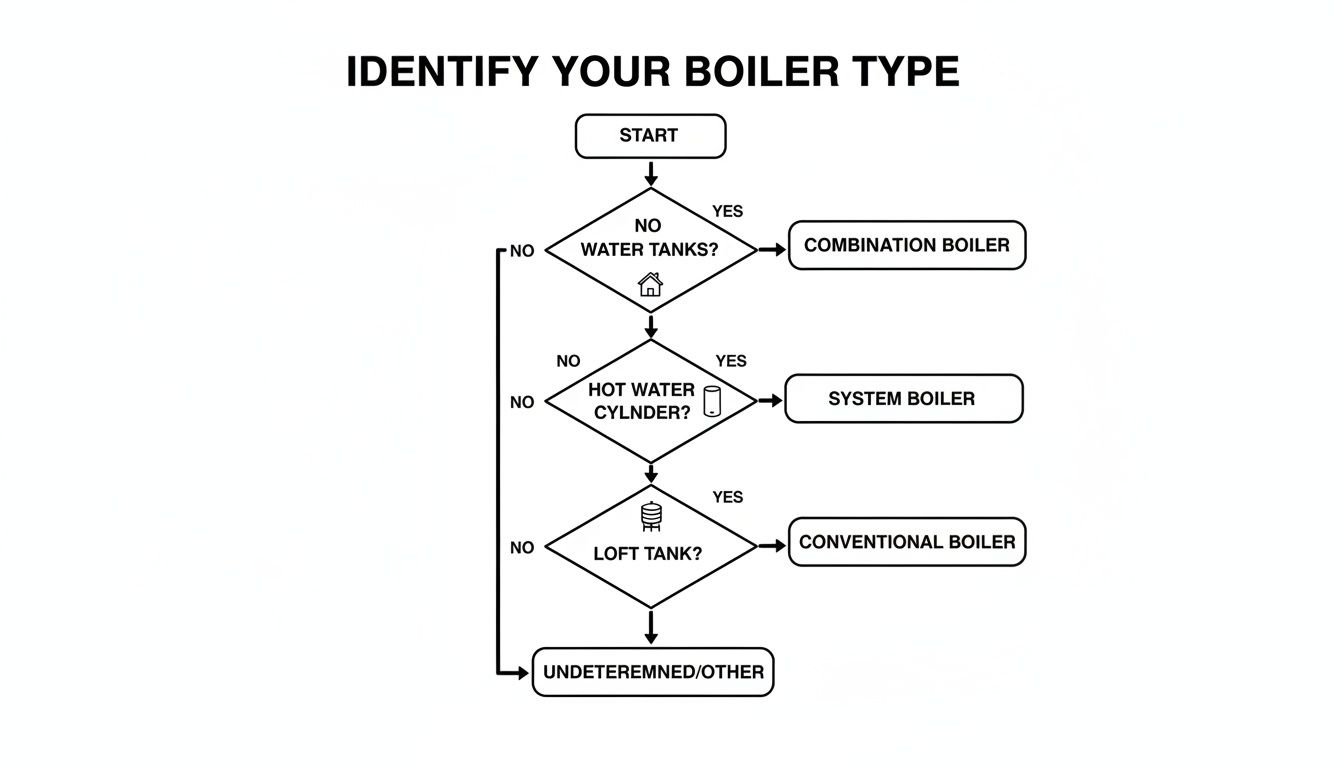
As you can see, the complete absence of any water storage tanks is the dead giveaway for a combi boiler. Let's break down those differences a bit more clearly.
At a Glance Boiler Identification Key
To make things even simpler, here’s a quick comparison table. It lines up the main features of the three boiler types found in most UK homes, so you can see exactly what to look for.
| Feature | Combi Boiler | System Boiler | Regular (Conventional) Boiler |
|---|---|---|---|
| Hot Water Production | Instant, on-demand | Stored in a cylinder | Stored in a cylinder |
| Water Tanks | None | None | Feed and expansion tank in loft |
| Hot Water Cylinder | No | Yes (usually in an airing cupboard) | Yes (usually in an airing cupboard) |
| Space Requirement | Minimal (a single wall-hung unit) | Moderate (boiler + cylinder) | High (boiler + cylinder + loft tanks) |
| Best Suited For | Smaller homes, flats | Homes with multiple bathrooms | Older, larger properties |
A combi boiler setup is by far the most common these days. If your boiler is a single unit on the wall with no separate hot water cylinder hogging the airing cupboard, it’s almost certainly a combi.
With 78% of UK homes running on gas central heating, many properties, particularly in places like London, have combi boilers from well-known brands like Worcester Bosch or Vaillant. It's worth remembering, though, that many models installed before 2005 don't have modern condensing technology, making them far less efficient. You can always check the latest UK boiler statistics to see how things are changing across the country.
Alright, while checking for tanks and cylinders gives you a pretty good idea of your setup, the one foolproof way to know exactly what you're working with is to find the boiler's data plate. Think of it as the boiler's birth certificate. It’s a simple sticker or small metal plate that holds all the vital statistics, and it’s the very first thing any Gas Safe engineer will look for when they visit.
Every single boiler has one, but manufacturers can be surprisingly creative about where they hide them. Finding it is usually just a matter of knowing their favourite spots.
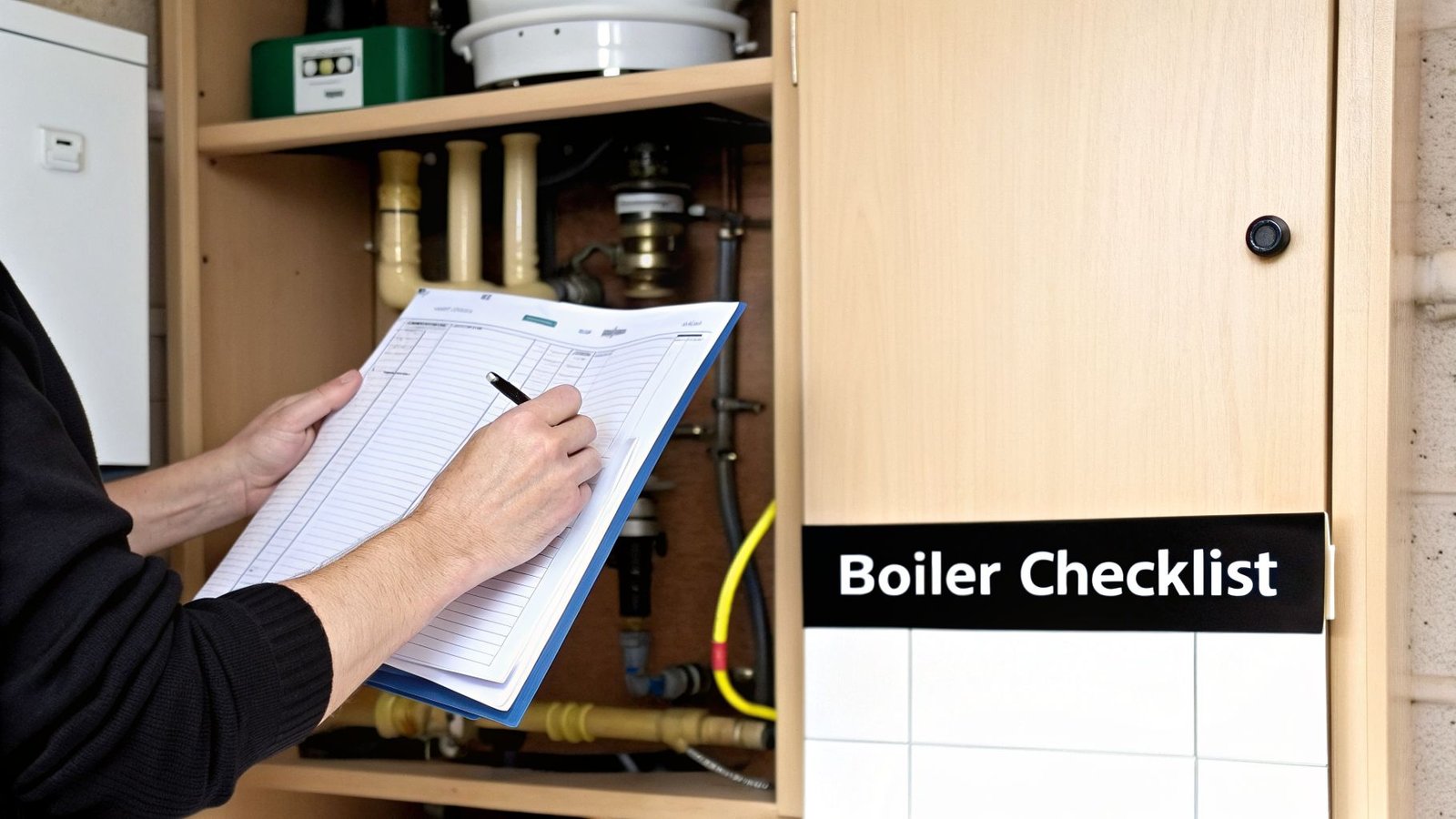
Where to Look for the Data Plate
Your first port of call should always be a quick scan of the boiler's outer casing. Some brands, like Ideal, are often kind enough to put the sticker right on the top or side, where it’s easy to see.
If you don’t spot it there, the next place to check is underneath the unit. You'll likely need to get on your hands and knees and use your phone's torch to have a good look. This is a particularly common spot for brands like Worcester Bosch.
Still no luck? The final hiding spot is usually behind the drop-down front panel. Most modern boilers have a flap covering the controls and pressure gauge. Gently pull this down towards you, and you’ll often find the data plate stuck to the inside of the panel or on the chassis behind it. For some older boilers, you might need to remove the main front casing, but only attempt this if you're confident and it can be done easily without any tools.
A Quick Tip from Experience: Before you start crawling around in a dark cupboard, have your phone ready. As soon as you find the plate, take a clear photo of it. It saves you from squinting at tiny text and gives you a digital copy you can easily pull up later.
Making Sense of the Information
Once you've found the plate, you’ll be faced with a block of text and numbers that can look a bit technical. Don't worry, it's actually quite simple to decipher. The two most important pieces of information you need are the manufacturer and the model name.
The model name is the jackpot. It often tells you everything you need to know right away. Just look for keywords in the name itself:
- Worcester Bosch Greenstar 30i Combi: The word "Combi" is a dead giveaway—it's a combination boiler.
- Vaillant ecoTEC plus System: The word "System" confirms it’s a system boiler.
- Ideal Logic+ Heat: Terms like "Heat" or "Heat Only" are just other names for a regular (or conventional) boiler.
Besides the model name, you'll also see a serial number and usually a GC number (Gas Council number). These are unique identifiers for your specific boiler. You’ll need this info handy when booking a service, calling for a repair, or just checking your warranty status. Having these details ready to go makes any call to a heating professional much smoother and faster.
Looking for Clues Around Your Home
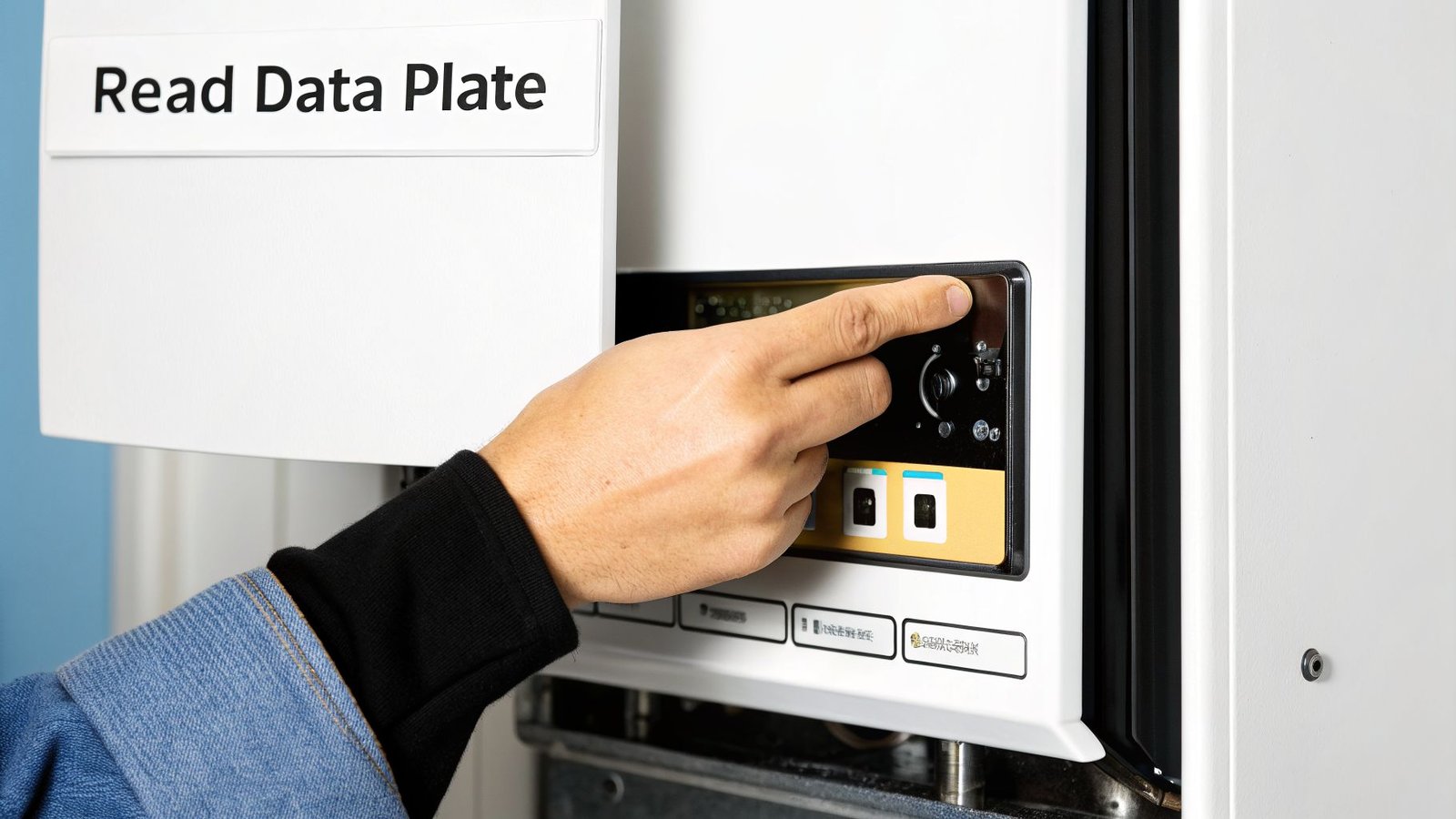
While the data plate on your boiler gives you the official specs, you can figure out what you have just by playing detective around your home. A boiler isn't a standalone appliance; it’s the heart of your entire heating system. The other bits and pieces dotted around your house—or what's missing—are often the biggest giveaways.
Let’s take a quick tour of a typical UK home. The main thing we’re looking for is the presence (or absence) of big water storage tanks. These are the single biggest clue separating one type of boiler system from another.
First Stop: The Airing Cupboard
Pop open your airing cupboard. If you’re greeted by a large, insulated hot water cylinder, you can immediately rule out having a combi boiler. This cylinder’s job is to store a full tank of hot water that the boiler has already heated, keeping it ready for your bath or shower.
Finding this tank narrows it down to two possibilities:
- System Boilers: A more modern, pressurised setup where the cylinder stores hot water fed directly from the boiler.
- Regular (Conventional) Boilers: An older, gravity-fed system that also uses a cylinder, but it has a partner tank somewhere else in the house.
So, if you’ve got a hot water cylinder, your detective work isn’t quite finished. The next clue is usually hiding up in the loft.
A common point of confusion I see is people thinking the hot water cylinder is the boiler. It’s not—it’s just a storage tank. The boiler itself is the box on the wall that actually burns fuel to create the heat, which you’ll usually find in the kitchen, a utility room, or a garage.
A Quick Trip to the Loft
Right, time to head upstairs. If you poke your head into the loft and see one or two large water tanks, you've found the classic sign of a regular boiler. They’re usually big black plastic cisterns, though you might find older galvanised metal ones.
These tanks rely on gravity to feed water down to the boiler and cylinder below. The larger tank is the cold water storage cistern that refills your hot water cylinder. The smaller one is a feed and expansion tank, which keeps the water level in the radiator circuit topped up. Finding these in your loft is a dead giveaway.
But what if your loft is completely empty of water tanks, yet you do have that hot water cylinder in the airing cupboard? Congratulations, you have a system boiler.
What if You Have No Tanks at All?
If you’ve checked the airing cupboard and the loft and found nothing but cobwebs and last year's Christmas decorations, the answer is pretty straightforward. You almost certainly have a combi (combination) boiler.
Combi boilers are compact, all-in-one units. They heat water on demand, straight from the mains, whenever you turn on a tap. This efficient design means there’s no need for any storage tanks, which is exactly why they’re so popular in modern flats and houses where every square foot counts.
The tell-tale sign of a combi is instant hot water and hearing the boiler fire up with a whirr. Sometimes this can be a bit more of a clunk—if you're hearing that, it might be worth reading about why a boiler might be making loud banging noises, as it can point to other issues.
What Your Boiler's Pipes and Flue Reveal
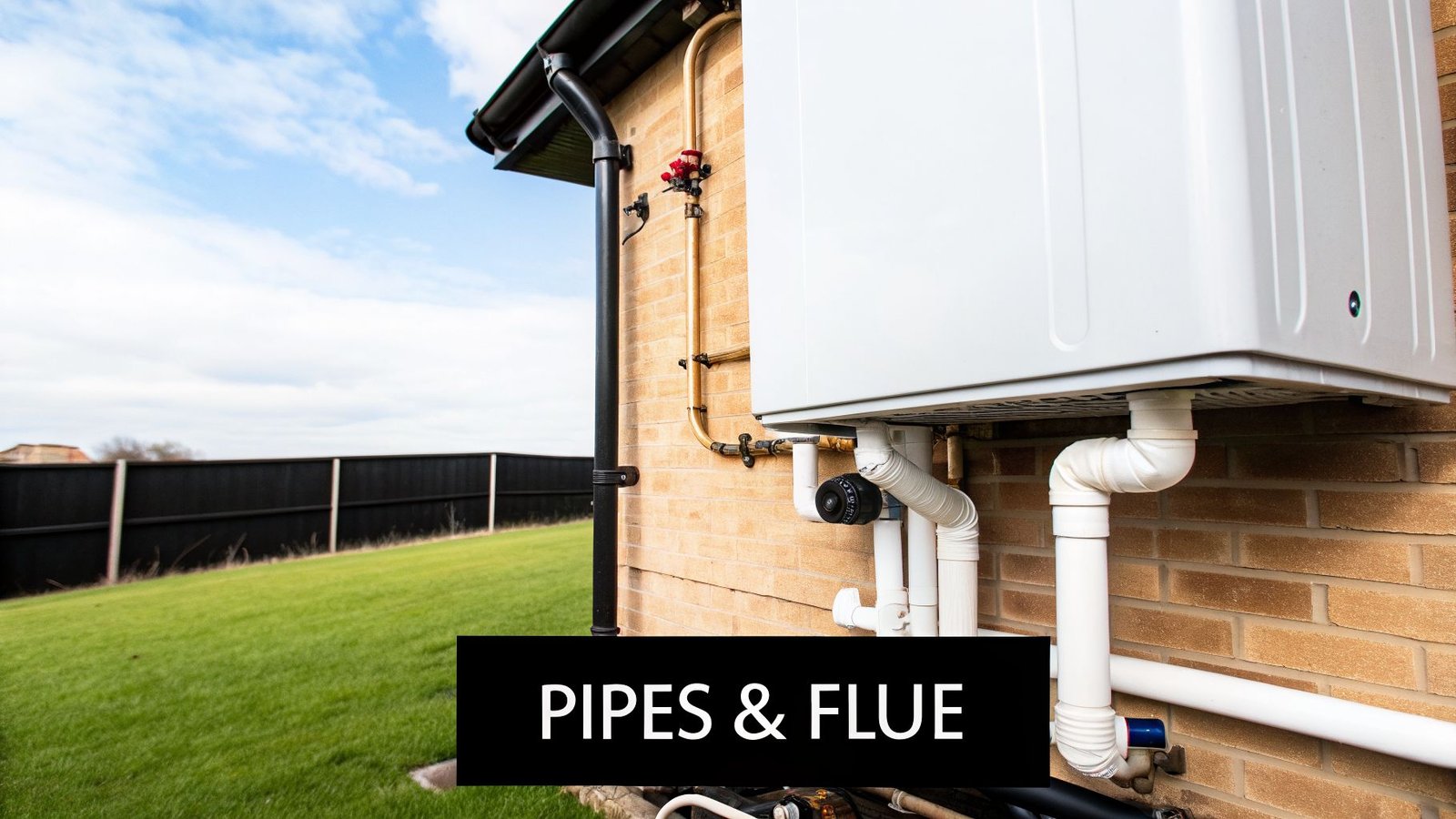
The plumbing connected to your boiler and the main pipe exiting the wall—the flue—are fantastic clues for identification. They can tell you the boiler type and even give you a good idea of its age and efficiency, once you know what to look for.The easiest place to start is with the flue. This is the large exhaust pipe that carries waste gases safely outside. A quick glance at where it comes out of your exterior wall can tell you a lot.
If you spot a white plastic pipe, that's your sign of a modern, high-efficiency condensing boiler. These units are designed to capture so much heat from the flue gases that the exhaust is cool enough for a plastic pipe to handle it.
In fact, all new boilers installed in the UK since 2005 have to be condensing models. So, a plastic flue immediately tells you your boiler isn't ancient and is built for better efficiency.
Spotting Condensing vs Non-Condensing
On the other hand, if your boiler’s flue is made of metal, you're looking at an older, non-condensing model. The gases blasting out of these are incredibly hot, which is why they need a durable metal pipe. This is a clear indicator of an outdated and inefficient system that is almost certainly costing you more to run.
There's another dead giveaway for a condensing boiler: a small plastic pipe, usually white and about the diameter of a washing machine hose, running from the bottom of the unit. This is the condensate pipe.
It’s there to drain away the slightly acidic water (the "condensate") that's produced when the boiler recycles heat from the flue gas. This pipe will lead to a drain, either inside to a sink waste pipe or outside to a drainpipe. If you see this little pipe, you can be 100% certain you have a condensing boiler.
The Pipework Underneath
Now, have a look at the copper pipes coming directly out of the bottom of your boiler. Just counting them can often be enough to tell you what kind of boiler you have.
A combi boiler is the busiest of the bunch, with a whole collection of pipes underneath. You should be able to count several connections:
- Gas supply pipe
- Cold water mains inlet
- Hot water outlet to your taps
- Central heating flow (hot water out to radiators)
- Central heating return (cooler water back from radiators)
- A smaller copper pipe for the pressure relief valve (a safety outlet)
A combi has all this pipework because it’s a self-contained unit doing two jobs at once: heating your home and providing instant hot water on demand. It needs separate connections for the mains water and the closed-loop central heating circuit.
System and regular boilers, by contrast, have a much simpler arrangement underneath. You'll typically only see the gas supply and the flow and return pipes for the central heating circuit. That’s because the hot water for your taps is being handled by a separate hot water cylinder stored elsewhere in your home.
If you also spot a pressure gauge on the boiler's front panel, that’s another common feature of these sealed systems. If you're wondering why a boiler might be losing pressure, our guide on the topic can help you diagnose the issue.
Right, you've figured out whether you have a combi, system, or regular boiler. The next big question is: what does it actually run on? Knowing your boiler's fuel source is essential before you can book a service, get a repair quote, or even start thinking about a replacement.
While most homes in the UK—around 78%—are on the mains gas grid, a significant number aren't. Let's pinpoint exactly what's powering your heating.
Check for a Gas Meter
The dead giveaway for a gas boiler is, unsurprisingly, a gas meter. This is the device that the utility company uses to track your consumption.
Take a quick look for it. It’s usually found in one of a few common spots:
- Outside your home: Have a walk around the outside of your property. You’re looking for a small, fairly discreet box (often white or cream-coloured) fixed to an external wall, typically near the front.
- Tucked away inside: In flats or older terraced houses, it's common to find the meter tucked away indoors. Check any kitchen cupboards, utility rooms, or that classic spot under the stairs.
A gas meter will have a digital readout or older-style dials and will be connected to a pipe with a prominent, usually yellow, shut-off lever. If you spot one, your boiler runs on mains gas. Simple as that.
Safety First: You should never touch or try to adjust your gas meter or the pipes connected to it. If you ever smell gas or think you might have a leak, leave your property straight away and call the National Gas Emergency Service on 0800 111999.
No Gas Meter? Look for a Tank or Bottles
So, you've searched high and low and there's no gas meter in sight. This isn't unusual, especially in more rural locations or on properties that were never connected to the gas network. In this case, your boiler is almost certainly running on either heating oil or Liquefied Petroleum Gas (LPG).
To figure out which one, you'll need to look for the fuel storage.
- Oil Boilers: An oil-fired system needs a large tank to hold its fuel. Scan your garden or back yard for a big plastic or steel tank—they're usually green or black. You'll see a pipe running from this tank towards your house, feeding the boiler.
- LPG Boilers: An LPG boiler is fed by gas stored in either a large communal tank or, more commonly, from large gas bottles. Look for two or more big, upright bottles (often bright orange or white) standing against an outside wall of your house.
You've Identified Your Boiler—What Happens Next?
Right, so you've done the detective work. After a bit of poking around in cupboards, maybe even a brave trip into the loft, you’ve managed to decipher that little data plate. You can now confidently answer the question, "what type of boiler do I have?"
But what's the big deal? Whether it’s a combi, system, or regular boiler, this piece of information is your key to properly managing your home’s heating and hot water. It’s not just homeowner trivia—it’s practical knowledge that shapes your decisions on everything from routine maintenance to a full-blown replacement.
Let's walk through the three most common situations you'll face and see how knowing your boiler type makes all the difference.
Time for an Annual Service
Every boiler, no matter the type, needs an annual service to keep it running safely and efficiently. It’s also a must-do to keep your manufacturer's warranty valid.
When you call a Gas Safe registered engineer, the difference between saying "I have a Worcester boiler" and "I have a Worcester Bosch Greenstar 30i Combi" is huge.
Giving them the exact details allows the engineer to:
- Know what they're walking into: Servicing a sprawling regular boiler system with its separate cylinder and loft tanks is a different job entirely from working on a compact, all-in-one combi.
- Bring the right parts: Good engineers often carry a stock of common seals and components for popular models. Knowing your boiler type upfront massively increases the chance of a first-visit fix.
- Give you an accurate quote: The time and labour can vary between boiler types, so an accurate quote hinges on you providing accurate information.
Think about it: if you have a system boiler, the engineer knows they’ll also need to check the pressure of your unvented hot water cylinder. That’s a whole set of checks that simply don’t apply to a combi boiler.
Dealing with a Boiler Breakdown
There’s nothing quite like the feeling of waking up to a cold house and the realisation there’s no hot water. When the worst happens, being able to tell an emergency engineer what boiler you have can slash the diagnostic time.
An error code on a combi boiler, for example, might point straight to a diverter valve issue—a part that system and regular boilers don’t even have. If your older, G-rated regular boiler has given up, the engineer might immediately suspect a pilot light failure or a problem with the pump, which could be located somewhere completely different from the boiler itself.
Knowing your boiler type helps the engineer build a mental checklist of likely culprits before they even step through your door. That saves their time and, more importantly, your money.
Planning for a Replacement
Maybe your investigation has revealed you’re living with a very old, non-condensing boiler. You’ve just uncovered a massive opportunity to improve your home’s energy efficiency and lower your bills. Swapping an old, inefficient G-rated boiler for a modern A-rated condensing model can cut your energy costs by as much as 30% a year.
Knowing your starting point is crucial. For instance, if you have a regular boiler, you're at a crossroads. Do you go for a straightforward, like-for-like swap? Or do you seize the chance to modernise and switch to a combi system, getting rid of the old tanks and freeing up valuable space in your airing cupboard and loft?
This is a big decision with lots of factors to consider. You can get a clearer picture by reading our detailed guide on what a new boiler replacement involves.
Ultimately, identifying your boiler is the first step toward making smarter, more informed decisions for your home. You're now in a much better position to handle everything from routine servicing to major upgrades with confidence.
At Urbanic Services Ltd, we specialise in helping London homeowners with all their heating needs, from servicing and repairs to full system upgrades. Our Gas Safe registered engineers are experts in all boiler types. Get a transparent, fixed-price quote today at https://urbanicservice.co.uk.