
When you're renovating a London property, the choice between underfloor heating and radiators is a big one. It’s a decision that hits your budget upfront and your energy bills for years to come. While radiators are often cheaper to get in the door, it’s underfloor heating (UFH) that usually delivers on long-term efficiency and a more pleasant, even warmth. Ultimately, it comes down to a classic trade-off: save money now, or save money later?
The Real Cost of Heating a London Home
Getting your heating right is one of the most important calls you'll make as a London homeowner. The whole "underfloor heating vs radiators cost" question isn't just about buying the kit. It’s a blend of installation challenges, running costs, the type of property you own, and even how you live in it. This guide is here to break down those financial trade-offs so you can make a decision that feels right for your home and your bank balance.
London's mix of housing stock, from draughty Victorian terraces to slick new-build flats, throws up different problems and possibilities for each system. Sticking with radiators might feel like the simplest option in an older house, but UFH is fast becoming the go-to for modern apartments, prized for its clean look and efficient performance.
Key Financial Differences at a Glance
First, let's get the main cost differences straight. Radiators nearly always have a lower price tag for the initial installation. Over time, however, the superior efficiency of UFH means it can be the more economical system to run.
| Feature | Underfloor Heating (Wet System) | Traditional Radiators |
|---|---|---|
| Upfront Cost | Higher, especially for retrofits | Lower, more budget-friendly initially |
| Running Costs | Generally lower due to efficiency | Can be higher, especially older systems |
| Installation | Complex, may require floor removal | Simpler, less disruptive to install |
| Property Value | Can increase home's market appeal | Standard feature, less impact on value |
That table gives you the headlines, but the real story is in the specifics of your project. Whether you're gutting a place or just redecorating makes a huge difference. Trying to retrofit underfloor heating into an existing home means pulling up floors, which is a major, labour-intensive job that can send costs soaring. On the other hand, putting it into a new build or extension is far simpler and much more affordable.
Here's a vital point many people miss: the difference between electric and wet underfloor heating is massive. Electric mats are cheap to buy and install, but they can cost three to four times more to run than a wet system plumbed into your boiler or heat pump. If you're heating your whole London home, a wet system is almost always the smarter financial move.
In the end, you're balancing the immediate hit to your wallet against the promise of lower bills and a more comfortable home down the line. For Londoners, where every pound and every square foot counts, thinking through these factors properly is non-negotiable. Let’s dive into the real-world installation costs, what you can expect to pay to run each system, and when you might see a return on your investment.
Breaking Down the Installation Costs for a London Home
When you're weighing up underfloor heating against radiators, the first number that usually jumps out is the upfront installation cost. For London homeowners, this initial spend is a huge part of the decision, and it can swing wildly depending on the type of property you have, the system you pick, and just how big the job is. Getting a handle on these variables from the start is the best way to budget properly and avoid any nasty shocks later on.
The single biggest factor that dictates the price is whether you're working on a new-build or retrofitting into an existing home. In a new extension or a ground-up construction project, slipping a wet underfloor heating system in is relatively painless. The pipes go down before the final floor screed is poured, so it’s just another step in the build process.
On the other hand, trying to shoehorn UFH into an older London property is a different beast altogether. It's a far more disruptive and expensive job. You're typically looking at ripping up your current flooring, prepping the subfloor, laying the system, and then putting new flooring back down over the top. The labour costs and general upheaval are significantly higher.
A Head-to-Head on Upfront Costs
At the installation stage, the cost difference between the two systems is stark. Radiators have a clear edge here with a much lower initial price tag, especially if you're just swapping out old units for new ones.
Let's look at what you can expect to pay for a typical project.
Typical Installation Cost Comparison for a London Home (2026 Estimates)
This table breaks down the estimated upfront installation costs for underfloor heating and radiators in both new-build and retrofit scenarios for a typical London room or small flat.
| Heating System | Scenario | Estimated Cost per 20 sq m Room | Key Considerations |
|---|---|---|---|
| Wet Underfloor Heating | New-Build / Extension | £1,500 – £2,000 | Installed before the final floor screed is laid, making it simpler and more cost-effective. |
| Wet Underfloor Heating | Retrofit | £2,500 – £4,000+ | Requires removing existing floors, which adds significant labour costs and disruption. |
| Radiator System | New-Build / Retrofit | £400 – £800 | Assumes installing 2-3 modern radiators. Cost is lower as it doesn't require major floor work. |
As you can see, the initial outlay is where radiators really shine. According to data from suppliers like The Floor Heating Warehouse, the supply-and-fit cost for wet UFH hovers around £50 to £85 per square metre, but this can climb sharply for complex retrofits. In contrast, a straightforward radiator installation might only set you back a few hundred pounds per room.
This infographic gives a great visual summary of the core differences between the two heating methods.
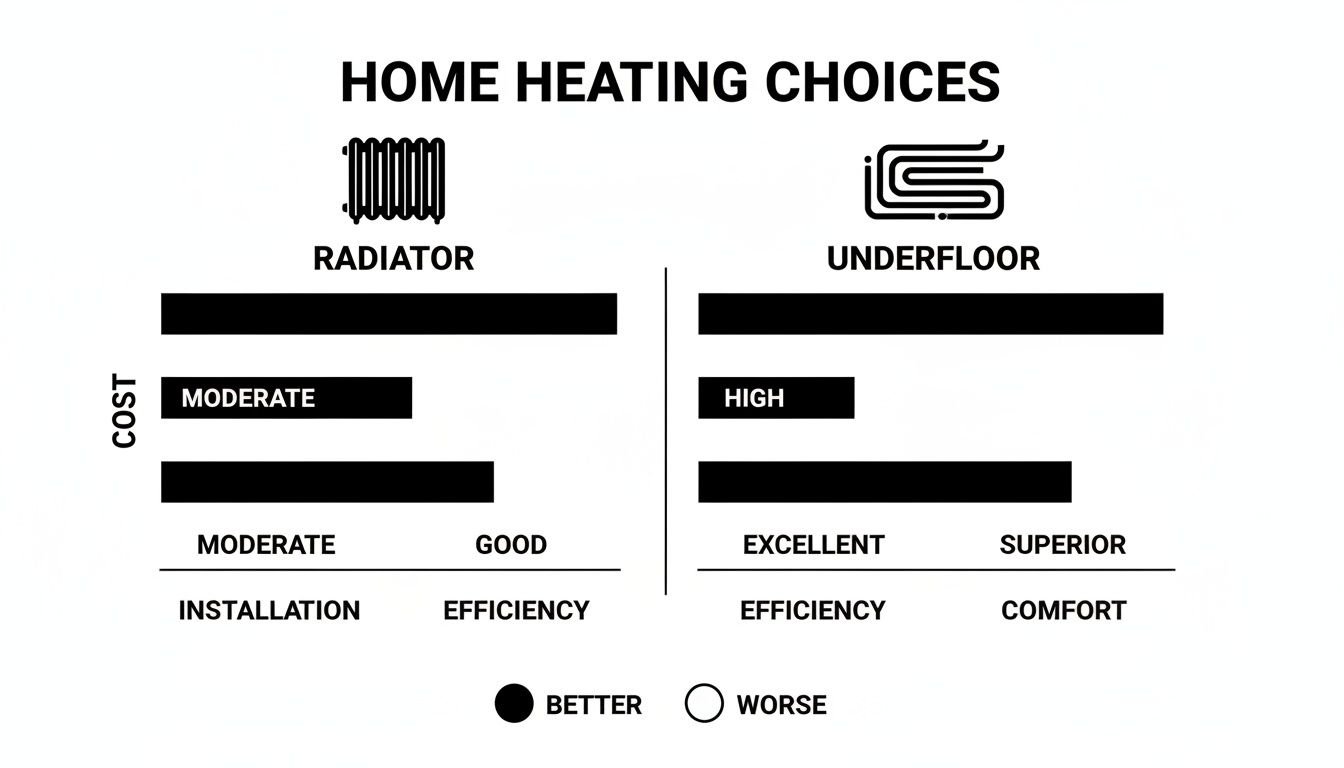
It really drives home the point that while radiators are cheaper to get in the door, underfloor heating is engineered from the ground up for gentle, even heat that fills the entire space.
The Factors That Will Shape Your Final Quote
Your final bill won't just come down to a simple square metre rate. Several key things will influence the price, and it’s worth thinking about these before you start getting quotes.
- Your Property's Age and Construction: A Victorian terrace with suspended timber floors is a totally different challenge from a modern flat with solid concrete floors. Older buildings often need more prep work to get them ready.
- The Type of Floor You Have: Laying UFH onto a concrete subfloor is usually cheaper and quicker than fitting it between wooden joists, which needs specialist heat spreader plates and more labour.
- Which System You Choose: A 'wet' hydronic UFH system has higher material and labour costs than an electric mat system. However, electric systems are much, much more expensive to run day-to-day.
- Your Heat Source: Are you connecting to your existing boiler? That's fairly standard. But if you're installing a new air source heat pump at the same time, that’s a major additional cost to factor into the project.
- The Controls: The sophistication of your thermostats and zoning will also play a role. Smart, multi-zone controls add to the initial bill but can deliver excellent long-term savings on your energy use.
The bottom line on installation: Radiators win on simplicity. You can often upgrade, replace, or even move them during a renovation without needing to perform major surgery on your home, making them a really practical choice for budget-conscious updates.
If you’re just looking to upgrade what you already have, it's worth exploring modern, high-efficiency radiators. You can learn more about what’s involved in our guide to professional radiator installation services in London.
Ultimately, the right choice comes down to the scope of your project. If you're doing a full ground-floor renovation on your London home and the floors are coming up anyway, the extra cost to install wet UFH might feel marginal and well worth it. But if you're just redecorating a single bedroom, the cost and mess of retrofitting UFH are probably hard to justify. In that case, a couple of new, efficient radiators would be the far more logical and affordable path.
Uncovering Long-Term Running Costs and Efficiency
Once the installers have packed up their tools, the true cost of your heating system starts to show up on your monthly energy bills. This is where the debate between underfloor heating and radiators really heats up, especially for London homeowners facing notoriously high energy prices. For a long time, the accepted wisdom was simple: underfloor heating is more efficient.
And on paper, it's easy to see why. Underfloor heating (UFH) works by running warm water through pipes at a low temperature, typically around 35°C. This turns your entire floor into a huge, gentle radiator. Traditional radiators, on the other hand, need to be much hotter, often requiring water heated to 60-75°C to push heat around a room using convection. Because it operates at a lower temperature, UFH is often quoted as being up to 25% more efficient.
Your Lifestyle Dictates Your Running Costs
But technical specs are only half the story. The real-world cost of heating your home is deeply tied to your daily routine. How you actually use your heating plays a massive role in whether underfloor systems or modern radiators will be kinder to your wallet.
There are really two main ways people heat their homes, and each method suits a different system:
Low and Slow: This strategy is all about consistency. You leave the heating on at a low, steady temperature for long stretches, sometimes even 24/7. This is where underfloor heating truly shines. Once it gets the floor's thermal mass up to temperature, the system just sips energy to maintain that comfortable, ambient warmth.
Intermittent Bursts: This is the classic British approach – a blast of heat in the morning to get you out of bed, and another in the evening when you're back from work. Radiators are built for this. They heat up fast, deliver warmth exactly when you need it, and then switch off, so you're not paying to heat an empty house.
New Research Is Shaking Things Up
Lately, the conversation around running costs has become a lot more interesting. With everyone focused on efficiency, some compelling new research is challenging the old assumptions. While industry sources often suggest UFH can lead to savings of 15% to 25% (some households report saving up to £150 a year), recent findings from the University of Salford's Energy House 2.0 facility tell a different story.
In a comprehensive test of 28 different heating setups under typical UK winter conditions, they discovered something surprising. Homes using radiators throughout actually had lower running costs than those with a mix of UFH and radiators. Why? Because radiators proved more cost-effective for the intermittent heating patterns that most of us follow. The study noted that UFH would be more economical if run 24/7, but that this 'always on' approach is 25% to 35% more expensive overall than standard, intermittent radiator use. For a typical London household, this suggests modern radiators might offer better real-world value.
This changes the calculation significantly. If your household is empty during the day, running UFH constantly on a 'low and slow' basis may not be the most cost-effective strategy, even though the system itself is highly efficient. The quick response time of modern radiators could be a better financial match for your lifestyle.
Of course, the efficiency of either system hinges on proper control. A smartly programmed thermostat can slash your bills by ensuring you’re only using heat when and where you need it. To get the most out of your system, it’s worth understanding how a professional thermostat installation can fine-tune your heating.
Ultimately, when weighing the long-term costs, you have to look past the simple efficiency ratings and think about your life. Are you home all day and crave a constant, gentle warmth? Underfloor heating is probably the right call. But if your family is in and out, needing quick, powerful bursts of heat at peak times, a modern radiator system could well be the more economical choice in the long run.
Choosing Between Electric and Wet Underfloor Heating
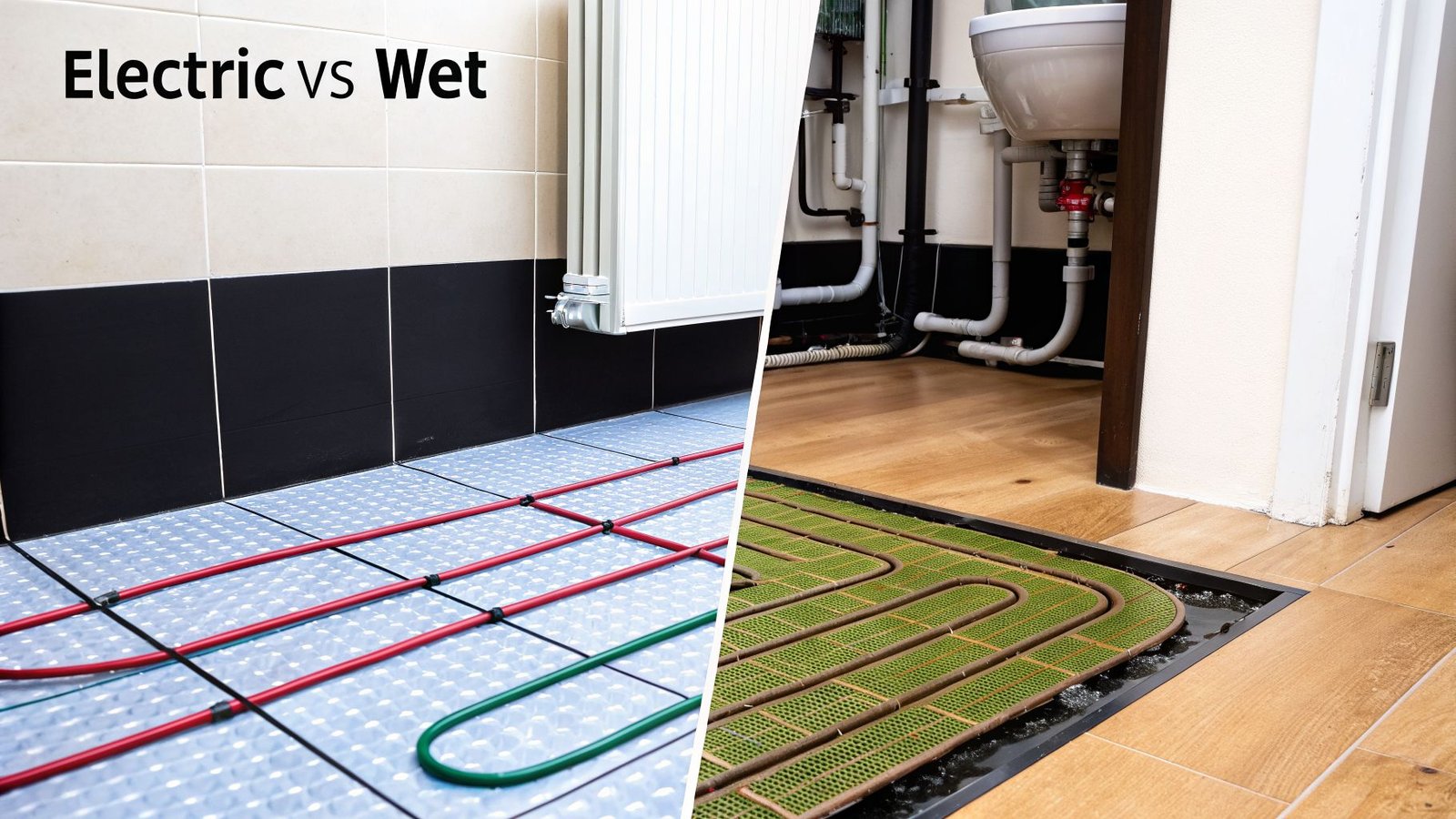
So you've decided on underfloor heating. A great choice for comfort and style. But now for the big decision that will really shape your budget for years to come: will you go for an electric system or a wet one?
This isn’t just a minor technical detail. It’s a fundamental choice that dramatically affects both the upfront installation bill and, more importantly, your long-term running costs.
Electric UFH works by running electricity through a network of wires or pre-spaced mats laid directly under your floor. A wet (or hydronic) system, on the other hand, functions more like a giant, hidden radiator, circulating warm water from your boiler or heat pump through a series of pipes. The way they generate that lovely warmth is worlds apart, and so is the cost.
Installation Cost vs. Running Cost
At first glance, electric systems look like the obvious winner on price. The materials are cheaper and the installation is far more straightforward—there’s no complex plumbing involved. It makes them a tempting option, especially for a single-room project or for a confident DIYer.
A wet system, however, requires a much larger upfront investment. You're not just laying pipes; you’re installing a manifold, connecting it all back to your main heat source, and likely dealing with more significant floor preparation. In a London renovation, where you might be lifting original floorboards, this complexity adds up in both labour and material costs.
But here’s where the tables turn completely. Once the system is in, you have to pay to run it. And in the UK, the cost of electricity per unit of heat is vastly higher than gas. This is a simple fact that can’t be ignored.
An electric underfloor heating system costs roughly 3 to 4 times more to run than an equivalent wet system. For heating a whole house or even a large living area, that cost difference makes a wet system the only sensible long-term financial choice.
The initial savings on an electric system can quickly become a very expensive mistake if you plan to use it as a primary heat source across a large space. Its real value is found in using it strategically.
The Right System for the Right Space
This stark difference in running costs gives us a clear rule of thumb for deciding which system goes where. Think of electric UFH as a specialist tool, not a one-size-fits-all solution.
When to Choose Electric UFH:
- Small, targeted zones: It's perfect for a bathroom, ensuite, or a compact kitchen where you only need a quick blast of heat for short periods.
- When simplicity is key: If you're renovating a single room and the thought of connecting to your central heating is a nightmare, electric mats offer a much less disruptive path.
When to Choose Wet UFH:
- Whole-home heating: For an entire ground floor or a large, open-plan extension, a wet system is the only economical option for daily use.
- New builds and major gut-renovations: If the floors are coming up anyway, the extra work to install a wet system is minimal compared to the massive long-term savings you'll make.
The numbers make it clear. Installing an electric system in a 20-square-metre room might only cost £1,000 to £1,500. But running it every day through a London winter would be eye-wateringly expensive. A wet system costs more to fit but pays you back year after year by using your cheaper gas boiler or super-efficient heat pump. If you'd like to dive deeper, you can discover more insights about these cost differences from Heat and Plumb.
Calculating Your Return on Investment

When you start comparing quotes for underfloor heating and radiators, it's easy to get fixated on that big installation number. But the real story isn't just about the upfront cost; it’s about the return on your investment, or ROI. Will that higher initial spend on underfloor heating (UFH) eventually balance out through lower energy bills and a boost in your home's value?
Figuring out this payback period is what turns a potentially scary expense into a smart, long-term decision.
Of course, this isn't a simple one-size-fits-all calculation. The numbers can swing dramatically based on your specific London property, how much work you're doing, and even your family’s heating habits. Let's walk through a few real-world examples to see exactly when UFH moves from being a luxury to a genuinely sound financial choice.
Payback Scenarios for London Properties
To get a true sense of long-term value, we need to look at the whole picture: installation costs, potential energy savings, and the undeniable appeal UFH adds to a property. Here are three common scenarios you might encounter in London.
Scenario 1: The Victorian Terrace Renovation
Picture a classic Victorian terrace in Greenwich, mid-way through a huge ground-floor renovation. The floorboards are already up to sort out some old joists and create a modern, open-plan space. This is the golden opportunity to install wet underfloor heating.
- The Project: A complete ground-floor gut and extension, resulting in a 50 sq m open-plan kitchen and living area.
- Installation Cost Premium: Since the subfloor is being replaced anyway, the extra cost for a wet UFH system over new radiators isn't as steep as you'd think. We'll estimate this premium at £4,000.
- Annual Savings: With good insulation in the new extension, the UFH system can run very efficiently. The homeowner could realistically see a 15% reduction in their heating bills compared to running radiators. If the annual bill was £2,000, that’s a solid saving of £300 per year.
- Payback Calculation: £4,000 (cost premium) ÷ £300 (annual savings) = roughly 13 years.
Now, a 13-year payback might seem like a long time. But that simple maths doesn't factor in ever-rising energy prices or the serious value a modern, invisible heating system adds to a period home.
For major renovations where floors are already being replaced, the decision becomes less about pure payback and more about 'cost-neutral' comfort. The disruption is happening anyway, making the UFH upgrade a logical and valuable addition.
Scenario 2: The New-Build Flat
Let's switch gears to a brand-new, two-bedroom flat in a development near Canary Wharf. Here, the developer is deciding between UFH or radiators from scratch.
- The Project: A 70 sq m new-build apartment.
- Installation Cost Premium: In a new build, installing wet UFH is much simpler. The cost difference versus fitting a standard radiator system might only be £1,500 – £2,000.
- Annual Savings: In a super-insulated, airtight modern flat, UFH is in its element. We could estimate annual savings of around £150 – £200.
- Payback Calculation: £2,000 (cost premium) ÷ £200 (annual savings) = 10 years.
For developers, the clean aesthetics, extra wall space, and premium feel of UFH are huge selling points. The relatively small cost increase is often absorbed by the higher sale price it can command.
Scenario 3: The 1930s Semi-Detached Upgrade
Finally, let’s consider a family in a 1930s semi in Lewisham. They aren't planning a massive renovation but are thinking about upgrading their heating.
- The Project: Retrofit wet UFH across the 40 sq m ground floor.
- Installation Cost: This is where things get expensive. The project involves ripping up all the existing flooring, installing the system, and then laying new floors. The total cost could easily hit £6,000 or more.
- Annual Savings: Even with estimated annual savings of around £250, the numbers just don't add up.
- Payback Calculation: £6,000 ÷ £250 = 24 years.
In this case, the ROI on a disruptive retrofit is poor. The upheaval and immense cost make it a non-starter for most. Upgrading to modern, efficient radiators would deliver better performance for a fraction of the price and hassle. Here, the decision clearly points towards sticking with radiators.
Which Heating System Is Right for You?
Choosing between underfloor heating and radiators isn't just about comparing quotes. It's about finding the right fit for your home, your lifestyle, and your budget here in London. To cut through the "underfloor heating vs radiators cost" noise, you need to ask yourself a few honest questions about your situation.
The answers will point you toward the system that makes the most sense for you, both practically and financially.
Are You Building New or Renovating?
Honestly, the scope of your project is probably the biggest decider.
New Builds & Major Renovations: If you're building an extension or planning a big ground-floor overhaul where the floors are being ripped up anyway, wet underfloor heating (UFH) is almost always the best path forward. The extra installation cost is pretty small when it's part of a larger job, and you'll reap the rewards in efficiency and comfort for years. The disruption is already happening, so it's the perfect opportunity to invest.
Minor Updates & Retrofits: Thinking of just redecorating a single room or replacing an old heating system without major surgery? Modern, low-temperature radiators are the clear winner here. The cost and sheer mess involved in retrofitting a wet UFH system into an existing space are often just too much to justify. Swapping out radiators is fast, relatively cheap, and won't turn your home into a building site for weeks.
What Is Your Property Like?
The age of your home and, crucially, its insulation levels will have a huge say in what works best.
A well-insulated modern flat or a new extension is brilliant at holding onto the gentle, ambient warmth that UFH provides, making it incredibly efficient. On the other hand, a draughty Victorian terrace might leak that low-grade heat, meaning you’d be better off with responsive, high-output radiators unless you're also planning a serious insulation upgrade.
The one thing I always tell clients is that any heating system is only as good as your home's insulation. Before you spend a penny on heating, invest in sealing up draughts and topping up insulation. It makes both radiators and UFH cheaper to run.
What Are Your Heating Habits and Budget?
Finally, think about how you actually live in your space. If the house is busy all day and you love a constant, comfortable background warmth, the 'low and slow' nature of UFH is perfect. It’s designed to maintain an even, ambient temperature.
But if the house is empty all day and you just need quick, powerful blasts of heat in the morning and evening, radiators are far better suited to that pattern. They heat up fast, giving you warmth precisely when you need it without you having to pay to heat an empty house. For anyone looking ahead to green energy, it's also worth understanding how a heat pump solution can work with either of these systems.
A Few Common Questions
When you're weighing up the pros and cons of underfloor heating versus radiators, a few key questions always seem to pop up. We hear these all the time from London homeowners, so let's tackle them head-on.
Can I Just Have Both?
Yes, and it’s often a brilliant solution. We regularly fit hybrid systems in London properties, especially in period houses with multiple floors. It's a common and very practical approach.
A typical setup involves installing wet underfloor heating (UFH) on the ground floor, bringing that lovely, consistent warmth to your main living spaces like the kitchen and lounge. Then, you might stick with efficient, modern radiators for the bedrooms upstairs. This approach gives you the best of both worlds: luxurious comfort where you spend most of your time, and fast, responsive heat upstairs, all while managing the initial installation cost and disruption.
Just How Messy Is It to Retrofit UFH?
Let’s be honest: retrofitting a wet underfloor system is a big job. It’s not something you do on a whim. The work involves taking up all your existing flooring, laying down the pipework and a new screed (or specialised low-profile boards), and then putting a brand-new floor on top. Expect a fair amount of dust and noise, and the room will be out of commission for a while.
Electric UFH systems are much less disruptive. The mats are very thin and can often be installed directly onto the existing subfloor with only a minimal change in floor height. That said, their high running costs mean they really only make sense for smaller rooms, like a bathroom or ensuite.
The scale of your project is everything here. If you're just redecorating a room, new radiators are the sensible choice. But if you're already planning a major ground-floor renovation where the floors are coming up anyway, the extra disruption for UFH is pretty minimal.
Are Modern Radiators Really as Efficient as UFH?
This is where it gets interesting, and the answer depends entirely on how you live in your home. On paper, UFH is more efficient because it heats a large surface area at a much lower temperature (around 35°C compared to over 60°C for radiators), which can lead to energy savings of 15-25%.
However, that assumes the heating is on for long periods. If you're out all day and only need quick blasts of heat in the morning and evening, the fast response time of modern radiators can actually make them cheaper to run. If your home is occupied most of the day and you prefer a constant, stable temperature, UFH will almost certainly prove more economical in the long run.
Choosing the right heating is a major investment that affects your home’s comfort and long-term value. For expert advice and a clear, fixed-price quote tailored to your London property, reach out to Urbanic Services Ltd. Book your free consultation online and let's find the perfect solution for you.