
Deciding between a hot water tank and a combi boiler boils down to one key question: do you need a large reserve of hot water ready to go, or is the efficiency and space-saving nature of on-demand heating a better fit for your home? The answer really depends on your property and lifestyle.
A Quick Guide to Your Next Heating System
Choosing the right heating system is a major decision for any London homeowner. It’s something that directly affects your energy bills, your daily comfort, and even how you use the space in your home. Let's cut through the jargon and get straight to what you need to know to pick the best option for you.
How Do They Actually Work?
A combi boiler is a single, compact unit that does it all, providing both your central heating and hot water. When you turn on a hot tap, it fires up and heats water directly from the mains, instantly. It’s perfect for properties where you can't afford to lose precious cupboard space.
On the other hand, a system or conventional boiler works as a team with a separate hot water cylinder (the tank). It heats up a large volume of water and stores it, ensuring you have a powerful supply ready for multiple taps at once. Think of it as having a big thermos, always full and ready to pour.
Combi Boilers: Why They've Become the Go-To Choice
There's a reason combi boilers have become the default choice for most UK homes. In a city like London, space is at a premium, and the move towards greater energy efficiency has made them incredibly popular.
Modern A-rated combi boilers are highly efficient, typically running at 92% to 94% efficiency. For anyone upgrading from an older, less efficient boiler, the savings are significant. We've seen homeowners in Greenwich and Lewisham cut their energy bills by up to 40%, which can mean saving around £511 per year. This trend towards combis is a huge part of the UK heating market, as detailed in reports like this one on researchnester.com.
Key Takeaway: The high efficiency and compact design of combi boilers have made them the UK standard, leading to substantial annual savings on energy bills for many households.
To give you a clearer picture, here’s a straightforward breakdown of how the two systems stack up against each other.
Quick Comparison: Combi Boiler vs Hot Water Tank System
This table gives you a high-level summary of the fundamental differences between the two primary residential heating systems in the UK.
| Feature | Combi Boiler (Combination Boiler) | Hot Water Tank (System/Conventional Boiler) |
|---|---|---|
| Hot Water Delivery | Instant, on-demand | Stored, ready-to-use supply |
| Space Required | Minimal; single wall-hung unit | Significant; boiler + cylinder + potential loft tank |
| Best for | Smaller homes, flats, 1-2 bathrooms | Larger homes, multiple bathrooms, high demand |
| Water Pressure | Strong, direct from mains | Can vary; excellent with unvented cylinders |
| Backup Supply | No; a breakdown means no hot water | Yes; immersion heater can act as a backup |
Ultimately, the best system is the one that meets your specific needs for space, water usage, and efficiency.
Understanding How Each System Delivers Hot Water
When you're deciding between a hot water tank and a combi boiler, it really boils down to one thing: how you get your hot water. One system heats it on the spot, while the other keeps a large supply ready to go. This single difference has a huge impact on your daily life, from your morning shower to your energy bills.
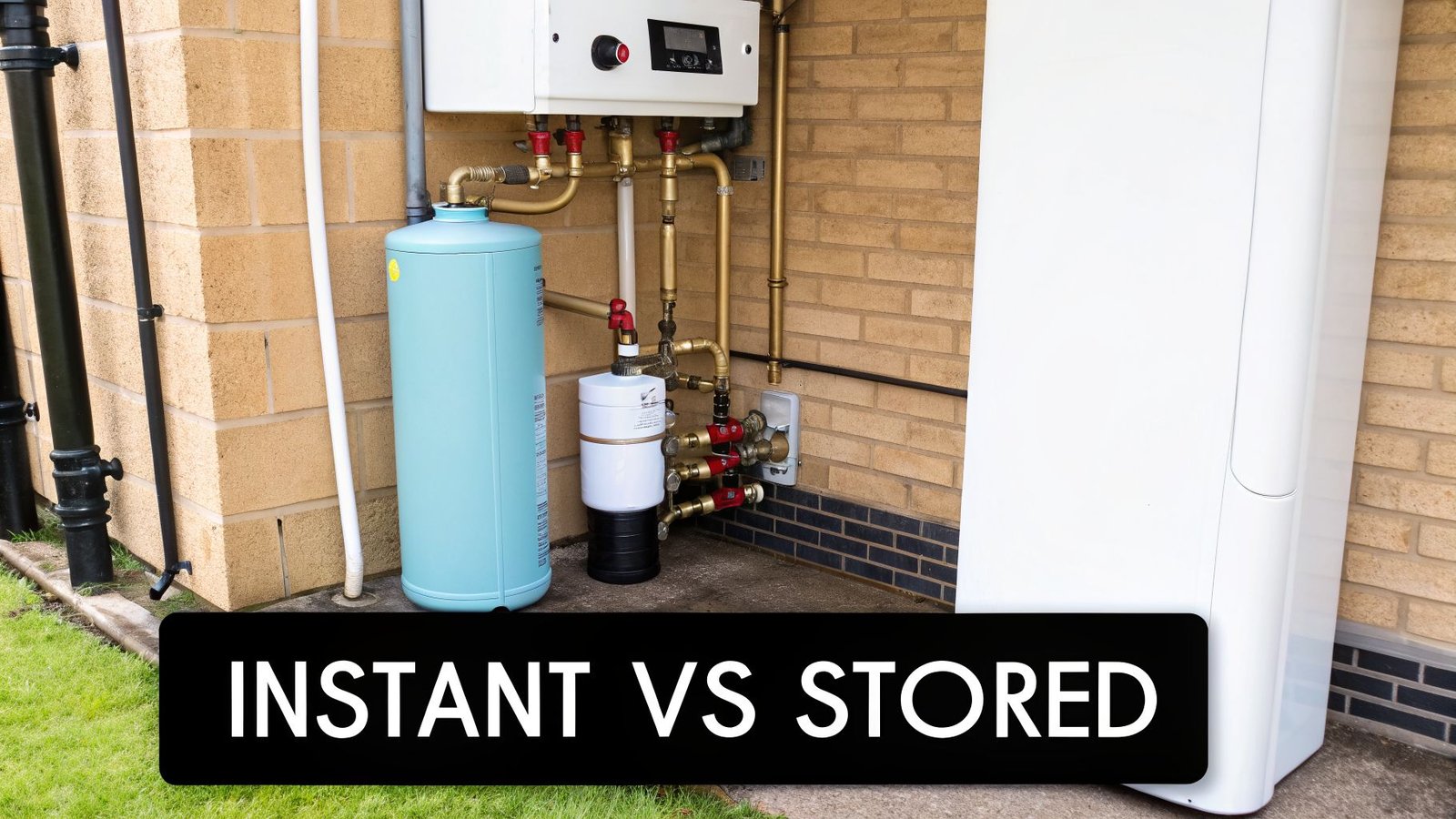
A combi boiler is an all-in-one, on-demand powerhouse. It’s a single, wall-hung unit that fires up the second you turn on a hot tap. Cold water flows in from the mains, passes through a high-efficiency heat exchanger, and comes out of your tap steaming hot.
It's brilliantly simple. You only heat the water you need, exactly when you need it. There’s no energy wasted keeping a big tank of water warm 24/7, making the process itself very efficient.
The Stored Water Approach
On the other hand, a system with a hot water tank—often called a hot water cylinder—works more like a giant, insulated flask. Your boiler heats a large volume of water, which is then stored in the cylinder, ensuring you have a generous reserve of hot water waiting for you.
These are typically paired with a system boiler (drawing water from the mains) or a conventional boiler (fed by a cold water tank, often in the loft). In either case, the cylinder's job is to keep that water hot and ready for action.
The Key Takeaway: A combi boiler is an instant water heater. A hot water tank is a storage system. One gives you unlimited hot water (but not all at once), while the other gives you a large, ready supply that can be used in multiple places simultaneously.
This isn't just a technical point; it directly affects how your home’s plumbing performs under pressure. For a closer look at all the parts involved, you can learn more about what a boiler system includes in our guide.
A Simple Way To Picture The Difference
Let’s put this in everyday terms.
- Combi Boiler: Think of it like an instant hot water tap in an office kitchen. It gives you a cup of tea right away, but you’d have a long wait to fill a big cooking pot. It’s perfect for one or two taps at a time.
- Hot Water Tank: This is more like the large hot water urn at a big family gathering. It can fill dozens of mugs back-to-back without breaking a sweat, but it needs time to heat up beforehand and uses energy to stay ready.
These examples get to the heart of the trade-off. The combi is compact and efficient for smaller demands. The tank system is all about high-volume delivery, making sure no one gets a cold shower just because the dishwasher is running. Understanding this fundamental difference is the first step to making the right choice for your London home.
Let's get down to brass tacks. The technical specs of a boiler are one thing, but how it actually performs in your home day-to-day is what really matters. This is where the choice between a combi boiler and a system with a hot water tank moves from the showroom floor into your daily life.
The real test is how your system copes with the demands of your household, especially during those hectic weekday mornings. Will it deliver a powerful, hot shower, or will it leave you with a frustrating trickle?
Flow Rate and Simultaneous Use
The biggest difference you’ll notice in day-to-day use comes down to one thing: running more than one hot tap at the same time.
A hot water tank is the undisputed champion here. Because it keeps a large volume of water constantly hot and ready to go, it can easily supply two, even three, outlets at once without breaking a sweat. If you've got a busy family home with multiple bathrooms, this ability to deliver strong, consistent hot water to everyone at the same time is a game-changer.
On the other hand, a combi boiler heats water instantly as you need it. This is incredibly efficient, but it has a physical limit on how much hot water it can produce per minute (its flow rate). Even the most powerful modern combi boilers will struggle if you turn on two showers at once. The flow gets split, and the pressure drops for everyone.
Think of it this way: a hot water tank is for homes needing high volumes of hot water simultaneously, while a combi is perfect for efficient, on-the-spot hot water in homes with lower, staggered demand.
Getting the boiler size right is crucial, as a more powerful combi can mitigate some of these issues. You can learn more about matching boiler output to your home in our guide to choosing the best combi boiler for a 3-bedroom house. Ultimately, you need to decide what’s more important: an endless supply for one tap or a powerful supply for several taps all at once.
Water Pressure and Shower Performance
Your shower's power and how fast the bath fills are all about water pressure. This is another area where your choice of system has a direct impact.
- Combi Boilers: These are fed directly from the water mains. If you live in an area with good mains pressure, a combi boiler will give you a fantastic, powerful shower without needing any extra pumps.
- Unvented Cylinders: When paired with a system boiler, these also run at mains pressure. You get the same brilliant flow as a good combi, but with the huge advantage of being able to supply multiple bathrooms at the same time.
- Vented Cylinders: Common in older properties, these use gravity. A cold water storage tank in the loft feeds the cylinder, and the pressure you get at the tap depends on the height difference. This usually means the flow is noticeably weaker, especially in upstairs bathrooms.
It’s worth noting just how far boiler technology has come. Modern condensing combi boilers have slashed flue gas temperatures from over 200°C in older models down to around 55°C. This massive leap in heat recovery means far less energy is wasted up the chimney.
New A-rated combi boilers can achieve 90-94% efficiency, a world away from the 70% (or less) of their non-condensing predecessors. For London homeowners, upgrading from an old, inefficient boiler can genuinely cut energy bills by up to 40%, making it a smart investment for your wallet and the environment.
Performance Showdown: Flow Rate vs Simultaneous Use
So, how does this play out in the real world? This table breaks down how each system typically handles different living situations.
| Scenario | Combi Boiler Performance | Hot Water Tank Performance |
|---|---|---|
| Single Person in a Flat | Excellent. Delivers instant, efficient hot water with strong pressure. Perfectly suited for one-person use. | Overkill. The tank would lead to higher standing heat loss and waste of space for minimal demand. |
| Couple in a 2-Bed House | Very Good. Easily handles consecutive showers and daily chores. Might see a slight pressure dip if taps run together. | Good. An unvented cylinder provides great pressure, but may be unnecessary unless demand is unusually high. |
| Family of Four, 2 Bathrooms | Acceptable to Poor. Will struggle with two simultaneous morning showers, leading to reduced flow and potential arguments. | Excellent. An appropriately sized cylinder will comfortably supply both bathrooms and the kitchen at once. |
| Large HMO Property | Not Recommended. Cannot cope with unpredictable, high-volume demand from multiple unrelated occupants. | Essential. A large-capacity cylinder is the only way to ensure adequate hot water for all residents. |
As you can see, there’s no single "best" option—it all comes down to matching the system's strengths to your household's specific needs.
Looking Beyond the Quote: The True Cost of Your Heating System
When you get a quote for a new heating system, whether it’s a combi boiler or one with a hot water tank, you're only seeing the first chapter of the story. To really understand the financial impact on your London home, you need to look at the total cost over the system's entire life – that includes the installation, the running costs, and the long-term value.
A lower price tag on day one can feel tempting, but it often hides steeper energy bills and more expensive maintenance down the line. Let's dig into the real numbers for each system so you can see past the initial quote and make a choice that pays off for years to come.
Upfront Installation Costs
This is the number that most people fixate on, and there can be a big difference between the two systems right from the start. A simple, like-for-like combi boiler swap is almost always the most budget-friendly option.
Things get more involved if you're switching from an old boiler and hot water tank to a new combi. The job requires removing the old cylinder and any tanks in the loft, then rerouting all the pipework. This does add to the initial cost, but the flip side is you gain a huge amount of storage space—a serious perk in most London properties.
- Combi Boiler Installation: In London, you can expect to pay anywhere from £2,000 to £4,500. A straightforward swap will be at the lower end, while a more complex conversion will be at the higher end.
- System with Hot Water Tank: A new system boiler plus a modern unvented cylinder is a bigger job. The cost usually starts around £3,000 and can go up to £5,500+, reflecting the extra parts and labour for the cylinder installation.
Getting a fixed-price quotation from a trusted installer like Urbanic Services is the best way to avoid any nasty surprises. It gives you absolute certainty on the final price before work even starts, which is exactly what you want for a major project like this.
Running Costs and Energy Efficiency
Now, this is where the long-term finances of a hot water tank vs combi boiler really start to diverge. How much you spend month-to-month comes down to one thing: energy efficiency.
Modern, A-rated combi boilers are incredibly efficient, turning over 92% of the fuel they use directly into heat. The key is that they only heat water the moment you need it. There’s no energy wasted keeping a big tank of water hot just in case you need it.
A hot water tank, no matter how well-insulated, always suffers from "standing heat loss." It constantly leaks a little bit of warmth into the room around it. This means the boiler has to fire up every so often just to top up the heat, even when you haven't turned on a tap.
While a brand-new unvented cylinder is lightyears ahead of old, jacketed tanks, that standing loss still adds up over the year. According to the Energy Saving Trust, upgrading from an old, inefficient boiler to a new A-rated combi can cut hundreds of pounds from a typical household's annual fuel bill.
Calculating Lifetime Value
Let's put this into a real-world scenario to see how the numbers play out over time.
Imagine a family is replacing their old, G-rated boiler and trying to decide between a new combi and a new system boiler with a tank.
- The Combi Boiler Payoff: By switching to a high-efficiency combi, they find they're saving about £400 a year on their gas bills. Over the boiler's typical 15-year lifespan, that's a massive £6,000 back in their pocket.
- The System with a Tank: Even with a new, efficient boiler, the small but constant standing heat loss from the cylinder means their annual savings are slightly less. Over 15 years, that difference adds up.
In this case, even if the combi installation was a bit more expensive at the start (because they had to remove the old tank), the huge fuel savings give it far better lifetime value. The annual savings effectively pay back the initial cost and then some, making it the smarter financial move in the long run.
Installation Space and System Reliability
When you're weighing up a hot water tank against a combi boiler, the practicalities of where it will actually fit in your home can often make the decision for you. This is especially true in London, where every square metre counts. The layout of your property and your long-term view on reliability are huge factors.
Comparing Installation and Footprint
For most Londoners, particularly those in flats or terraced houses, space is at a premium. This is where the combi boiler really shines. It's a single, compact unit that can be tucked away neatly in a kitchen cupboard, meaning you don't need to sacrifice a large airing cupboard for a bulky hot water cylinder. That reclaimed space can be a game-changer.
The installation process itself also varies quite a bit. Swapping an old combi boiler for a new one is often a relatively straightforward job for a Gas Safe engineer and can typically be wrapped up in a single day.
In contrast, fitting a full system with a hot water tank is a more involved project. You need to find room for both the boiler and the cylinder, and modern unvented cylinders can be pretty sizable to meet a family’s demands. While the system definitely takes up more room, it's worth getting your head around what's involved. Understanding the specifics of a hot water cylinder installation is a crucial first step if you're leaning this way.
Key Insight: For smaller, space-conscious properties, the combi boiler's compact footprint is often the winning feature. But in larger homes where you have the storage space to spare, the conversation shifts more towards system reliability and raw hot water output.
System Lifespan and Long-Term Reliability
Any major investment in your home needs to be built to last, and this is where you’ll find a clear trade-off between the two systems.
There's a noticeable difference in how long you can expect them to serve you. Generally, a combi boiler has a working life of around 10 to 15 years. A traditional system boiler paired with a separate hot water cylinder, however, can often push on for 15 to 20 years, sometimes even longer.
While a shorter lifespan for the combi might seem like a downside, this is often balanced out by its superior energy efficiency. As an example, Greenmatch.co.uk analysis shows that upgrading to a modern A-rated combi boiler could save a typical household around £511 per year. Those savings add up significantly over the boiler's lifetime.
From a maintenance point of view, it’s a bit more nuanced. A combi boiler is a complex piece of kit with all its working parts—pumps, valves, and heat exchangers—packed into one box. If one component fails, you could lose both your heating and your hot water at once.
A system with a separate tank has a different reliability profile. The boiler itself is simpler, with fewer internal parts dedicated just to making hot water, which many engineers argue makes it more robust. Better yet, most hot water cylinders are fitted with an electric immersion heater. This acts as a fantastic backup; if your boiler gives up the ghost, you can switch the immersion on and still have a hot shower.
Making the Right Choice for Your London Property
Choosing between a combi boiler and a system with a hot water tank isn't just about the technical details; it’s about what works for your life in London. Now that we've looked at how they work, what they cost, and how they perform, the final decision really comes down to your home's specific needs.
To make it simpler, let’s boil it down to a few practical questions. How many bathrooms are in your home? How many people are relying on that hot water every morning? Is every square metre of space precious? Your answers are what will point you to the right choice.
Your Property Is the Deciding Factor
More often than not, the type of property you live in is the biggest clue. A system that's a perfect fit for a large family house would be completely impractical in a compact city flat, and the reverse is just as true.
This decision tree gives you a simplified starting point, guiding you based on your property's size.
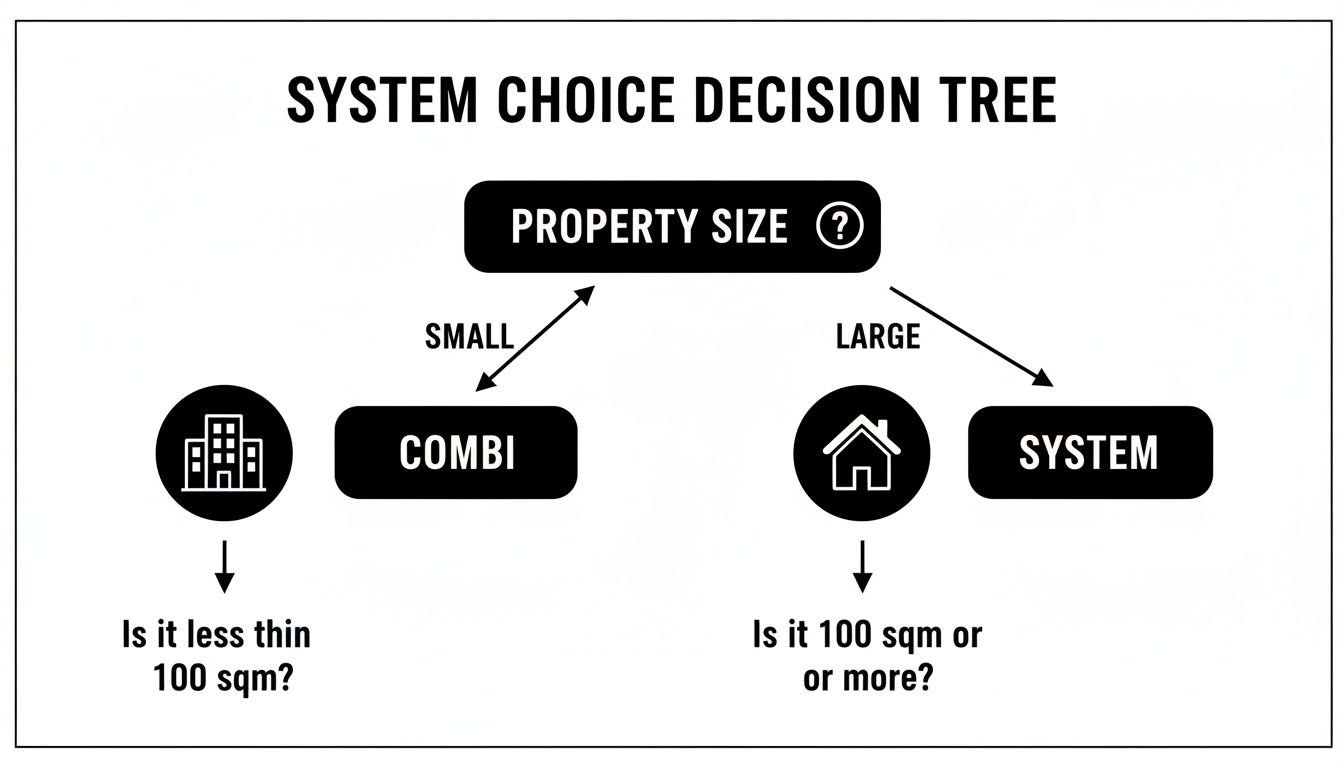
As the diagram shows, smaller properties almost always lead to a combi boiler, while larger homes get the most from the powerful output of a system boiler paired with a tank.
Let’s put this into practice with a few real-world London examples to see how the hot water tank vs combi boiler debate really stacks up.
For a 1-2 bedroom flat in Greenwich with limited storage: A combi boiler is the clear winner here. Its all-in-one design frees up what would have been the airing cupboard, and its on-demand heating is perfectly efficient for one or two people.
For a 4-bedroom family home in Lewisham with three bathrooms: You’ll want a system boiler with a high-capacity unvented cylinder to prevent the morning rush hour arguments over hot water. It's built to handle multiple showers and taps running at once, guaranteeing everyone gets a powerful, consistent flow.
The best heating system is the one you don’t have to think about. It should just work, delivering hot water and warmth without getting in the way of your family’s routine—whether that means saving space or supplying multiple bathrooms at the same time.
At the end of the day, this guide gives you the framework, but only a professional assessment can account for things like your home's insulation, the state of your pipework, and your mains water pressure. Every property has its own quirks, and a tailored recommendation is the only way to be certain you're getting the best performance and long-term value.
Ready to find the perfect heating solution for your London home? Contact Urbanic Services today for a personalised, no-obligation assessment from one of our Gas Safe registered engineers. We’ll help you make a confident investment in your home’s comfort and efficiency.
Still on the Fence? Let’s Clear Up a Few Common Questions
Even after weighing the pros and cons, it's normal to have a few nagging questions. We hear them all the time from London homeowners trying to decide between a hot water tank and a combi boiler. Here are some straight-talking answers to the most common queries we get.
Can I Swap My Old Hot Water Tank for a Combi Boiler?
Absolutely. In fact, this is probably the most popular heating upgrade we carry out across London. It's a well-trodden path.
The job involves removing your old boiler, the hot water cylinder (goodbye, airing cupboard!), and any water tanks you might have in the loft. We then install a compact new combi boiler and adjust the pipework to suit. While it’s a bit of work, the space you gain back is a massive win, especially in a city where every square foot counts.
Is a Combi Really Powerful Enough for a Home with Several Bathrooms?
This is where you need to be honest about how your family uses water. A standard combi boiler will likely struggle if you want to run two powerful showers at the exact same time. You’ll probably notice a drop in pressure.
However, modern, high-capacity combis are a world away from the older models and can handle more than you'd think.
For a busy family home where multiple hot taps are often running at once, a system boiler paired with a properly sized unvented hot water cylinder is still the king. It’s the only way to guarantee everyone gets strong, consistent hot water without any arguments.
What Happens If My Combi Boiler Breaks Down?
Here’s the main trade-off with a combi boiler. Because it’s a single unit that does everything, a breakdown usually means you lose both your heating and your hot water. You’ll be without either until an engineer can get it sorted.
A system with a separate hot water tank has a handy backup plan. Most cylinders have an electric immersion heater fitted. If your gas boiler gives up, you can switch on the immersion heater to get hot water while you wait for a repair. It’s a crucial difference in reliability that’s well worth considering.
Which System Is Better for Smart Heating Controls?
Good news – both systems work brilliantly with modern smart controls like Nest or Hive. They just use them in slightly different ways to boost your efficiency.
- With a Combi Boiler: Smart thermostats give you pinpoint control over your heating schedules from your phone, which is a great way to trim your energy bills.
- With a Tank System: Smart controls really shine here by managing your cylinder's heating schedule. You can make sure the water is only heated right when you need it, which drastically cuts down on the standing heat loss that traditional timers can't avoid.
Ultimately, adding smart controls is a smart move for either system, making them more convenient and efficient.
Choosing the right system is a big decision and a major investment in your home. For honest, expert advice tailored specifically to your London property, get in touch with Urbanic Services Ltd. Our Gas Safe registered engineers can provide a personalised, no-obligation assessment to find that perfect balance of performance, efficiency, and value. Get your free quote today.