
A boiler leaking water often announces itself at the worst time. You go to the kitchen, utility room or airing cupboard, spot a small puddle under the casing, and your mind jumps straight to worst-case scenarios. Has the boiler failed? Is it dangerous? Will the ceiling below get damaged? How much is this going to cost?
That reaction is normal. Water near any heating appliance gets people worried quickly, and in some cases it should. But panic leads to bad decisions. Homeowners often keep topping pressure up, keep running the heating, or call for an emergency visit when what they are seeing is not a true leak.
The useful approach is calmer and more practical. Find where the water is coming from, look at the pressure, separate normal discharge from a fault, and then decide whether you need a routine repair or an urgent call-out. In London, there is another layer to this. Hard water causes problems that many generic guides barely mention, especially corrosion inside older boilers and faster wear on valves and heat exchangers.
That Dreaded Puddle A First Look at a Leaking Boiler
The story is familiar. The heating has been working, then one morning there is water under the boiler and a faint drip sound from inside the casing or from a nearby pipe. Sometimes the pressure gauge has crept up. Sometimes it has dropped. Sometimes the boiler is still running, which makes the whole thing more confusing.
I see two common reactions from London homeowners. One group ignores it because the boiler still fires. The other group assumes the entire appliance is finished. Neither response is ideal.
A boiler leaking water is not something to leave for days, but it also does not mean replacement. Many leaks start with a serviceable fault such as a pressure relief valve issue, a failing seal, or a seeping joint. Other leaks point to a more expensive internal problem, especially on older combi boilers in hard-water areas.
Why London homes get caught out
Older housing stock changes the picture. Boilers in ageing flats, terraces and conversions often sit on systems with mixed pipework, older controls, and water quality issues that speed up internal wear. That matters because pressure faults and corrosion do not always show themselves gradually. They often show up as that first puddle.
Tip: If you find water under the boiler, do not wipe it away and forget it. Dry the area, place a tray or towel beneath it, and check again after the heating or hot water has been used. That simple check helps distinguish an old spill from an active leak.
What matters now is avoiding guesswork. It is narrowing the fault down safely and quickly to prevent water damage, electrical risk, or a small repair turning into a bigger one.
The Six Common Culprits Behind Boiler Leaks
A boiler usually leaks for one of six reasons. The difficulty is that very different faults can leave water in the same place, especially at the bottom of the case or on the pipework beneath it.
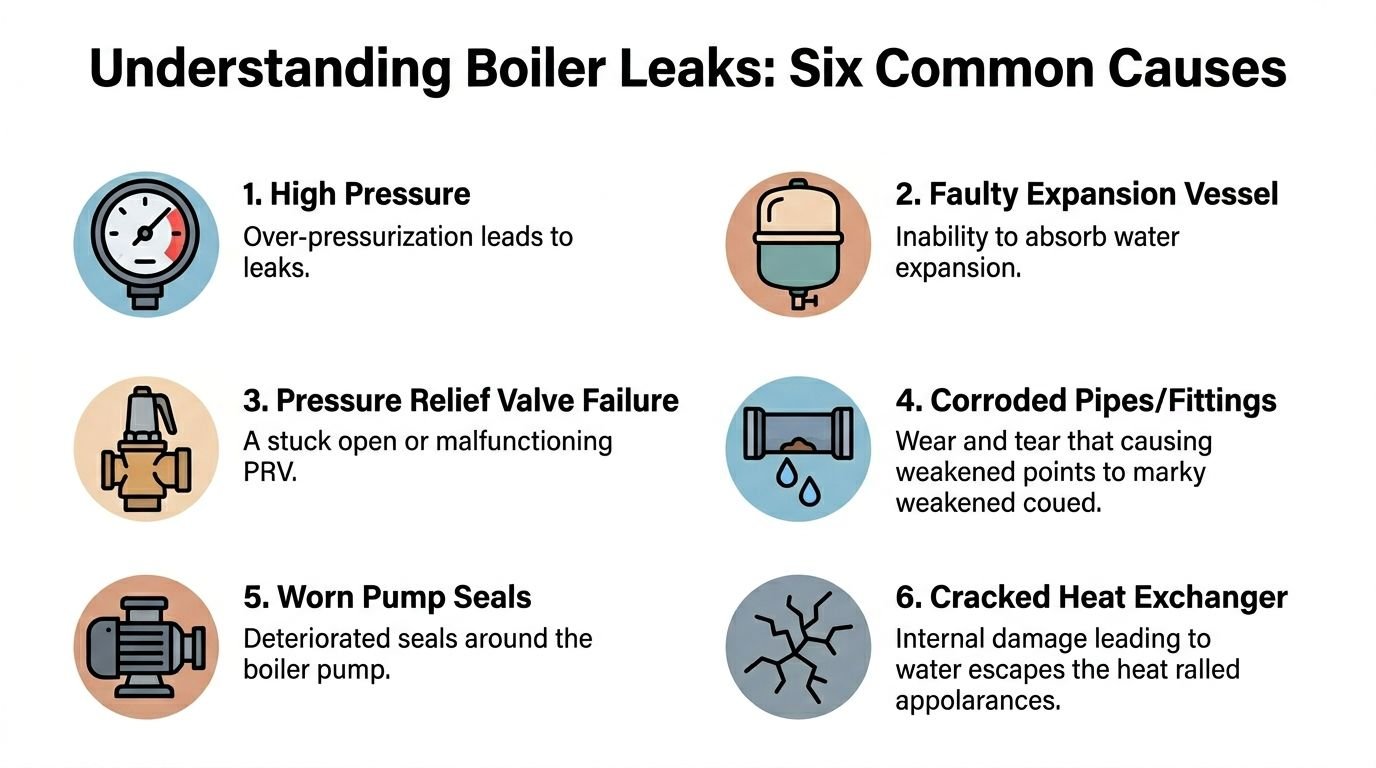
High pressure in the system
Pressure problems sit near the top of the list. A sealed system needs the right cold pressure to circulate properly, but once it starts running too high, water will find the weakest point and escape.
In most homes, the gauge should sit around 1 to 1.5 bar when the system is cold. If it keeps climbing once the heating fires, or regularly sits too high, stop topping it up through the filling loop and check the wider pattern. This guide on why a boiler keeps losing pressure explains one side of that issue, but pressure that rises too far can be just as telling.
Watch for these clues:
- Pressure rising sharply as the boiler heats up
- Water dripping from the copper discharge pipe outside
- A relief valve that has opened and does not seal cleanly afterwards
In practice, high pressure is often the symptom, not the root fault.
Faulty expansion vessel
The expansion vessel absorbs the increase in water volume as the system heats. If it loses its air charge, or the internal diaphragm fails, the pressure has nowhere to go. The result is a boiler that seems fine when cold, then leaks or discharges water once it gets up to temperature.
This is one of the faults homeowners misread most often because the leak can appear intermittent. I see it regularly on older combis across London, particularly where annual servicing has been missed and nobody has checked the vessel charge for years.
Internal corrosion and a cracked heat exchanger
London homes present a different situation here. Hard water accelerates scale build-up, and scale drives higher operating stress inside the heat exchanger. Add older system water, poor inhibitor levels, or mixed metals in ageing pipework, and internal corrosion becomes far more likely than many national guides suggest.
A leaking heat exchanger is one of the more expensive outcomes because the part itself can be costly and labour is heavier. On some boilers, a heat exchanger replacement makes sense. On older models, the numbers can push the job close to replacement territory. That trade-off matters in London, where labour, parking, and parts delays can all affect the final bill.
Typical signs include:
- Water collecting underneath the boiler with no obvious external joint leaking
- Corrosion marks or staining inside the case
- A leak that gets worse as the boiler heats and cools
Pump or valve seal failures
Pumps, diverter valves, automatic air vents and similar components all rely on seals. Heat cycling hardens those seals over time, and hard-water systems do them no favours.
These faults usually start as a slow seep. The awkward part is that water often tracks along the underside of a component or copper pipe before it drops off, so the visible drip point is not always the true source. A proper diagnosis takes tracing it back, not just tightening the nearest nut.
Pipe joints and fittings
Sometimes the boiler is innocent. The leak comes from an isolation valve, compression joint, filter body, or a fitting on the immediate pipework.
That is common in London properties with older alterations, cramped cupboards, and layers of previous repair work. I often find a minor seep where pipework has been disturbed during another job, or where vibration has worked on a tired joint over time. These are often among the cheaper fixes, provided the leak has not been left long enough to damage electrics or casing panels.
Condensate and related drainage issues
Modern condensing boilers produce acidic condensate as part of normal operation. If the trap is cracked, the waste connection is loose, or the condensate pipe is partially blocked, water can appear around the base of the appliance.
Condensate leaks usually look different from heating-system leaks. The water is often cleaner, cooler, and tied to the waste side of the boiler rather than the pressurised circuit. In winter, I also see frozen external condensate runs in London causing backing up and internal dripping.
Key takeaway: The puddle is only the symptom. The underlying cause could be pressure, an expansion vessel, internal corrosion made worse by London’s hard water, a failed seal, a nearby joint, or a condensate fault.
Your First Steps Safe Diagnosis and Shutdown
The first job is not repair. It is making the situation safe and gathering enough information to avoid guesswork.
Start with the pressure gauge
Look at the pressure reading with the boiler cool if possible. If it sits well above the normal range, do not keep adding water through the filling loop. That is one of the most common mistakes I see after a homeowner notices a fault.
If the pressure is above the usual level and you are comfortable doing a simple check, bleeding a radiator can help confirm whether excess pressure is part of the issue. If the pressure remains unstable, the system needs a proper inspection.
Work out where the water begins
Dry the area thoroughly first. Then check after the boiler has run.
Look for these clues:
- From the copper discharge pipe outside: This points toward pressure relief activity.
- From a visible nut, valve or pump body: More likely a local seal or joint fault.
- From inside the casing with no obvious external source: Internal components need inspection by an engineer.
- From a white plastic pipe or trap connection: Condensate side fault is possible.
Do not remove the boiler casing unless you are qualified to do so.
Know the difference between discharge and a true leak
Much anxiety comes from misunderstanding the pressure relief valve. Industry data suggests many boiler “leak” callouts are normal discharge when pressure temporarily exceeds 3 bar during a heating cycle. A continuous drip points to a genuine fault, as explained in this PRV discharge guidance for homeowners.
That distinction matters. A brief release during a hot cycle is not the same as a valve that keeps passing water all day.
Shut it down if needed
If water is actively dripping or pooling, take these steps in order:
- Turn the boiler off at the controls: This stops normal firing and circulation.
- Isolate the electrical supply if safe to do so: Use the nearby fused spur or switched isolator.
- Close the water supply to the boiler if the installation has an accessible isolation valve: This can limit ongoing leakage on some faults.
- Protect nearby flooring or units: Towels and a shallow tray help prevent secondary damage.
- Do not restart the boiler repeatedly: That can worsen pressure-related faults and internal leaks.
Tip: If water is near wiring, the fused spur, or any exposed electrical point, stop touching valves and switches around the appliance and arrange professional attendance.
When a Leaking Boiler Becomes an Emergency
Not every leak needs an out-of-hours call. Some do. The difference comes down to risk, not annoyance.
A scheduled repair is usually enough when
A routine appointment is reasonable if the leak is slow, contained, and away from electrical components. For example, a small drip from a visible compression joint, a minor seep from a valve body, or occasional discharge that only appears briefly during heating can often wait for the next available slot.
You should still switch the boiler off if the leak is active. “Non-urgent” does not mean “safe to ignore”.
It becomes urgent when water volume rises
An emergency starts when the leak moves beyond a drip.
Use this practical rule of thumb:
- Slow drip: Usually manageable for a booked repair if isolated safely
- Steady trickle: Escalating fault. Better treated quickly
- Flowing water or repeated pooling despite towels or a tray: Emergency attendance is the right call
A leaking boiler can damage flooring, kitchen units, ceilings below, and adjacent electrics long before the appliance itself becomes the biggest cost.
Location changes the risk
A small leak near the right component is more serious than a larger leak in a harmless spot.
Immediate action is warranted if water is:
- Running onto electrical controls or wiring
- Entering the boiler casing around live components
- Dripping through ceilings or into concealed spaces
- Appearing near gas-related controls or connections
Water and electrics are enough reason to treat the job urgently even before you know the exact cause.
Boiler behaviour matters too
Pay attention to the appliance's behavior alongside the leak. A boiler that is leaking and also locking out, making unusual noises, or cycling unpredictably is telling you more than one component may be affected.
A landlord or managing agent handling this remotely should ask the occupier three things only: how much water, exactly where, and whether the boiler is still operating normally. Those answers usually sort a same-day emergency from a next-day repair.
Key takeaway: The important question is not “Is there a leak?” It is “Can this leak damage the property, affect electrics, or worsen quickly if left alone?”
Likely Repair Options and Associated Costs in London
Once the fault is pinned down properly, the spending decision gets much easier. In London homes, the same leak can have very different repair values depending on boiler age, access, and whether hard water has already started damaging nearby parts.

What usually affects the price
The labour is only part of the bill. The primary cost is driven by what has failed, how long the leak has been left, and whether scale or corrosion has caused secondary damage.
In London, hard water often turns a simple pressure fault into a wider repair. I regularly see a passing PRV or tired expansion vessel sitting alongside scale build-up, staining, and early corrosion on fittings. That is why a proper diagnosis matters more than the first part you can see dripping.
Repair by fault type
| Fault type | Typical repair approach | Likely cost position |
|---|---|---|
| PRV passing water | Replace valve, test system pressure, then check what caused it to open | Usually lower end |
| Expansion vessel fault | Recharge vessel if serviceable, replace if failed, then confirm stable pressure hot and cold | Lower to middle range |
| Seeping joint or valve | Reseal or replace the affected fitting, then inspect nearby pipework for corrosion | Often lower end if caught early |
| Pump seal leak | Replace seals or the full pump assembly, depending on model and wear | Middle range |
| Condensate leak | Renew trap, connection, or damaged waste section | Lower to middle range |
| Heat exchanger leak | Replace exchanger, or price up boiler replacement if repair value is poor | Highest cost category |
Small parts can still lead to awkward jobs. A cheap valve on paper is no longer cheap if the casing has to come apart, seized fittings need freeing off, or access is tight in a London flat cupboard.
The repair that changes the conversation
Heat exchanger leaks are usually where repair stops being the obvious answer. If the exchanger is cracked or heavily corroded, the bill climbs quickly and the boiler's remaining life needs an honest review.
On older appliances, I would not judge that repair on the exchanger alone. I would also look at burner condition, fan noise, parts availability, service history, and signs of scale from London's hard water. If several of those are poor, replacement is often the cleaner decision financially.
Repair or replace
Repair is usually sensible when the boiler is relatively modern, the leak comes from a serviceable component, and the rest of the appliance is in decent order.
Replacement becomes more likely when:
- The heat exchanger has failed
- The boiler has a pattern of recent faults
- Corrosion is visible in more than one area
- Parts are becoming difficult to source
- The repair cost is too close to the value of keeping the existing boiler going
There is a trade-off here. A lower repair bill can still be poor value if it only delays a larger failure by one winter.
What a proper diagnosis should include
A decent engineer does more than swap the wet part. The job should include pressure checks, inspection of the leak path, and a reasoned view on why that component failed in the first place.
If you book a professional boiler repair service in London, expect a clear explanation of the fault, what can be repaired now, and whether hard water or corrosion is likely to cause the same problem again. Topping the pressure up repeatedly, using leak sealants, or replacing one visible part without checking the rest of the system usually leads to another callout.
Preventing Future Leaks with Proactive Boiler Care
A lot of London homeowners first notice the pattern in winter. The boiler still runs, but the pressure needs topping up more often, one radiator stays half-cold, and there is a faint mark under the casing that was not there last month. That is usually the point to act. Leaks rarely start as a dramatic failure. They build from small signs that get missed.
What homeowners can do themselves
You do not need specialist tools to spot early trouble.
A sensible routine includes:
- Check the pressure occasionally: Learn what the normal cold reading is for your boiler, then notice if it starts dropping between top-ups.
- Look around the boiler and pipework: Fresh staining, green deposits on copper, or repeat dampness around valves and joints should not be ignored.
- Keep an eye on the discharge pipe outside: If it is dripping regularly, that can point to pressure or expansion vessel issues.
- Notice changes in sound or behaviour: Gurgling, kettling, banging, lockouts, or frequent resets often show up before a visible leak does.
- Bleed radiators when needed: Air in the system affects circulation, but repeated air build-up can also point to a wider system problem.
These checks help you catch a fault earlier. They do not replace inspection by an engineer.
Why London boilers need closer attention
London’s hard water changes the maintenance picture. Scale builds up faster inside heat exchangers and other wet components, and that extra stress raises the chance of overheating, corrosion, seal failure, and poor circulation. In older systems, I often find that the leak is only the final symptom. The water quality has been causing damage for years.
That is why generic advice from national articles often misses the mark for this city. A boiler in a hard-water part of London usually needs more attention to inhibitor levels, system cleanliness, and early signs of internal wear than the same model in a soft-water area.
For landlords and managing agents, this is not only a repair issue. It affects budgeting and scheduling across multiple properties with the same water conditions.
Tip: If your boiler is over a few years old and the property is in a hard-water area, ask specifically whether the engineer has checked system water quality, inhibitor protection, and any signs of scale-related corrosion.
Annual servicing is the practical line of defence
Regular servicing lowers the chance of being caught out by a leak in the middle of the heating season. It also gives you a record of pressure behaviour, component condition, and early corrosion before water starts escaping onto floors, cupboards, or ceilings below.
The trade-off is straightforward. Planned maintenance costs less than emergency attendance, repeat callouts, and repairing damage to surrounding finishes. In London flats, where a leak can affect a neighbour’s property as well as your own, delaying maintenance can get expensive quickly.
A useful overview of what proper maintenance involves is below.
What a proper service should achieve
A proper annual visit should do more than confirm the boiler fires up. It should include combustion checks, pressure testing, inspection for staining or active seepage, assessment of the expansion vessel and safety devices, and a look at system water condition. On London systems, I would also expect attention to scale risk and signs that hard water is shortening component life.
For homeowners who want fewer surprises, regular boiler servicing is the clearest way to pick up pressure faults, vessel problems, and corrosion before they turn into a puddle on the floor.
A boiler leaking water is usually a symptom of wear somewhere in the system. Stopping the current leak matters. Reducing the chance of the next one matters just as much.
If your boiler is leaking water and you want a clear diagnosis without guesswork, Urbanic Services Ltd provides Gas Safe registered boiler repairs, servicing and planned maintenance across London. Whether you are a homeowner in Greenwich, a landlord in Lewisham or a property manager dealing with repeated heating issues, the team offers fixed-price quotations, responsive booking and practical advice on whether your boiler is worth repairing or better replaced.