
You’ve got the keys. The survey looked manageable. The boiler fired on during the viewing. The agent said the house had “character”, which usually means someone made three decades of decisions behind plasterboard, under floorboards, and around pipe runs you haven’t seen yet.
That’s especially true in blackheath.
A home here can be a brilliant long-term buy. It can also ask more from you than a newer flat would. Older heating systems, draught-prone joinery, patched extensions, buried drainage issues, and water entry after heavy rain all tend to show up slowly, not on day one. If you’re a landlord, there’s another layer on top. You need a plan that protects the building, keeps tenants safe, and makes sense against looming EPC expectations.
The right approach isn’t panic spending. It’s sequencing. Start with safety. Get clear on the fabric of the house. Fix what causes damage first. Then upgrade the parts that improve comfort, resilience, and running costs over time.
Welcome to Blackheath A Unique London Village
Buying in blackheath often feels like a trade many owners are happy to make. You accept the quirks of an older London property because the setting is hard to beat. Step outside and you’ve got the heath, the village feel, independent shops, and quick rail links when work still pulls you into central London.

Why the area feels different
Blackheath has a distinct rhythm. Streets can feel calm and residential, then you turn a corner and the open heath changes the whole sense of space. That matters for homeowners because people don’t just buy a house here. They buy into the setting around it.
That sense of place has deep roots. Blackheath has been a historic rallying point for major English rebellions, including Wat Tyler’s Peasants’ Revolt in 1381, when around 100,000 rebels assembled on the heath. Its role was reinforced by Jack Cade’s Rebellion in 1450 and the Cornish Rebellion in 1497, long before it was formalised as a 270-acre public open space in 1871, as noted by Encyclopaedia Britannica’s history of Blackheath.
Older areas with that kind of history usually come with tighter planning expectations, more period detailing, and stronger owner interest in preserving original features. That affects practical decisions. A boiler flue position, replacement windows, or even external pipe boxing can become more sensitive than it would be elsewhere.
What homeowners often realise after moving in
The first surprise is rarely dramatic. It’s the small stuff.
- Heating response gets your attention first. Many period homes warm up slowly and cool down quickly if insulation and controls haven’t kept pace.
- Water behaviour comes next. Drains may cope fine in normal weather, then struggle during heavy rainfall.
- Previous repairs tell their own story. One replaced radiator beside several old ones, patched pipework under the sink, or a condensate line routed in a way that works until winter hits.
Blackheath rewards owners who think beyond the cosmetic finish. The houses that stay comfortable and hold value are usually the ones where the unseen systems have been sorted properly.
That’s why preserving a blackheath home isn’t only about appearance. It’s about keeping a valuable, character-filled property safe, dry, efficient, and workable for the next decade rather than the next viewing.
The Character and Challenges of Blackheath Homes
A lot of blackheath housing stock asks the same question in different ways. How do you bring an older building up to modern comfort standards without fighting the way it was built?
Victorian terraces, larger villas, and later conversions each have their own habits. The plumbing and heating issues aren’t random. They usually follow the fabric of the building.
What the building fabric usually tells you
Older blackheath homes often combine solid walls, suspended timber floors, chimney breasts, aging drainage, and later heating upgrades layered on top. None of that is automatically a problem. Trouble starts when one part has been modernised and the rest hasn’t.
A few examples show up repeatedly:
- Boilers out of step with the system. A newer appliance connected to dirty pipework, tired valves, and undersized emitters won’t deliver what the label suggests.
- Cold rooms at the edges of the house. Bay windows, single-glazed sash windows, and uninsulated loft areas create uneven heat demand.
- Hidden water issues. Older wastes, patched soil stacks, and exterior gullies can all work adequately in dry weather, then reveal weaknesses under strain.
Typical weak points in period homes
The main challenge isn’t that old houses are bad. It’s that they’re unforgiving of half-measures.
| Area of the home | Common issue | What tends to work |
|---|---|---|
| Loft space | Heat escaping through poorly insulated roof areas | Upgrade insulation and improve ventilation together |
| Windows and doors | Draughts and uneven room temperatures | Repair seals where possible, then plan sympathetic upgrades |
| Pipework | Mixed-era repairs and awkward routing | Trace the whole run before replacing sections |
| Radiators | Sludge, imbalance, weak output in larger rooms | Flush where needed, rebalance, and match radiator size to room use |
| Sub-floor and drains | Damp smells, slow drainage, hidden leaks | Inspect access points and clear defects before cosmetic works |
Where owners lose money
The expensive mistakes usually follow a pattern.
First, someone treats a comfort issue as a boiler issue when the cause is heat loss or poor circulation. Second, they spend on visible finishes before checking drains, incoming pipework, or ventilation. Third, they replace parts piecemeal until the system becomes a mix of old and new that no longer works cleanly together.
Practical rule: If two or three rooms behave differently from the rest of the house, don’t assume the boiler is failing. Look at system balance, emitter sizing, controls, and insulation before replacing major equipment.
The houses that perform well in blackheath usually have a joined-up approach. Heating, plumbing, ventilation, and fabric upgrades need to support each other. If they don’t, owners keep paying to chase symptoms.
Your Year-Round Home Maintenance Checklist
Most emergency call-outs in older homes don’t start as emergencies. They start as ignored warning signs. A dripping overflow, a gutter that’s been full of leaves since autumn, a sluggish outside drain, a radiator that never quite heats evenly. Keep on top of those and the house gets easier to run.
Blackheath owners need to think about maintenance with local weather in mind. The area is vulnerable to surface water flooding from heavy rainfall, and Greenwich and Lewisham saw over 150 flood warnings in 2025, with 20% higher flood damage claims than the London average, according to this community report on local flood impacts and resilience gaps. That makes drainage checks and flood-resilient plumbing decisions more than a nice extra.
Autumn and winter priorities
Autumn is the season that sets up winter performance.
- Clear gutters and hoppers. Overflowing rainwater can saturate walls, find weak points around penetrations, and add unnecessary damp pressure around the property.
- Check outside drains. Lift covers where it’s safe to do so, remove debris, and make sure water runs away freely.
- Bleed radiators and note patterns. If one radiator needs constant bleeding or several stay cool at the bottom, the system wants attention before cold weather deepens.
- Insulate exposed pipework. Pay attention to lofts, cupboards on external walls, and vulnerable condensate runs.
Once winter arrives, keep checks simple and regular.
- Watch boiler pressure. If it drops repeatedly, don’t keep topping it up without finding the cause.
- Listen for changes. Kettling, banging, or pumps running noisily often point to circulation or component issues.
- Test stopcocks. You don’t want to discover a seized stopcock during a leak.
If the heating fails and you need a fast diagnosis, it helps to know when the problem is routine and when it needs urgent attendance. A local boiler repair service is most useful when you can describe the symptoms clearly, including fault codes, pressure behaviour, and whether hot water is affected as well as heating.
Spring and summer jobs people skip
Spring is when winter damage shows itself. That’s the time to inspect before repainting or refurbishing covers over the evidence.
- Look at exterior pipe clips and seals after cold weather.
- Run outdoor taps and garden lines slowly, checking for cracks or leaks.
- Book the annual boiler service after peak winter use rather than waiting until the first cold week of the next season.
- Check mechanical extraction and background ventilation in kitchens and bathrooms.
Summer is the right time for larger work because disruption is easier to tolerate.
| Season | Best focus |
|---|---|
| Autumn | Rainwater goods, drains, heating prep |
| Winter | Pressure, freeze protection, fast fault response |
| Spring | Post-winter inspection, service, external plumbing |
| Summer | Upgrades, insulation works, ventilation improvements |
If your property has any history of water entry, don’t treat that as a one-off storm problem. Trace the route, improve drainage resilience, and protect vulnerable services before the next heavy rainfall event.
Future-Proofing Your Home with Energy-Efficient Upgrades
Maintenance keeps a house stable. Upgrades change how it lives.
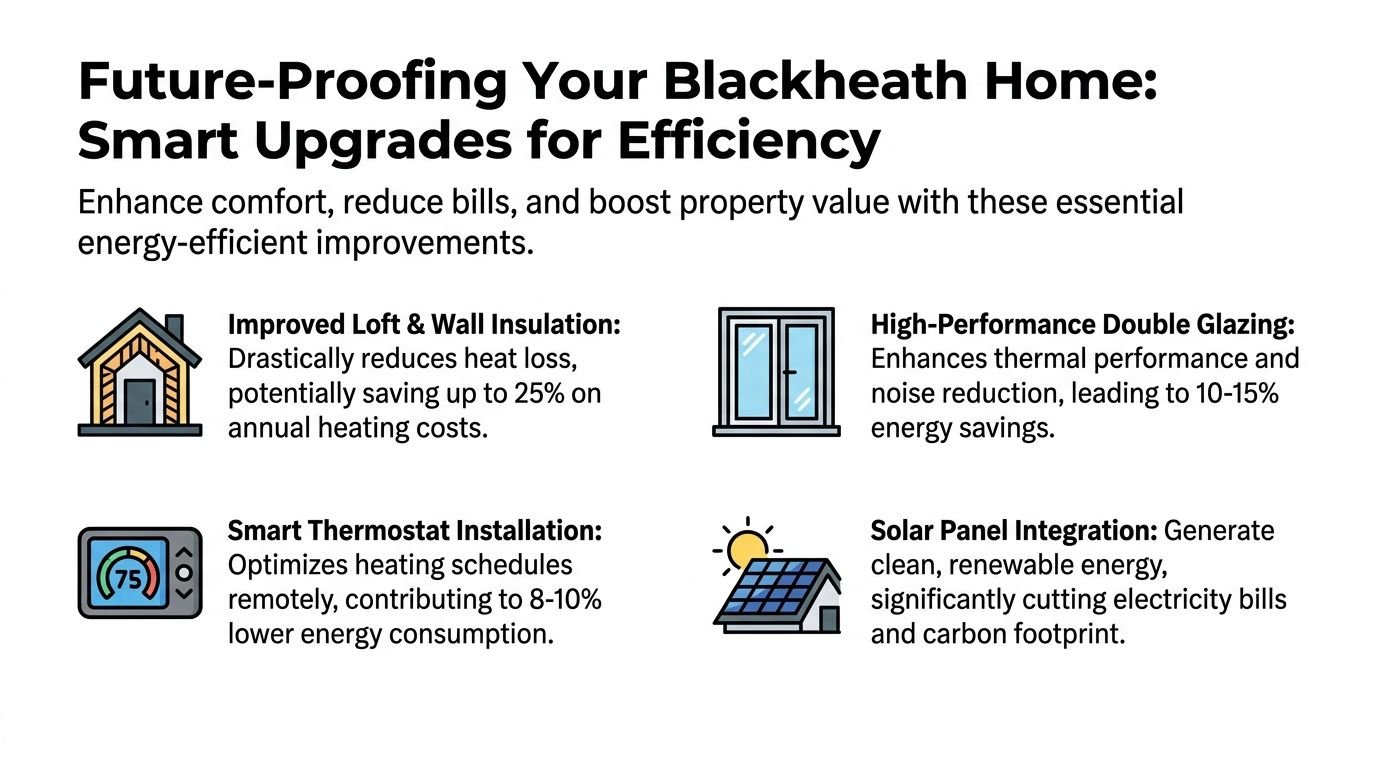
That matters in blackheath because many homes are good-looking but energy-hungry. A smart upgrade plan doesn’t mean ripping everything out. It means putting money into the changes that improve comfort, reduce waste, and fit the building.
A useful local benchmark already exists. The Blackheath Station redevelopment uses Air Source Heat Pumps, PV panels, energy-efficient lighting, and mechanical ventilation with heat recovery in a highly insulated envelope that exceeds Part L 2021 standards. The planning statement says these systems can reduce gas dependency by up to 80%, cut space heating energy by 40 to 60% in similar local retrofits, and may be supported by ECO4 grants of £5,000 to £10,000 in relevant cases, as set out in the Blackheath Station redevelopment planning statement.
What usually delivers the best return
In practice, older homes respond best when upgrades are stacked in the right order.
Start with heat loss. If the loft is weak, the windows are draughty, and uncontrolled ventilation is pulling warmth out, even a good boiler or heat pump has to work harder than it should.
Then address control. Many blackheath homes still waste energy because the heating comes on in broad blocks rather than matching how the house is used. Smart controls such as Hive or Nest can help, but only when zoning, radiator performance, and scheduling are sensible.
Then match the heat source to the house. For some owners, that means replacing an ageing boiler with a modern A-rated condensing model. For others, especially during larger refurbishments, low-carbon options become more realistic if insulation and emitter upgrades happen first.
What works and what doesn’t
A few trade-offs are worth saying plainly.
- A new boiler won’t fix an under-radiated house. If large rooms have small emitters, comfort will still be poor.
- Smart thermostats don’t rescue bad habits on their own. If the schedule is wrong or rooms are overheating because lockshields were never balanced, app control won’t solve it.
- Heat pumps need preparation. They work best when the house is insulated properly and the system is designed for lower flow temperatures.
The same planning statement notes practical specifications such as ASHP coefficients of performance typically ranging from 3.5 to 4.5 under UK climate conditions, with SCOP above 3.0 per MCS 020, and operation even at -15°C. For a homeowner, the technical takeaway is simple. Design matters more than the headline technology.
This short video gives useful visual context on how modern low-carbon heating fits into a broader home efficiency plan.
Upgrades that suit blackheath homes
A sensible package often looks like this:
- Fabric first improvements such as loft insulation and draught reduction.
- Radiator review so output matches room demand.
- Controls upgrade with programmable zoning where practical.
- Hot water and heating plant review based on the size, layout, and long-term plan for the property.
- On-site generation where suitable. Homeowners exploring broader efficiency works may also look at solar panel installation as part of a coordinated upgrade rather than a standalone add-on.
The best upgrade is the one that fits the whole house. In period properties, isolated improvements often disappoint. Linked improvements usually don’t.
Finding a Trusted and Certified Local Contractor
Good work on a blackheath property starts before the first tool comes out. It starts with choosing the right person to trust with gas, water, heat, and the fabric around them.
For any gas work, Gas Safe registration is mandatory. That includes boiler installation, servicing, gas pipe alterations, and fault-finding on gas appliances. If someone can’t show valid credentials for the work they’re pricing, stop there.
What to check before you book
The strongest contractors are usually easy to assess because they don’t dodge basic questions.
Ask for these things up front:
- Proof of Gas Safe registration for gas work, with the engineer’s details matching the business and the category of work.
- Public liability insurance and clarity on who is responsible if finishes, pipework, or connected components are damaged during the job.
- A written quotation that states what is included, what isn’t, and what would trigger additional cost.
- A clear plan for parts and warranties so you know whether you’re getting manufacturer-backed components or generic replacements.
- Recent local references from jobs similar to yours, not just general testimonials.
Red flags that matter
A few warning signs are common.
| Red flag | Why it matters |
|---|---|
| Vague verbal pricing | Disputes usually appear once work has started |
| No system assessment | Boiler and controls decisions made blind often fail later |
| Pushy same-day close | Good contractors rarely need pressure tactics |
| No paperwork after the visit | You need a record for safety, warranty, and property files |
It also helps to notice how the contractor thinks. A strong engineer doesn’t only talk about the appliance. They ask about room temperatures, drain routes, past leaks, insulation, controls, and whether the house will change use in the next few years.
The right questions from your side
Use practical questions rather than broad ones.
- How will you confirm the fault before replacing parts?
- Will you inspect the wider system or only the boiler?
- What disruption should I expect, and what making-good is included?
- If this is a period property, how will you route pipework neatly and legally?
- What happens if you uncover a drainage, ventilation, or water ingress issue that affects the heating work?
A reliable contractor explains trade-offs clearly. If one option is cheaper now but likely to create another problem later, you should hear that before the job starts.
That’s the standard worth holding. Not because every job is complicated, but because older properties punish shortcuts.
A Landlord’s Guide to Compliance and Peace of Mind
Landlords in blackheath face a more complex decision than “repair or replace”. You need heating that’s safe, dependable for tenants, and sensible against energy rules that are tightening around older stock.
The pressure is sharper locally. Forty per cent of housing in SE3 is Victorian, and 25% of rentals are below EPC C rating. The same source states that fines of up to £5,000 per property from April 2026 may apply for non-compliance, while proactive Boiler Care Plans can reduce energy loss by 15 to 20% and lower emergency call-outs by 30%, according to the data cited in this landlord compliance and housing evidence reference.
Why ad hoc repairs cost more than they look
A one-off repair can feel cheaper because the invoice is immediate and limited. The true cost shows up later.
Tenants report the same faults more than once. Temporary repairs sit on tired systems. Annual obligations get handled late. You lose time arranging access, chasing paperwork, and managing complaints during breakdowns that could have been prevented with routine checks.
That doesn’t mean every landlord needs the top tier of cover. It means most landlords benefit from deciding in advance how much risk they’re willing to hold.
Urbanic Boiler Care Plan Comparison
| Feature | Essentials Plan | Complete Plan | Landlord Premier Plan |
|---|---|---|---|
| Annual boiler service | Included | Included | Included |
| Heating controls check | Included | Included | Included |
| Boiler breakdown attendance | Core cover | Broader cover | Priority-oriented landlord cover |
| Gas pipe cover | Not always included | Included | Included |
| Plumbing leak support | Limited | Included | Included |
| Internal and external drains | Not typically included | Included | Included |
| Landlord paperwork support | Basic | Useful for managed properties | Best suited to rental compliance workflows |
| Best fit | Owner-occupiers on a budget | Homes needing wider system cover | Landlords and letting portfolios |
The exact fit depends on the property, tenancy type, and how much of the maintenance burden you want under one arrangement.
How to decide which level makes sense
Here's a simple way to consider it:
- Essentials suits a straightforward property with relatively modern services and an owner who is comfortable handling non-heating issues separately.
- Complete fits older homes where plumbing faults and drainage concerns are just as likely to interrupt occupancy as the boiler itself.
- Landlord Premier makes more sense when you need organised records, less admin, and faster response across a tenancy portfolio.
Landlords should also take carbon monoxide risk seriously, not only because of legal duty but because poor servicing and ageing appliances can create hazards that tenants won’t always spot. It’s worth reviewing boiler and carbon monoxide safety guidance as part of your compliance routine.
For most landlords, the real benefit of a care plan isn’t convenience. It’s predictability. Predictable servicing, predictable records, and fewer avoidable emergencies.
In blackheath, that predictability matters more because older housing stock tends to generate linked faults. A leak can affect electrics. Poor ventilation can affect appliance performance. Delayed boiler attention can turn a manageable issue into a vacant-property problem.
Protecting Your Investment in Blackheath
A blackheath home usually asks for a longer view.
You’re not just maintaining a boiler or replacing a valve. You’re looking after a period property in an area where age, character, weather exposure, and practical compliance all overlap. That’s why the best results come from sequencing jobs properly. Safety first. Water tightness next. Heating performance after that. Major efficiency upgrades once the basics are sound.
For homeowners, that approach protects comfort and avoids paying twice for the same problem. For landlords, it supports compliance, tenant retention, and cleaner long-term budgeting.
A good property plan in blackheath usually has these traits:
- It deals with risk before appearance, especially around drainage, leaks, and gas safety.
- It matches upgrades to the building, not to whatever technology is being marketed hardest.
- It keeps records organised, including servicing, safety checks, and major works.
- It treats flood resilience as part of home maintenance, not a separate issue.
If you’ve recently bought in blackheath, start with a full review of the heating system, visible pipework, drainage condition, ventilation, and insulation weak points. If you’ve owned the place for years, look at what keeps recurring. Repetition is a clue. The house is telling you where the underlying issue sits.
The goal isn’t perfection. It’s a house that stays safe, runs efficiently, handles bad weather better, and doesn’t surprise you with preventable failures.
Frequently Asked Questions
What should I do first if I smell gas at home
Don’t start hunting for the fault yourself. Turn off the gas at the emergency control valve if you know where it is and can do so safely. Open windows. Don’t operate electrical switches. Get everyone out if the smell is strong or persistent, then call the relevant emergency service and a Gas Safe engineer once the immediate risk is controlled.
Should I repair my old boiler or replace it
Use a practical test. If the fault is isolated, parts are available, and the wider system is sound, repair can make sense. If the boiler is paired with recurring controls faults, poor hot water performance, circulation problems, or repeated call-outs across winter, replacement often becomes the cleaner long-term choice. The decision should include the condition of the whole heating system, not just the appliance.
Who is responsible for heating repairs in a rental property
Landlords are generally responsible for keeping heating and hot water systems safe and in working order. Tenants should report faults promptly and use controls properly, but they shouldn’t be left to arrange repairs to landlord-owned systems unless that process has been clearly set out and agreed. Good record-keeping matters because disputes often come down to who reported what, and when.
How do I make an older blackheath home more resilient to heavy rain
Start outside. Keep gutters, gullies, and drains clear. Check where water goes during a downpour. Protect vulnerable pipe runs and low-level service entries. If the property has any history of water ingress, treat drainage and flood-resilient plumbing upgrades as core maintenance, not optional extras.
Are smart controls worth it in a period property
Yes, if the basics are right. Smart controls are most useful when radiators are balanced, the boiler or heat source is working correctly, and the schedule reflects how the house is used. They won’t overcome major insulation defects or badly sized emitters on their own.
If you need practical help with a blackheath property, Urbanic Services Ltd can help with heating, plumbing, boiler servicing, repairs, and energy-efficient upgrades. Whether you want a fixed-price quote for a new boiler, an annual service, or ongoing cover for an older home or rental property, their team offers Gas Safe expertise, clear advice, and support built around long-term performance rather than quick fixes.