
Choosing a new boiler can feel like a minefield of technical jargon. Let's cut through the noise. In the UK, you’re really only looking at three main players: the combi, the system, and the regular (or heat-only) boiler. Each one is built for a different type of home and lifestyle, so getting this choice right is key for your comfort and your bills.
Choosing Your New Boiler: A Quick Comparison
I find it helps to think of them like this:
A combi boiler is the modern, all-in-one solution, a bit like a carry-on suitcase. It’s compact, efficient, and perfect for a flat or smaller house with one bathroom.
A system boiler is your reliable family-sized luggage. It works with a hot water cylinder, so it can handle the demands of a busy household with multiple bathrooms running at once.
Then you have the regular boiler, the old-school classic. Think of it as a full set of vintage trunks—it's designed for older, larger properties that already have the necessary tanks in the loft and an airing cupboard.
Which of these types of boiler UK homes benefit from most comes down to your property’s size, age, and how much hot water you get through. This simple flowchart is a great starting point.
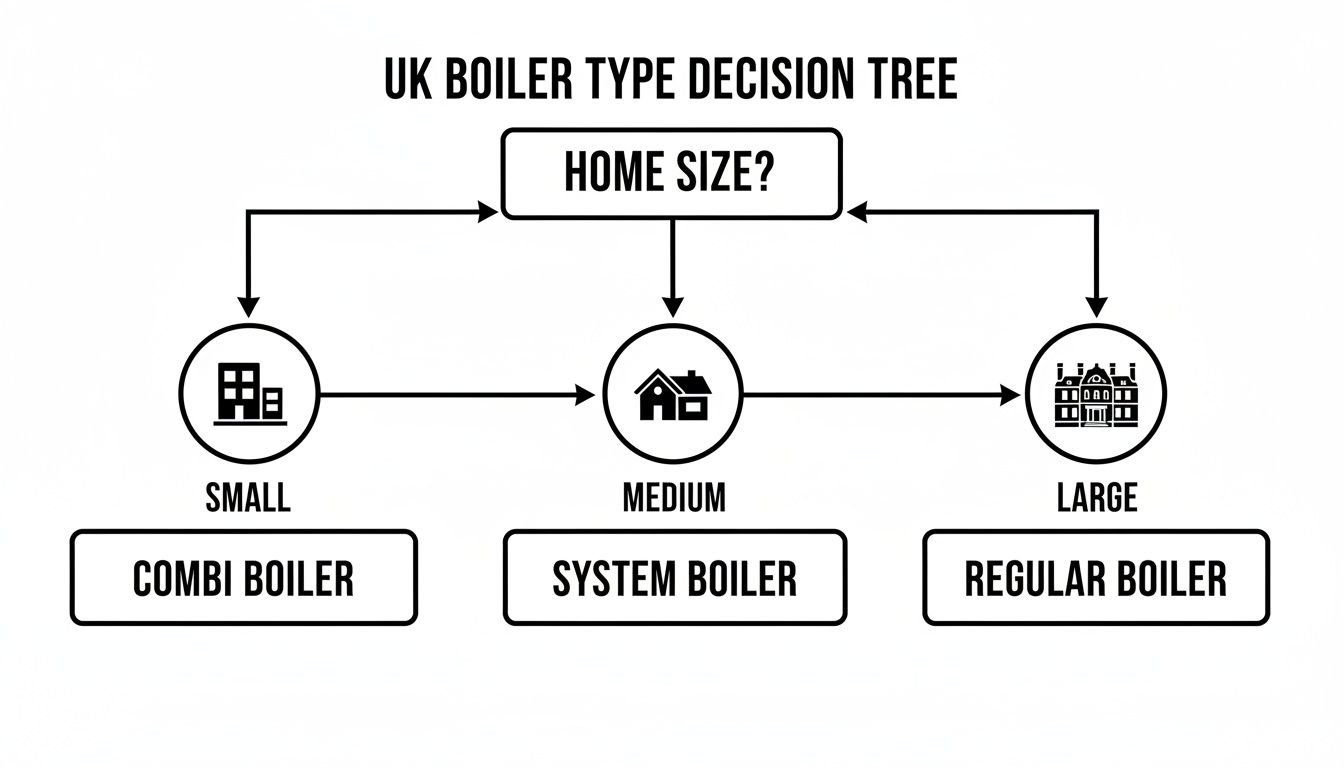
As you can see, the decision often follows a simple logic: combis for smaller spaces, with system and regular boilers stepping in as the demand for hot water grows.
At-a-Glance Boiler Comparison for UK Homes
To give you a clearer snapshot before we get into the finer details, this table lays out the fundamental differences between the three main boiler types.
| Boiler Type | Best For | Space Required | Hot Water |
|---|---|---|---|
| Combi Boiler | Small homes, flats (1-2 bathrooms) | Minimal – no tanks needed | Instant, but pressure may drop with multiple taps |
| System Boiler | Medium to large homes (2+ bathrooms) | Moderate – needs a cylinder | Stored, strong pressure to multiple taps at once |
| Regular Boiler | Large, older homes with existing systems | Significant – needs cylinder and loft tanks | Stored, good for low mains water pressure areas |
This table should help you quickly see which category your home might fall into. Of course, every property is different, and getting an expert to take a look is always the best way to be sure.
If you want a professional assessment for your London home, our boiler installation services are designed to find the perfect, most efficient fit for you.
The Combi Boiler: The Compact Choice for Modern Living
Walk into most modern flats or smaller houses across the UK, and chances are you'll find a combi boiler. There's a good reason why the combination, or 'combi', is far and away the most popular of all the types of boiler UK households have installed. It's the ultimate space-saver.
Think of it as a single, clever box that handles both your central heating and your hot water. It does all this without needing a bulky hot water cylinder or any tanks stashed away in the loft. This makes it a perfect match for modern living, especially here in London where every square metre is precious.
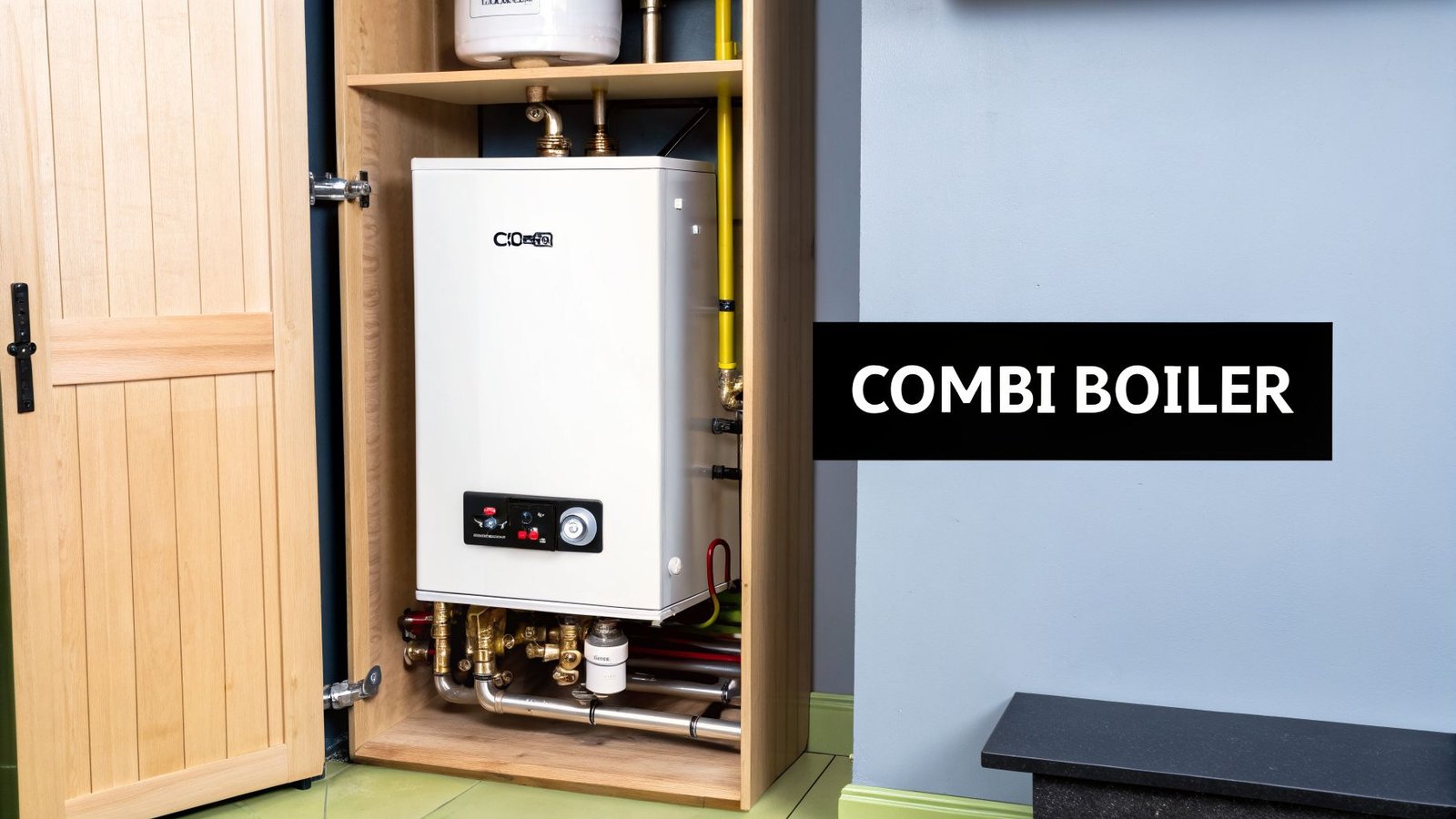
The real magic is how it delivers hot water on demand. The moment you turn on a hot tap, the boiler fires up and heats water directly from the mains. No waiting around. This means you get a seemingly endless supply of hot water, and you’re only ever paying to heat the water you’re about to use.
Why Are Combi Boilers So Popular?
The appeal of the combi boiler really comes down to how well it solves the problems of modern homeowners. Its efficiency and compact size are a winning combination.
Here’s what makes them such a popular choice:
- Space-Saving Design: Without the need for a hot water cylinder or loft tanks, you reclaim valuable storage space. Many modern combis are even small enough to be tucked away inside a standard kitchen cupboard.
- High Efficiency: Because you're heating water instantly, no energy is wasted keeping a tank hot all day. Modern condensing combi boilers can achieve efficiencies of over 90%, squeezing more heat out of every bit of fuel you pay for.
- Cost-Effective Installation: They have fewer parts and less pipework than older system or regular boilers, which means installations are often quicker and more affordable, especially if you're replacing an old combi.
- Instant Hot Water: As long as your boiler is working, you have a continuous flow of hot water right when you need it. No more waiting for a tank to reheat after someone's had a long shower.
These benefits have made gas combi boilers the undisputed leader in the UK's domestic heating market. In cities where space is tight, their affordability and efficiency are a huge draw. A typical like-for-like gas combi boiler swap is projected to cost around £2,820 by 2026, making it one of the most accessible heating upgrades for many.
It’s no surprise, then, that over 80% of UK households still rely on gas, with combi models leading the charge. You can dig into the numbers yourself by reviewing the latest government statistics on boiler upgrades.
What Are the Drawbacks?
For all its strengths, the combi boiler isn't the right solution for every single home. Its on-demand nature comes with a few compromises you need to be aware of.
The main limitation is water pressure. A combi heats water straight from the mains as you call for it, but it can only heat so much at once. If you start running a bath while someone else jumps in the shower, the flow rate gets split between the two, meaning a weaker stream for both of you.
Key Consideration: A combi boiler's performance is directly linked to your home's incoming mains water pressure. If your pressure is low to begin with, even a single shower might feel a bit disappointing.
This is why they're generally less suitable for larger homes with multiple bathrooms that are likely to be used at the same time. Any good heating engineer will always test your mains pressure before even suggesting a combi, just to make sure it has enough oomph to meet your family's needs.
The System Boiler: Powering Homes with High Hot Water Demand
If you’ve found that a combi boiler just can't keep up with your family's needs, it’s time to meet its more powerful sibling: the system boiler. This is the go-to solution for larger homes with multiple bathrooms, bridging the gap between an instant combi and a traditional tank-fed setup.
Think of it this way: a system boiler works by heating a large reserve of water inside a pressurised hot water cylinder. It’s like having a giant, permanently-on-tap kettle, keeping a huge volume of water hot and ready to go. This means someone can be having a powerful shower upstairs while you’re washing up in the kitchen, with no frustrating drops in pressure or temperature for either of you.
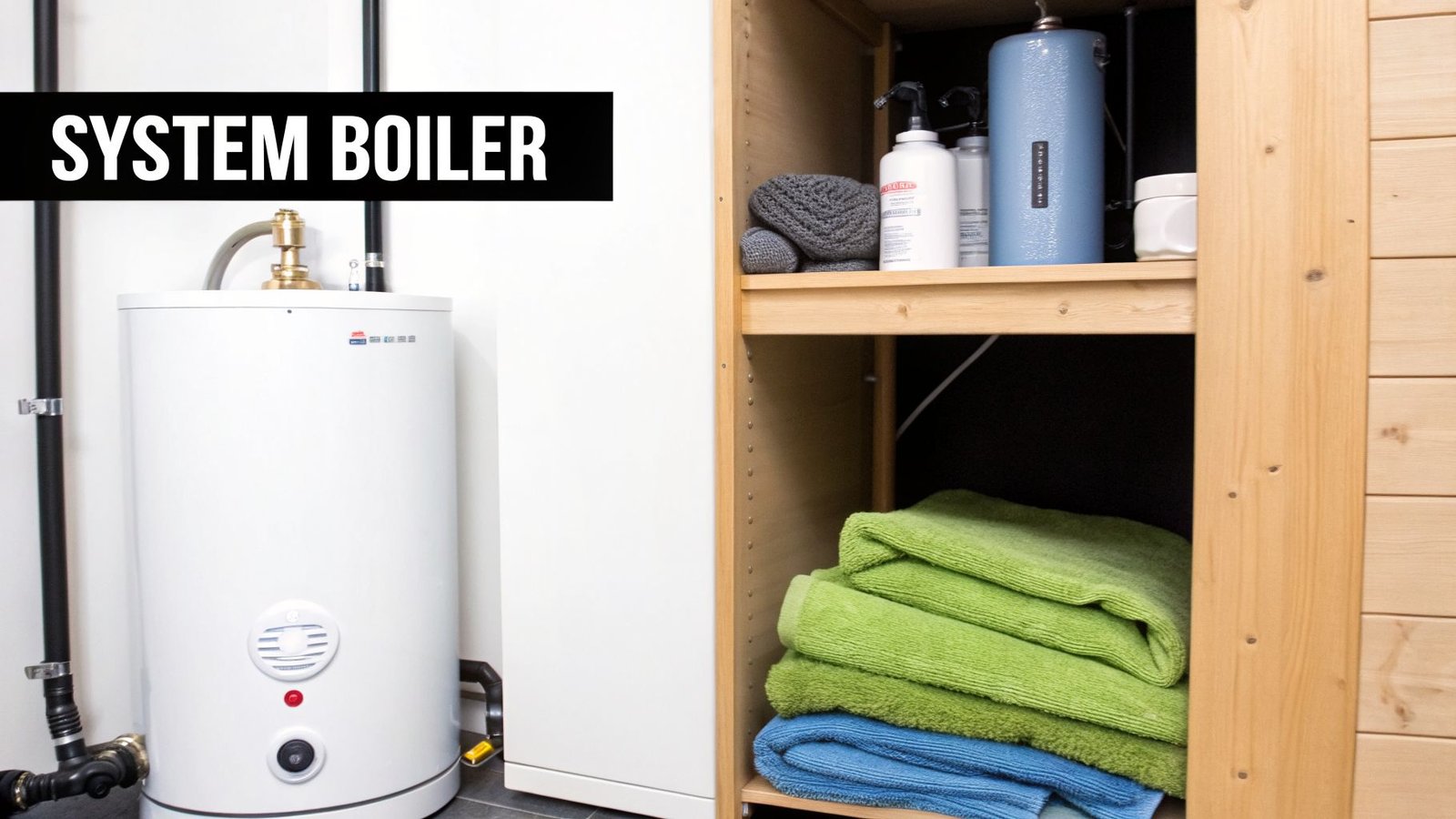
It’s this ability to serve multiple outlets at once that makes it the default choice for busy homes with two or more bathrooms.
How Does a System Boiler Actually Work?
The magic lies in the partnership between the boiler itself and a separate, unvented hot water cylinder. Because the entire system is sealed and takes its water directly from the mains, it can deliver hot water at a consistently high pressure. That’s the secret behind those fantastic, powerful showers you get in homes with a system boiler.
Unlike older, conventional boilers, most of the important components like the pump and expansion vessel are built right into the boiler unit. This makes the installation much tidier and often quicker. Crucially, it means you don't need a cold water feed tank up in the loft, which frees up valuable space and removes the worry of frozen pipes or leaks from above.
Essentially, a system boiler gives you the best of both worlds: the strong, multi-tap performance of a tank-based system, but with the modern efficiency and neater design of a sealed unit. If you're curious about the storage side of things, our guide on how a hot water cylinder works can help you understand if it’s the right fit for your home.
The Main Benefits of a System Boiler
For the right kind of property, a system boiler has some very clear advantages.
- Powerful Hot Water Delivery: It can comfortably supply hot water to several taps and showers at the same time without the pressure dropping off a cliff.
- More Space-Efficient: While you need room for a cylinder, getting rid of the tanks in the loft makes it a far less bulky option than a regular boiler.
- Ready for Renewables: System boilers work brilliantly with solar thermal panels. You can use the sun's free energy to pre-heat the water in your cylinder, which in turn cuts down on your gas or oil bills.
The One Big Catch: The Cylinder
The main thing to consider is space. A system boiler relies on its hot water cylinder, and that cylinder needs a home—usually an airing cupboard. The size of the cylinder will depend on how much hot water your family gets through. While this isn't a problem in most larger houses, it's something you absolutely must factor into your plans, as you can't just tuck the whole system away in a kitchen cupboard.
The Regular Boiler: The Traditional Workhorse for Older Homes
Poke your head into the loft of an older, larger British house, and you'll likely find the components of a traditional heating system. This is the domain of the regular boiler, sometimes called a conventional or heat-only boiler. For decades, this classic three-part system was the standard for keeping UK homes warm and supplied with hot water.
If a combi is a neat, all-in-one smartphone, think of the regular boiler as a powerful, component-based desktop PC. It’s not one single unit but a team of separate parts working together: the boiler itself (often found in the kitchen), a hot water storage cylinder (usually in an airing cupboard), and a pair of water tanks up in the loft.
One of those loft tanks, the feed and expansion tank, is there to keep the radiator system topped up. The other, a much larger cold water storage cistern, uses simple gravity to feed the hot water cylinder below. This reliance on gravity to create pressure is the defining feature of a regular boiler system.
Why Choose a Regular Boiler Today?
With all the modern alternatives, you might think the regular boiler is a thing of the past. But there’s one very compelling reason they are still being installed: the building’s existing plumbing. Many older properties were built with pipework designed specifically for a low-pressure, gravity-fed system.
Those old pipes simply can't cope with the high-pressure water that a combi or system boiler pushes through. To upgrade, you'd have to rip out the entire network of pipes, which is a massive, disruptive, and very expensive job. In these situations, replacing an old regular boiler with a new one is by far the most sensible and cost-effective solution.
A key benefit of this setup is its performance in areas with low mains water pressure. Because it draws from a large cold water tank in the loft, it can provide a consistent flow of hot water even when the incoming supply from the street is weak.
This makes it a reliable choice for homes where the local water pressure just isn't strong enough for a modern pressurised system to work properly.
Pros and Cons of a Conventional System
Just like any of the types of boiler UK homeowners can choose from, the regular boiler has its own set of trade-offs you need to consider.
Key Advantages:
- Ideal for Low Mains Pressure: As we've covered, it's the go-to solution if your home struggles with a weak water supply.
- Multi-Tap Use: Like a system boiler, it draws from a large cylinder, meaning it can easily supply hot water to several bathrooms or a kitchen tap at the same time without the flow dropping off.
- Simple Technology: The design is based on tried-and-tested principles, so most experienced heating engineers know them inside and out.
On the other hand, the downsides are significant, and they’re the main reason people upgrade if their property’s plumbing allows it. The whole system is bulky, demanding space for the boiler, a cylinder, and two tanks in the loft. More importantly, because it constantly has to keep a large tank of water hot, there's ongoing heat loss, making it less energy-efficient than a combi that only heats the water you need, when you need it.
Understanding Boiler Fuel Types: Gas, Oil, and Electric
Once you’ve figured out which type of boiler you need—combi, system, or regular—your next big decision is what will fuel it. This choice doesn’t just affect your monthly bills; it also shapes your home's environmental impact. For most of us in the UK, this comes down to a choice between natural gas, heating oil, or electricity.
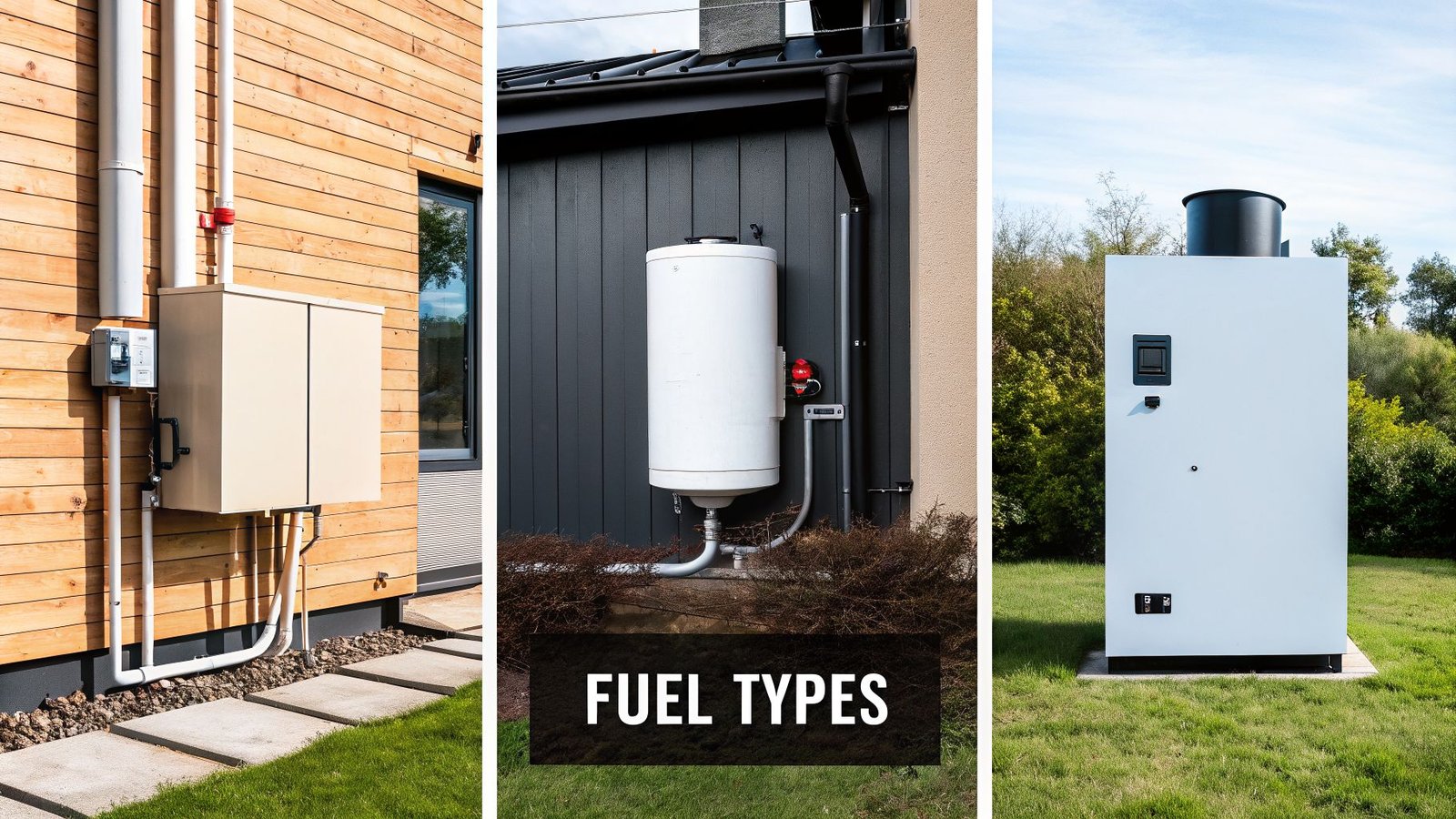
A good way to think about it is like choosing an engine for a car. A petrol engine is the common, reliable standard, much like a gas boiler. A tough diesel engine is often the only practical choice for demanding, long-haul jobs, similar to heating oil in rural areas. Then you have the clean, modern electric engine—perfect for city life—which is exactly the role electric boilers are starting to fill in places like London.
Natural Gas: The UK Standard
For the vast majority of UK homes, natural gas is the go-to fuel for central heating. If your property is already connected to the gas grid, it’s almost certainly your most convenient and affordable option. Gas is piped right into your home, so you never have to think about ordering more or running out.
Modern gas boilers are remarkably efficient. In fact, all new installations must be condensing boilers, which can hit over 90% efficiency. That means less of the fuel you’re paying for goes to waste. This blend of low cost and high efficiency makes gas the benchmark for all other types of boiler UK fuel choices.
Heating Oil: The Rural Lifeline
But what if you live somewhere the gas network doesn't reach? For millions of UK homes in more rural spots, heating oil is the answer. The oil is stored in a large tank on your property and delivered by a local supplier when you need it.
Oil boilers pack a serious punch, delivering heating power that’s on par with gas, and they’re available across all boiler types. They do, however, bring their own unique challenges:
- Storage Space: You’ll need a fair bit of outdoor space for a bulky storage tank.
- Price Fluctuations: The price of oil can swing quite a bit, so timing your purchase is key.
- Delivery Management: It’s up to you to keep an eye on your fuel level and book deliveries, which is crucial to avoid getting caught out in the cold.
While it’s an essential service for off-grid properties, the extra logistics and unpredictable costs mean oil is rarely the top pick if you have a gas connection.
Electric Boilers: The Urban and Green Solution
The third main option, electricity, is quickly becoming a popular choice, especially in specific city situations. Electric boilers are brilliantly simple. They work a bit like a kettle, using an electric heating element to heat the water for your taps and radiators.
Their biggest selling point is their point-of-use efficiency—they turn pretty much 100% of the electricity they draw into heat. There are no waste gases, which means no need for a flue. This makes them a fantastic solution for homes where fitting a flue would be complicated, expensive, or even forbidden.
For properties like London flats, high-rise apartments, or listed buildings, electric boilers are often the only viable modern heating solution. Their zero on-site emissions and simple installation requirements are a perfect match for the capital's unique housing stock.
The data backs this up. Electric boiler adoption is growing by 10-15% each year in urban centres. In London alone, installations jumped by 25% between 2024 and 2025 as building managers looked for ways to avoid disruptive flue work. When you pair them with smart thermostats, you can even achieve energy savings of 20-30%, which helps balance out the higher cost of electricity. If you want to dive deeper, you can find expert analysis in this guide to the best electric boilers for gas-free homes in 2026.
The main downside is still the running cost, as electricity per unit is more expensive than gas. But for the right property, the benefits are clear.
Navigating UK Boiler Safety and Regulations
Choosing a new boiler is one thing, but getting it installed is a whole different ball game. Here in the UK, boiler installation isn't just a technical job; it's governed by strict safety standards and Building Regulations. This isn't red tape for its own sake – it’s all about keeping you, your home, and your family safe.
First things first: any work on a gas appliance, whether it’s installing a new boiler or servicing an old one, must be done by a Gas Safe registered engineer. There are absolutely no exceptions. The Gas Safe Register is the official list of professionals who are legally qualified to work on gas systems in the UK.
Think of the Gas Safe ID card as a pilot's licence for heating engineers. They have to pass tough assessments to prove they know exactly what they're doing. So, before any work starts, always ask to see their card. You can even check their credentials on the Gas Safe Register website in seconds.
The Gas Safe Guarantee
Why is this so important? An improperly fitted boiler is incredibly dangerous. Hiring a Gas Safe engineer is your number one defence against the two biggest risks:
- Gas Leaks: A tiny mistake can lead to a leak, creating a serious risk of fires or explosions.
- Carbon Monoxide Poisoning: Known as the "silent killer," this gas has no smell or colour. A properly installed flue is vital for venting these harmful fumes safely outside.
Once the installation is finished, your engineer is legally required to give you a Building Regulations Compliance Certificate. This piece of paper is crucial. It's your proof the job was done safely and to the correct standard, and you'll definitely need it if you ever decide to sell your home.
But it’s not just about who does the work; it’s also about how they do it. The installation itself has to follow a specific set of national rules, designed to ensure every new boiler is not only safe but also as efficient as possible.
Key UK Building Regulations for Boilers
You don’t need to memorise the rulebook, but knowing the basics helps you understand what your installer is doing and why. It means you can ask the right questions and feel confident in the work being done.
Here are a few of the most important regulations you should be aware of:
Mandatory Condensing Boilers: Since 2005, pretty much every new gas and oil boiler fitted in the UK must be a high-efficiency condensing model. These are designed to capture extra heat from the flue gases, pushing their efficiency to over 90%.
Boiler Plus Standards: This rule, introduced in 2018, requires all new combi boiler installations to have an extra energy-saving feature. This is usually a smart thermostat, a weather compensation device, or a system that recovers heat from the flue gas.
Correct Flue Placement: There are very strict rules about where a boiler’s flue can be placed. It has to be a safe distance from any windows, doors, air bricks, or even your neighbour's property line to make sure the waste gases don't cause any problems.
Making sure your boiler is installed correctly is only the first step. Regular maintenance is just as critical for safety and efficiency. For London homeowners, routine checks are the best way to keep your boiler running smoothly for years. To understand what’s involved, take a look at our guide on professional boiler servicing and why it’s a non-negotiable part of responsible ownership.
Common Questions About UK Boiler Types
Choosing a new boiler often brings up a handful of really practical questions. As you start looking into your options, you'll find certain queries pop up again and again. We've put this section together to give you quick, straightforward answers to those common concerns, helping you feel confident in your decision.
Think of this as your boiler-buying cheat sheet. We’re going to tackle the most frequent questions we hear from homeowners trying to choose between the main types of boilers found across the UK, from sizing and regulations to the reality of upgrading your whole system.
How Do I Know What Size Boiler I Need?
This is probably the most critical question of all, because getting the size wrong can be an expensive mistake. When we talk about boiler "size," we're not talking about its physical dimensions but its power output, which is measured in kilowatts (kW). A boiler that’s too small will constantly struggle to heat your home and water. But one that's too powerful will "short cycle"—firing up and shutting down over and over, which wastes a shocking amount of energy and puts needless wear on its parts.
So, how do you find that 'just right' size? It all boils down to a few key factors:
- Number of Radiators: A simple radiator count is a good starting point. A home with 10-15 radiators obviously needs a beefier boiler than a smaller flat with fewer than 10.
- Number of Bathrooms: This is all about your hot water demand. If you have two or more bathrooms, you'll likely need a system or regular boiler with a hot water cylinder to keep up, and the boiler must be powerful enough to heat that tank quickly.
- Property Age and Insulation: An older, draughtier Victorian terrace loses heat far more quickly than a brand-new, well-insulated home. That older property will need a more powerful boiler just to maintain a comfortable temperature.
The only way to get a truly accurate answer is to have a Gas Safe engineer perform a proper heat loss calculation. This is a professional assessment where the engineer measures your home's unique features to pinpoint the perfect boiler size. This ensures you get maximum comfort and efficiency without wasting a penny on your energy bills. For context, a small flat might be fine with an 18-24kW combi, while a large detached house could need a 35kW+ system boiler.
What Is a Condensing Boiler and Do I Have to Get One?
The short answer is yes, you almost certainly do. Since 2005, UK Building Regulations have made it mandatory for virtually all new gas and oil boiler installations to be high-efficiency condensing models. It's not a specific brand or 'type' of boiler, but rather a piece of clever technology that's now built into every modern combi, system, and regular boiler on the market.
A condensing boiler is simply far more efficient. It works by capturing extra heat from the flue gases—heat that would just escape out of the chimney in an old, non-condensing model. By recycling this otherwise wasted energy, modern boilers can achieve incredible efficiency ratings of over 90%. For you, that means lower fuel bills and a smaller carbon footprint.
Can I Switch From a Regular Boiler to a Combi Boiler?
Absolutely. In fact, it’s one of the most popular heating upgrades people make in the UK. Moving from an old regular (or 'heat-only') boiler to a modern combi is a fantastic way to free up space, modernise your system, and boost your home's energy efficiency. The job involves removing the old boiler, the hot water cylinder from the airing cupboard, and the feed and expansion tanks that are probably lurking in your loft.
But here’s the crucial check that has to happen first: the engineer must test your home’s mains water pressure. A combi boiler heats water on demand, directly from the mains supply. For it to give you a powerful shower, it needs a good, strong flow rate coming into the property. If your mains pressure is low, a combi just won't perform well, and a system boiler paired with an unvented cylinder might be a much better high-pressure solution.
How Long Does a New Boiler Installation Take?
How long the job takes really depends on how complex it is.
- A straightforward like-for-like swap (for example, taking out an old combi and fitting a new one in the exact same spot) can usually be done and dusted within one day.
- A more involved system conversion (like the switch from a regular boiler to a combi we just discussed) is a bigger job. This typically takes two to three days because it involves removing the old cylinder and tanks and running new pipework.
A good installer will always give you a clear, honest timeline before they start any work, so you’ll know exactly what to expect and for how long.
If you're ready to find the perfect, most efficient boiler for your London home, Urbanic Services Ltd is here to help. Our Gas Safe registered engineers provide expert advice and transparent, fixed-price quotes to ensure your installation is seamless, safe, and built to last. Get your free, no-obligation quote today!